

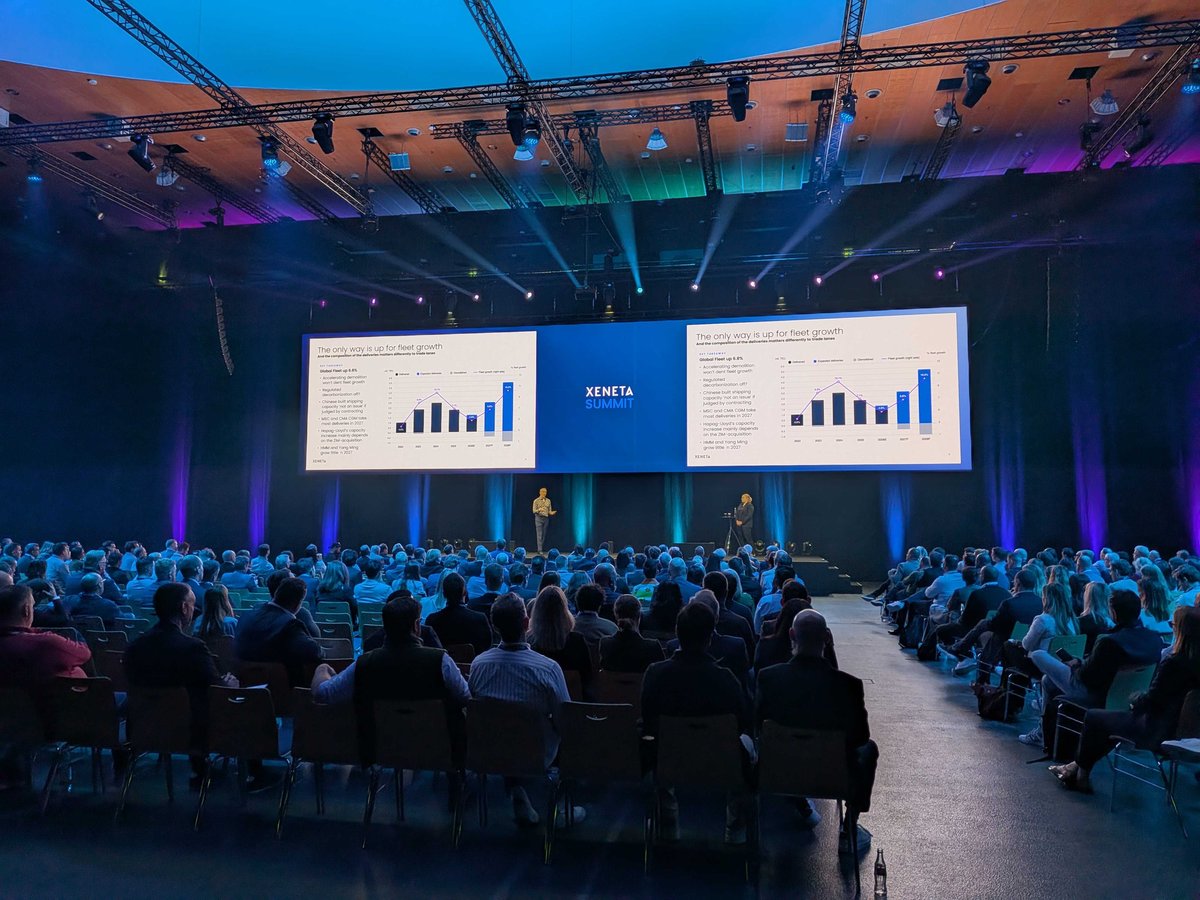
Day 2 of the tenth Xeneta Summit covered two things every shipper needs in 2027: how to think when the stakes are high, and what the market will do while you are thinking. The morning opened with two keynotes on decision-making and organisational change. The afternoon put our analysts on stage with the Ocean and Air Market Outlook for 2027.
Here's what the room heard.
The human biology of deal making
The day opened with a question to the room: do you think you are rational? The keynote argued that most humans are far less rational than we believe, and the body you bring to a negotiation shapes the deal you leave with.
People with a full bladder hold out longer in negotiations (Psychological Science, 2011). A hard chair makes both parties more rigid in their positions (Science, 2010). And one night without sleep turns up the brain's threat response (Current Biology, 2007).

The practical advice for anyone heading into a rate negotiation came in three parts:
- Remove the uncertainty. Share a clear agenda and avoid surprises.
- Manage the body. Sleep, eat and choose a comfortable room.
- Protect status, on both sides. Do not corner your counterpart, and do not give concessions away for free.
Then bring the data, so the strategist has something to work with. Kristina's session closed with a lighter finding from the same literature: a hint of citrus in the room makes people more generous. Bring the lemons.
Keynote: the outside-in advantage, with Geraldine Maringo
A beehive has no project plan. Thousands of actions, one shared outcome, and nobody in the centre handing out instructions. That was the first of three stories Geraldine Maringo used to explain why some organisations move at pace and others stall.
Underneath all three sat a pattern: purpose plus information plus identity produces adaptive teams. Remove purpose and you get activity without alignment. Remove information and you get decisions without truth. Remove identity and you get compliance without commitment.
Maringo's closing ask was for the individuals in the room to commit to one move in the next seven days. Clarify the outcome. Connect a data seam. Stop one activity. Run one bounded test.
Change moves at the speed of shared understanding.

Ocean Market Outlook 2027: demand cools, capacity keeps coming
On day one, Peter Sand, Chief Anayst, walked on stage to the guitar riff of Metallica's Enter Sandman. A fitting soundtrack for a year that gave analysts plenty of sleepless nights. Alongside Jacob Moe of DHL Global Forwarding, he walked through the macro picture: a trade map that is rerouting rather than retreating, fronthaul volumes 38% above 2019 while backhaul sits 9% below, and a 2027 that will be defined by how several shocks interact rather than by any one of them. Their closing line laid the foundations for day two. The advantage is not perfect prediction. It is prepared options.
Day two was the test of that idea.
Sand returned to the stage, this time with Emily Stausbøll, Senior Shipping Analyst, for the session most people had circled on the agenda: the 2027 outlook. They opened with a reminder that last year's forecast went belly up within six weeks, so this was an outlook, not a crystal ball. Then the numbers. Global GDP growth edges up from 3.1% in 2026 to 3.4% in 2027, driven by AI investment and the strongest growth in the Middle East, developing Asia and Sub-Saharan Africa. Global inflation peaks at 4.7% in 2026 before easing to 4.1%, and the northern hemisphere heading into winter with an energy crisis looming for importing nations.
That is the world the container market sails into next year.
So what happens to the boxes?
The analysts took it in order: demand, supply, fuel, routes, reliability.
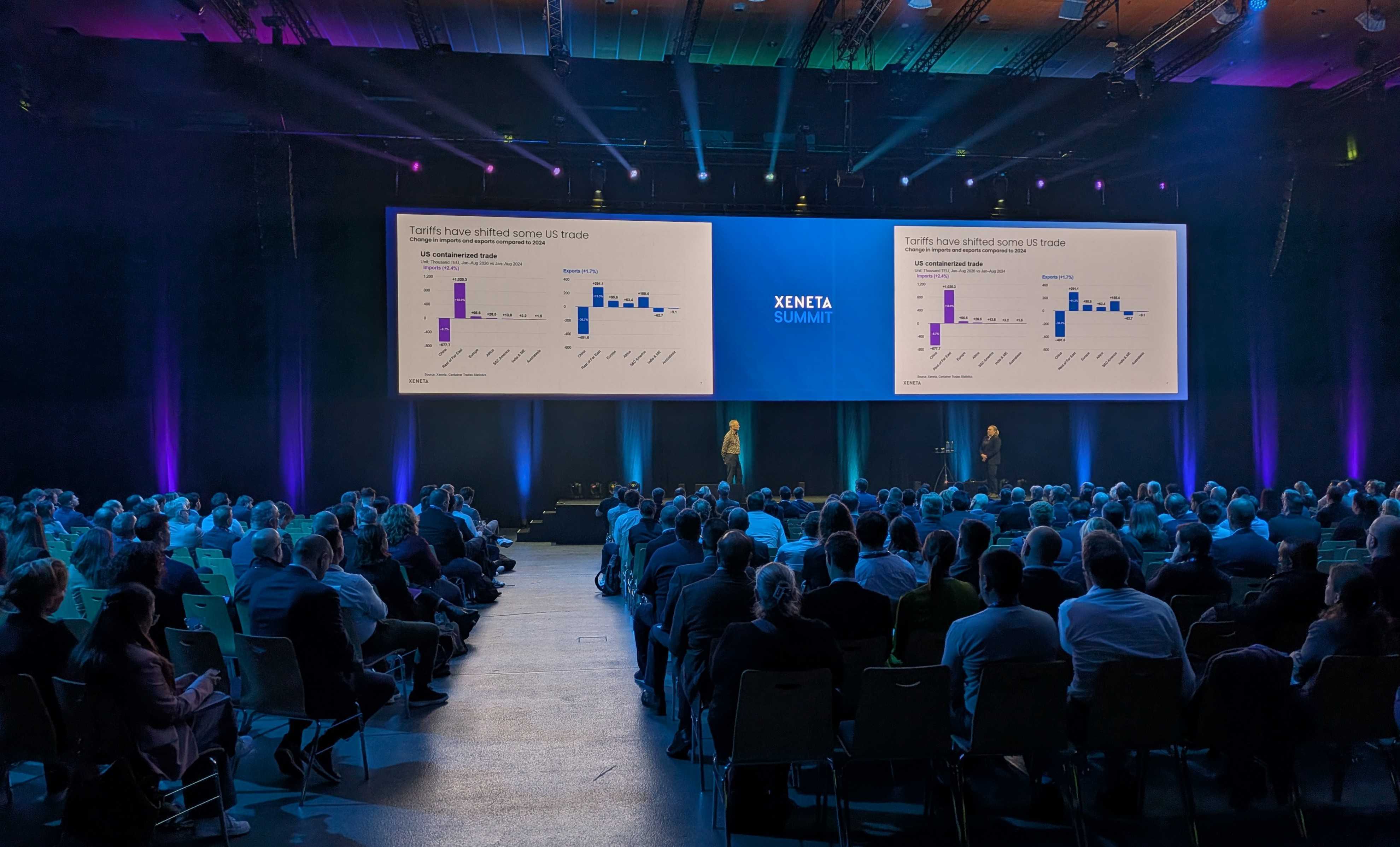
Container demand slows after a record 2026. Global volumes rose 4.7% in the first eight months of 2026, but that growth came from frontloading rather than underlying demand. For 2027, Xeneta expects volume growth to match GDP at around 3.4%, with risks weighted to the downside and a range of 2.5% to 4%. Trade balances have deteriorated too: fronthaul volumes are up 38% on 2019 while backhaul is down 9%.
Supply does not slow. The global fleet grows 6.8% in 2027 on a record orderbook of 15.5 million TEU. Accelerating demolition will not dent that. MSC and CMA CGM take most of the 2027 deliveries, Hapag-Lloyd's growth depends on the ZIM acquisition, and HMM and Yang Ming grow little.
Fuel stays in focus. Bunker surcharges on the top four trades have risen 45% since February, to USD 840 per FEU, and prices stay elevated in 2027. The spread between Singapore and Rotterdam signals concern about fuel availability in Asia. Shippers need to watch how that feeds through into their rates.
The Red Sea remains the single most important factor in the market. Around 50% of pre-crisis capacity has returned through Suez, and the analysts expect carriers to keep contingencies active even if the Hormuz situation resolves quickly. Hormuz itself is a story of workarounds, not a fix: capacity calling Jebel Ali is down 98%, and a political deal will not snap transits back to normal. A strong El Niño also puts Panama at risk in the first half of 2027, which pushes more Asia to US East Coast cargo towards Suez.
Reliability is falling again. Far East to Europe schedule reliability dropped to 4% in September with average delays of almost 10 days. Far East to North America sat at 19% with 7-day delays. Gemini still leads the alliances, but its lead is evaporating because its own performance has fallen rather than because the others improved. It fails to meet its 90% target on any lane.
The advice for 2027 contracting was direct. Build routing-change clauses into your agreements. Keep alternative routes live. Treat any transit savings on paper as the best-case scenario, not the plan.
Air Market Outlook 2027: supply overtakes demand
Niall van de Wouw, Chief Airfreight Officer, and Wenwen Zhang, Lead Airfreight Development and Analyses, started the Air segment of the 2027 Outlook looking back over the past 12 months. Fuel went through the roof but barely moved corridor rates. US Gulf Coast jet fuel sits at an index of 212 against last October. The most exposed corridor, Middle East to Europe, is at 172. Europe to North America is at 114. Fuel is a cost story for airlines more than a rate story for shippers.
Gulf capacity is still 13% below last year, at 152,800 weekly offered tonnes against a 22,700-tonne shortfall. The deepest gaps are into Europe, down 12,300 tonnes, and the Middle East, down 6,100 tonnes. As Gulf capacity returns in 2027 the supply shock unwinds, but new freighters stay scarce and cap underlying growth.
E-commerce has reset rather than disappeared. China to US low-value exports fell by roughly half after the US de minimis removal in 2025, then rebuilt through bulk, bonded-warehouse and re-routed models. Europe is following the same path about a year behind after the EU duty and handling fee. Growth returns in 2027, but well below the double-digit rates of the past.
AI remains the growth engine, and it is moderating. Taiwan ICT exports doubled year on year in September to USD 39.1 billion, pushing Transpacific rates to USD 5.92 per kg from Asia Pacific to North America. Worldwide chip billings growth has eased from an 11.2% peak to 7.3%. Hyperscaler capex guidance is intact, but 47 US data-centre projects have been delayed or withdrawn since January. Growth holds into 2027; the question mark sits after.

The air-to-ocean shift is also coming. Air's share of Asian exports to Europe rose from 1.1% in 2023 to 1.7% in 2024 as ocean reliability collapsed, then settled at 1.3% in 2026. When Red Sea transits normalise and ocean reliability recovers, cargo that moved to air will more than likely move back to sea. Volatility is already pushing shippers towards shorter-term deals, and the share of spot and short-validity contracts keeps growing.
The 2027 forecast: supply will grow faster than demand, which points to a 5–10% decline in air cargo rates. Six trends shape that picture:
-
GDP growth at 3.4% with tariff-hit trade deflected to third markets,
-
The air-to-ocean shift,
-
The e-commerce reset,
-
Moderating AI investment,
-
Gulf capacity returning,
-
The standing risk of physical and cyber disruption, natural disasters and a strong El Niño.
What to take with you into 2027
Day one asked for predictability. Day two showed where it will and will not come from. Both markets head into 2027 with more capacity than demand, which favours buyers, but the swing factors are routes and reliability rather than rates. Suez, Hormuz and Panama will decide the year on the ocean side. Gulf capacity, AI demand and the pull back to sea will decide it in the air.
The keynotes gave the other half of the answer. Capacity does not negotiate your contract for you. Walk in rested, remove the uncertainty for both sides, and bring the data. And before you reach for a new tool, connect the data you already have, because AI amplifies whatever system it lands on.
Day two also closed with a prize draw, run in partnership with Air Canada Cargo. Congratulations to Matthew Ashworth, Transport Specialist, Air and Ocean, and Stijn Laenen, Global Manager, Transportation Procurement. Each takes home two round-trip tickets with Air Canada.
Our own Abbie Bergesen is still hoping one of the winners needs a plus one!
None of it happens without our partners.
A big thank you to DHL, Hapag-Lloyd, Archlet, VIZION, CEVA Logistics, Air Canada, Flexport, Keelvar, Zauber, BlueCargo and BuyCo for backing the tenth Xeneta Summit, and to every customer and speaker who made it what it was.
We can't wait to welcome you to a future event.
Missed the launches? Day one brought the biggest set of product releases in Xeneta's history: Transshipment, the first view of actual transit times via a hub, a rebuilt Xeneta Air, AI Agents that find where you overpay, Ask Xeneta for the AI assistants you already use, and Xeneta Tender. Read the full announcement, or book a demo to see them on your own lanes.