
<img height="1" width="1" style="display:none;" alt="" src="https://px.ads.linkedin.com/collect/?pid=502551789&amp;fmt=gif">
Skip to content

Xeneta, trusted by the world's biggest buyers & sellers of containerized and air freight

For years, procurement leaders have signed contracts worth millions based on last quarter’s numbers, spot-only indices, or carrier quotes—because that’s what the market offered. Xeneta changes what’s possible.


Xeneta’s ocean freight rate data aligns to how you buy: short- and long-term contracts, by equipment type, carrier, and port pair—built on actual contracted rates paid by shippers and freight forwarders, giving you truly independent benchmarks.

Ocean Freight Rate Data at Scale

 What make Xeneta’s Ocean Freight Rate Data Unique

Data sourced from actual rates paid by shippers and forwarders — not carrier data — and independently owned and funded, outside of the industry, so benchmarks stay neutral.

800M+

Rates

Over 12 years’ historical long-term & short-term contracted rates.

160k+

Port Pairs Covered

Granular global coverage, not just major trade lanes.

Daily

Rate Updates

Live benchmarks, not quarterly snapshots.

XENETA OCEAN FREIGHT RATE DATA

What's in the dataset


Xeneta’s ocean freight rates reflect the total port-to-port cost a shipper, or freight forwarder, pays to move a container from origin to destination. This data is sourced in partnership with our network of shipper and freight forwarder customers—never from carriers—ensuring truly independent rate benchmarks.


The benchmarked freight rates you see already include major surcharges that shape the cost of the ocean leg. To keep benchmarks comparable across the market, Xeneta excludes charges that vary by shipment specifics.

Total port-to-port cost based on actual rates paid across global trade lanes

Total port-to-port cost by each of 16+ major carriers, benchmarked against the live market.

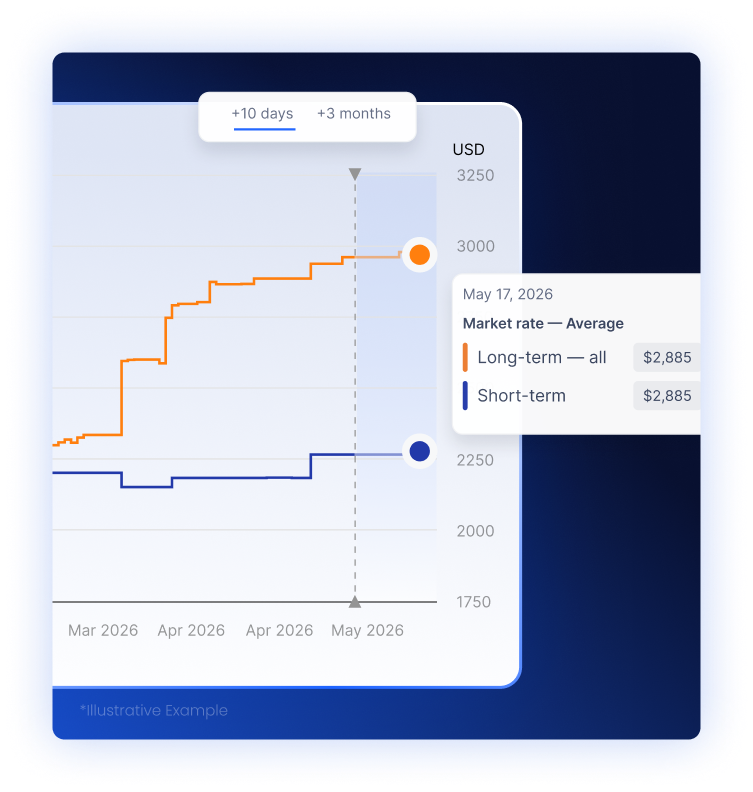
Forward visibility into rates from contracts starting in the next 10 days (short-term) to 3 months (long-term)
For historical trends on these surcharges broken out individually — BAF, peak season, congestion, EU ETS, Red Sea.
For 3 and 6-month predictive views on major corridors.

Explore each data set

1. Ocean freight rates

Live benchmarks built on actual rates paid from real shipper contracts, and freight forwarder agreements, not carrier-reported numbers.

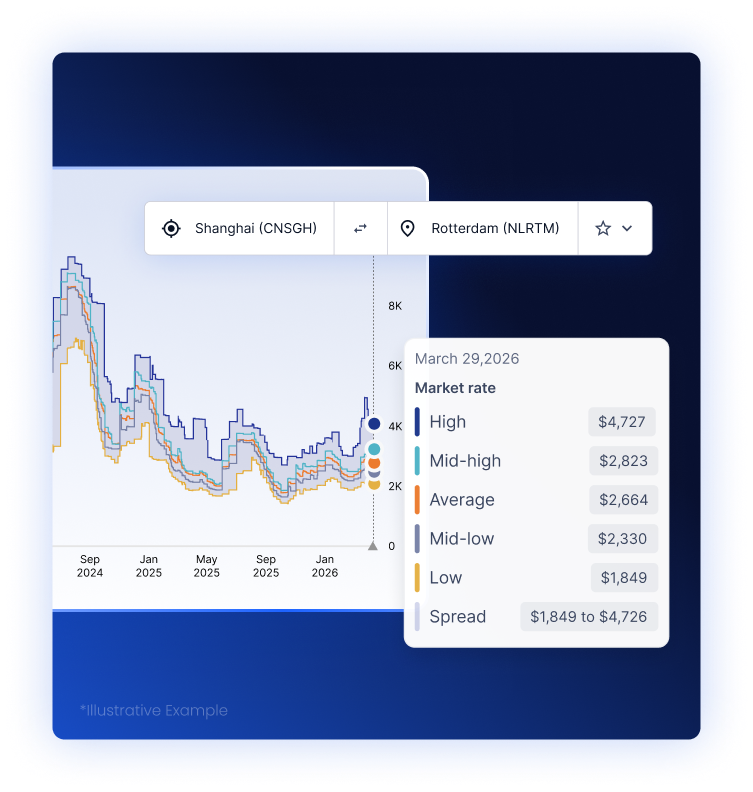
Valid contracted rates on any given day are combined into a daily market benchmark. Long- and short-term rates are shown separately, giving you clear visibility into the market.

What's included

  • short-term (less than 32 days) and long-term (more than 87 days), in separate views
  • Five benchmark rate tiers: market high, mid-high, average, mid-low, market low
  • View and compare the market at any level: industry peers, corridors, individual trade lanes, or suppliers
  • 16+ carriers and key alliances
  • Container types: 20' Dry, 20' Reefer, 20' Tank, 40' Dry, 40' HC, and 40' Reefer HC
Ocean_Product1

2. Carrier Rates

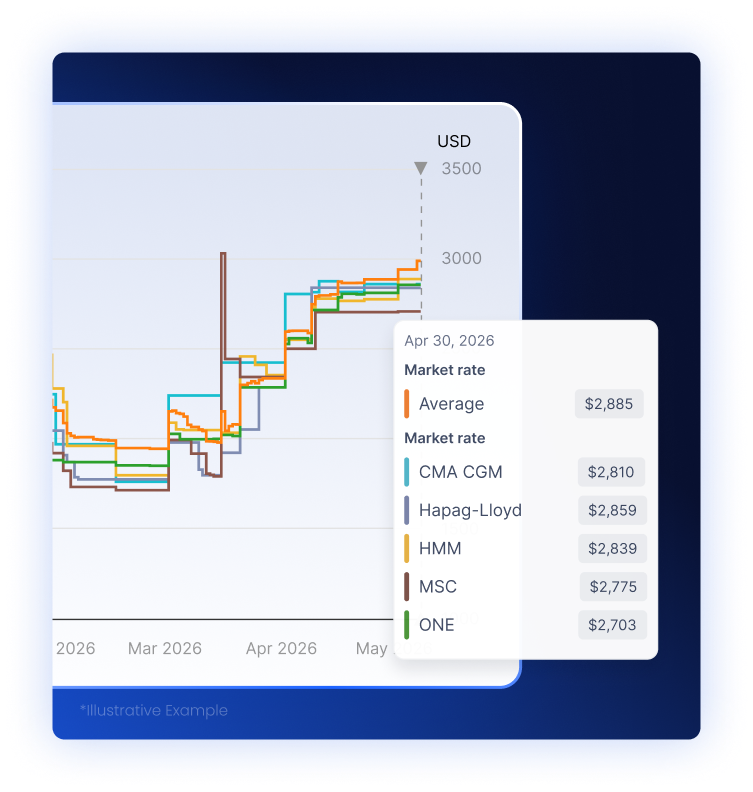
See where individual carriers sit against the live market — not just a blended average.

Rates for specific ocean carriers overlaid on broader market benchmarks. Compare any carrier to see exactly where they sit — above, below, or aligned.

What's included

  • 16+ major carriers
  • Key alliances
  • Comparison against market average, high, and low
Ocean_Product_CarrierRates

3. Future rates 

Forward visibility into contracts that are already signed — not forecasts or guesses.

See rates associated with contracts that begin in the future, so you know what's coming before it hits the market.

What's included

  • 10-day forward view on short-term contracts
  • Up to 3 months forward view on long-term contracts
  • Historical comparison for context
Ocean_Product_Future Rates2

4. Ocean Freight Surcharges

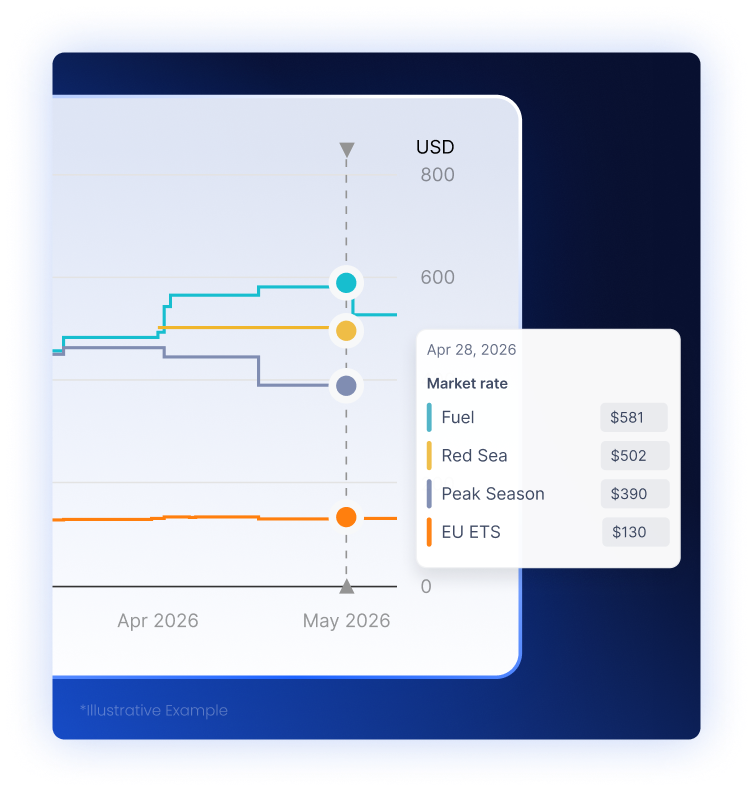
Surcharge benchmarks built on actual contracts — tracking how BAF, EU ETS, peak season, congestion, and Red Sea surcharges move across the market, normalized across carrier naming conventions.

What's included

  • BAF, EU ETS, PSS, Congestion, and Red Sea surcharges — each tracked individually
  • Market high, mid-high, average, mid-low, and low surcharge rate tiers
  • Historical and current surcharge levels by corridor, updated daily

Explore surcharge data →
Ocean_Product_Surcharges

5. Ocean Market Rate Outlook / Freight Rate Forecasts

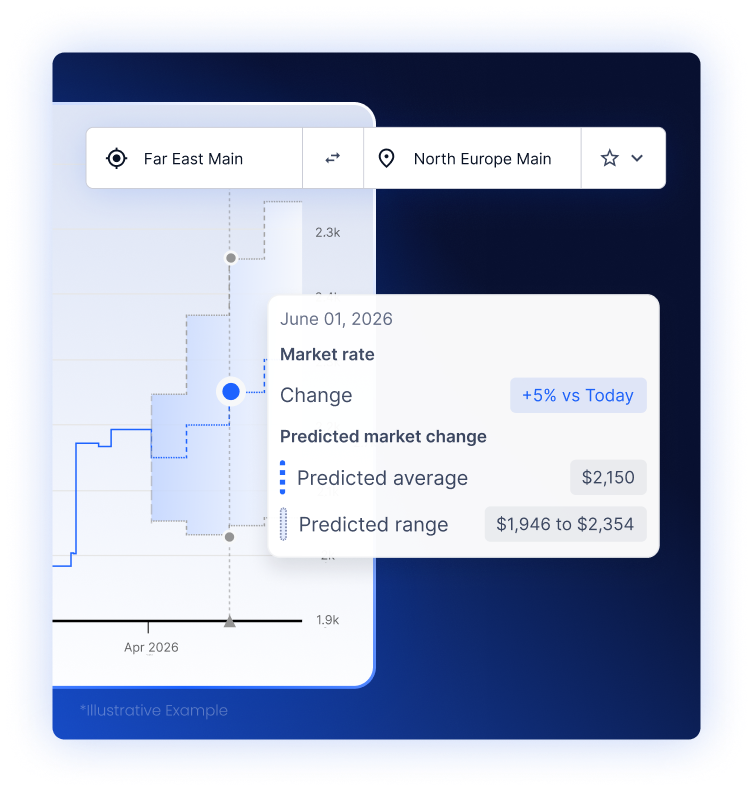
3- and 6-month forecasts on long-term contracted rates across major corridors — calculated using actual contracted rates data, machine learning, and expert validation.

What's included

  • 3- and 6-month forecasts with predicted range and consensus view
  • Seven major corridors: Far East Main, Mediterranean Main, North Europe Main, South America East Coast Main, South East Asia Main, US East Coast Main, US West Coast
  • Monthly updates with quarterly analyst commentary

Explore rate outlook data →
Ocean_Product3
Use Case Scenarios

When you'll use this data


01

Sourcing & tendering

Carrier bids show their price, not market reality. Xeneta gives you live benchmarks to time your RFQ, assess every round, and hold a defensible position on each lane.

02

Benchmark rates vs market & market monitoring

Contracted rates are only as good as their market context. See what others pay on the same lane across high, average, and low bands, and track how the market moves.

03

Spot buying / react to market shifts

Volatile markets lead to last minute bookings. Live benchmarks and alerts let you book urgent capacity at the right price, even under time pressure.

04

Forecasting & budgeting

Planning off last quarter's numbers leaves budgets misaligned. Rate outlook and historical trends give finance a market-aligned view that holds up under scrutiny.

05

Report & justify internally

Independent market data makes decisions easier to defend. Xeneta dashboards and exports turn rate decisions into evidence stakeholders accept.

Sources & data processing

How the data is processed

Xeneta’s data is sourced in partnership with our customers, including some of the world’s largest shippers and freight forwarders, drawn from actual contracts that we validate and enrich to deliver an accurate, independent view of the freight rates market.

01
Collect
Actual contracts

Collect data from our extensive user base. Secure, anonymous, and compliant data integration.

02
Cleanse
Error-checked

Correct the data and remove any errors before it enters the pool of valid rates.

03
Normalize
Normalized

Structure the data so it's comparable across contracts, carriers, and container types.

04
Validate
Quality gated

Check that data is accurate and of sufficient quality to be used to create the benchmarks.

05
Process
Generate Benchmarks

Create the market high, mid-high, average, mid-low, and low benchmarks, ready to publish in the Xeneta platform, and share via API and reports.

Get the data where you need it

Platform

Explore rates, build comparisons, create reports, and share dashboards with your team.

API & Datalink Download

Pipe rate benchmarks directly into your TMS, procurement system, or internal BI stack via API — or use Datalink Download for extracts without technical integration.

Reports

Tailored, executive-ready reports from Xeneta Advisory that power your decisions and report on savings secured. Add-on for existing customers.
Our data standards

Trusted & Certified


Xeneta's data is built on enterprise-grade security, privacy, and independence — trusted by the world's largest shippers and quoted by leading global news outlets.

check_circle_icon
ISO 27001:2022 Certified
check_circle_icon
Quoted by WSJ, FT, Reuters
check_circle_icon
GDPR Compliant

Frequently asked questions

The most common questions we hear from procurement, supply chain, and freight forwarding teams evaluating Xeneta rates data.

How does Xeneta calculate a daily benchmark rate?

Every day, Xeneta takes all valid contracts active on that date for a given trade lane and container type, then calculates benchmark tiers — market high, mid-high, average, mid-low, and market low. Short-term and long-term contracts are aggregated separately, so spot and contract markets don't get blended together. Rates are total port-to-port cost, including the major surcharges shaping the ocean leg.


How accurate are Xeneta's freight rates?

Xeneta's rates are sourced directly from actual shipper and freight forwarder contracts — not modelled, estimated, or carrier-reported. Each data point is validated against Xeneta's quality standards before it enters the benchmark. The result is a benchmark that reflects what the market is genuinely paying, not what it's being asked to pay.

Where does the data come from?

Rates come directly from the contracts of Xeneta's shipper and freight forwarder customers. Data is never sourced from carriers, which keeps the benchmarks fully independent.

What is the coverage of Xeneta's freight rate data?

Xeneta covers 160,000+ port pairs globally — including all major trade lanes, broken down by container type, carrier, and contract length.

How fresh is Xeneta's rate data?

Benchmark rates update in real time, with 90% of data ingested and processed within 1 day.

How does Xeneta keep data secure?

Xeneta is ISO 27001:2022 certified for information security. All contributed rates are fully anonymized and aggregated before entering the benchmark pool — no company-specific rates or supplier names are ever disclosed.

How are Xeneta’s ocean freight rate benchmarks different from freight rate indices from other companies?

Public indices typically show spot prices on a handful of major routes, sampled weekly. Xeneta is built on 800M+ actual contracted rates — both short- and long-term — at port-pair level, updated daily. Indices give you a market signal; Xeneta tells you where your specific lanes, carriers, and contracts sit against what peers are actually paying.

What surcharges are included in Xeneta's freight rates?

Xeneta rates represent the total port-to-port cost — not just the base ocean freight charge. Every rate includes BAF (Bunker Adjustment Factor), CAF (Currency Adjustment Factor), EU ETS (Emissions Trading System), canal surcharges, and all other surcharges within Xeneta's port-to-port definition. THC can be toggled on or off depending on how you buy, so you can match the rate view to your actual cost basis. Destination charges are excluded as these vary by terminal and fall outside the port-to-port definition. For the full surcharge list, see xeneta.com/hubfs/static/surcharge-list.pdf.