Use case
Build a Network & Supplier Strategy
Build stronger supplier relationships and plan your network with confidence using real market insight.
Xeneta delivers the transparency you need to navigate volatility and safeguard your supply chain.
Xeneta, trusted by the world's biggest buyers & sellers of ocean and air freight
Volatile rates, limited transparency, and outdated processes leave shippers, forwarders, and carriers making high-stakes decisions with limited visibility of the market. And when you can’t see the real picture, costs fluctuate unpredictably, impacting budgets, service levels, and your bottom line.
At Xeneta, our mission is to transform the way freight is bought and sold by bringing greater transparency to the market, so you can act quickly, negotiate fairly, and protect your supply chain.
The market is moving faster than teams can keep up. Many organizations are still relying on spreadsheets, inaccurate benchmarks, and fragmented data that simply weren’t built for
today’s pace.
You need timely, accurate freight intelligence built using the latest technology and real expertise to keep your business resilient in an unpredictable world.
Global leaders rely on Xeneta because our insights come from real market data.
no carrier bias, no commercial influence
data at scale, updated continuously
one source of clarity for your entire organization
cost control, better contracting, and stronger supplier performance
What you can do with our platform.
Full breakdown of our datasets
What's included in a Xeneta subscription
The community and expertise behind Xeneta
Our data and insight powers freight coverage in the world’s leading media.

Why do I need Xeneta if I already run competitive and data-backed freight tenders?
Competitive tenders create pressure, but they do not guarantee market-aligned outcomes. Carriers know your tender process, your volume, and your historical rates, and they price their bids accordingly. When every carrier in your tender is working from the same market knowledge and you are not, the lowest bid you receive is the most competitive rate carriers were willing to offer, not necessarily the rate the market supports.
Many procurement teams fill this gap with publicly available indices or rate guidance from their own carriers and forwarders. The problem is that indices track broad market averages across major lanes, which may bear little resemblance to what is actually achievable on your specific corridors, equipment types, and contract terms. And rate guidance from suppliers, however well-intentioned, comes from parties with a commercial interest in the rates you accept. Neither gives you the independent, lane-specific benchmark that makes a carrier's bid genuinely contestable.
Xeneta removes that information asymmetry. When carriers know a shipper has independent, third-party market evidence in the room, bids come in lower. This is not theoretical: customers who introduce Xeneta benchmarks into active tenders consistently find that carriers adjust their pricing further than they would have without it, because the usual tactic of anchoring to historical rates or obscuring market conditions no longer works.
Beyond the tender itself, Xeneta provides continuous visibility into whether rates awarded remain competitive as the market moves through the contract period. A rate that was at market when it was signed may be significantly above market six months later. Without ongoing benchmarking, that drift goes undetected until the next tender cycle, by which point the overpayment has already accumulated. Learn more about sourcing and tendering with Xeneta.
What makes Xeneta's data different from other freight market data sources?
Most freight market data reflects one side of the transaction. Spot indices track publicly visible rate movements on major trade lanes but do not capture what shippers with volume and negotiating leverage are actually paying under contract. Broad corridor averages aggregate across lane combinations that may bear little resemblance to your specific origins, destinations, equipment types, and contract terms. Neither gives procurement teams the lane-level contracted rate reference that a carrier negotiation actually requires.
Xeneta's data is sourced differently. The platform aggregates real contracted rates contributed by thousands of shippers and forwarders globally, covering both the rates they have agreed and the market conditions they are navigating. This means benchmarks reflect what companies like yours are actually paying on contract, not what spot markets are doing or what a major lane average suggests. The granularity is what matters: a benchmark is only useful in a negotiation if it reflects the specific lane, equipment type, and market segment you are buying in, and that level of specificity is only possible when the underlying data comes from contracted transactions at scale.
All contributed data is fully anonymized and aggregated, and Xeneta operates as an independent platform with no stake in the rates you ultimately agree. That independence, combined with the depth and granularity of the contracted rate dataset, is what makes Xeneta's benchmarks a credible reference in conversations with carriers rather than a starting point they can easily dismiss. Find out more about Xeneta's data and methodology.
What ROI can I expect from Xeneta, and how quickly does it materialize?
ROI from Xeneta typically materializes within the first tender cycle after adoption. The specific value depends on freight spend and how far current contracted rates have drifted from market, but customers consistently report savings on lanes where Xeneta reveals above-market contracts, often on lanes where procurement previously believed rates were already competitive because they had survived a tender process.
For companies spending $10M or more annually on ocean freight, even a modest improvement in contracted rates generates savings that represent a multiple of the platform cost. Stanley Black and Decker, with over $100M in annual logistics spend, consistently track savings in the range of 3 to 5 percent using Xeneta.
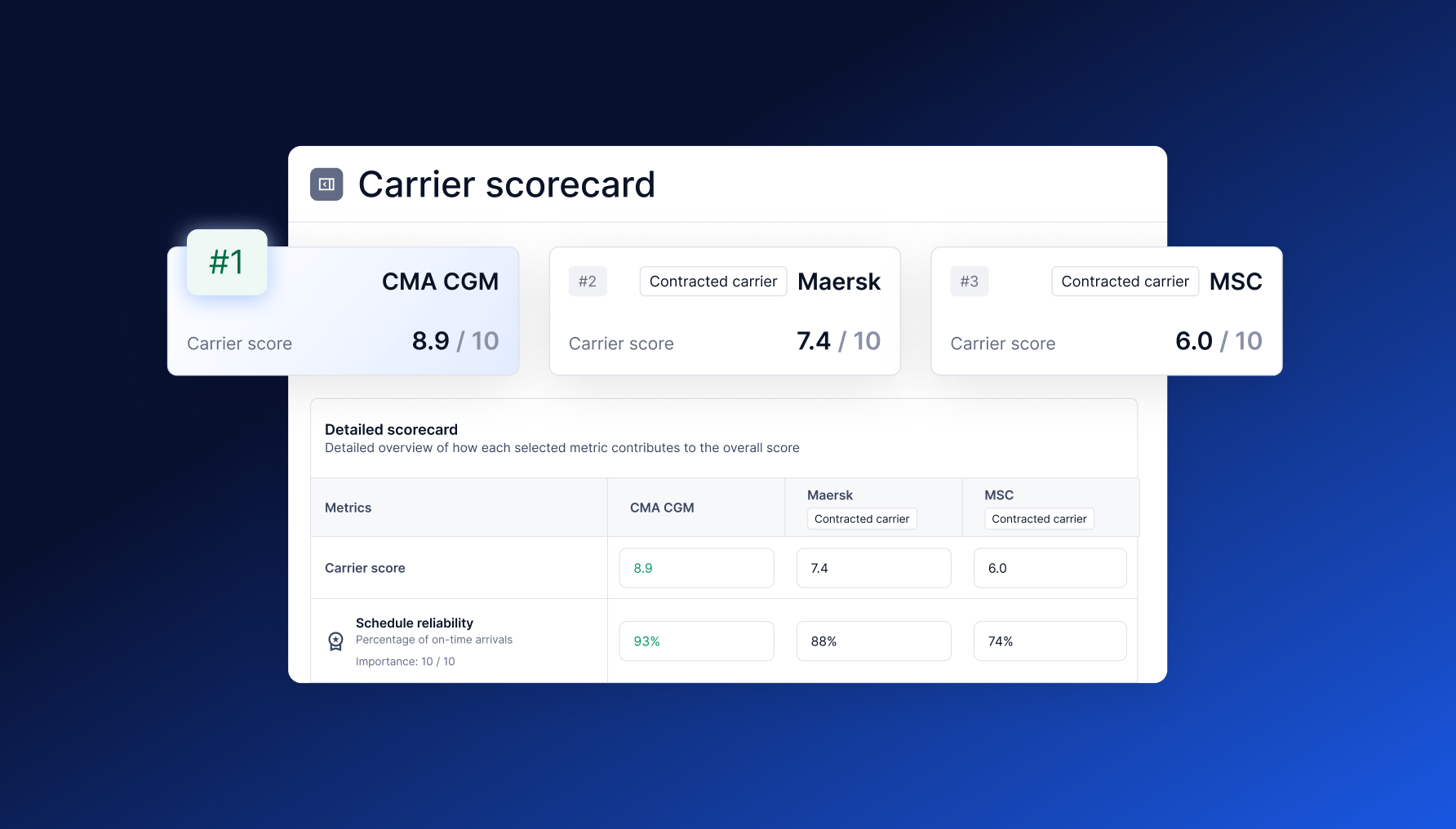
Rate savings are the most immediately quantifiable return, but they are not the only one. Carrier reliability data helps logistics and procurement teams select suppliers whose operational track record supports the service levels supply chains depend on, reducing the risk of delays that trigger emergency air freight, stockouts, or missed customer commitments. Transit time improvements on high-volume lanes reduce in-transit inventory and the working capital tied up in it. And the ability to act on mid-cycle market movements, rather than waiting for the next scheduled tender, means value compounds year on year rather than resetting each time.
Read the Stanley Black and Decker case study to see how one of the world's largest manufacturers tracks and quantifies the return.
How does Xeneta help me demonstrate procurement performance to finance and supply chain leadership?
One of the most consistent frustrations in freight procurement is the difficulty of demonstrating value to leadership who lack the context to assess whether contracted rates are competitive. Saying rates went down in a tender is not the same as proving they went down relative to the market, and the difference matters when budget decisions, headcount justifications, and strategic investment cases depend on how procurement performance is perceived.
Xeneta provides the independent, third-party evidence to make that case with data. Specific, quantified comparisons between contracted rates and what the broader market paid. Round-by-round tender analysis showing how each outcome compared to market benchmarks. Year-on-year performance tracking that demonstrates improvement over time.
The platform also allows teams to benchmark their rates against shippers in the same industry and against companies moving similar freight volumes, providing the peer context that turns a good internal performance story into a genuinely compelling one. Rather than comparing against a broad market average that blends all buyer types, procurement teams can show leadership exactly how they perform relative to the companies most comparable to their own.
Whether the audience is a CFO scrutinizing freight costs or a supply chain leadership team evaluating procurement capability, Xeneta turns what is often a subjective internal conversation into a structured, credible performance story. Learn more about forecasting and budget planning with Xeneta.