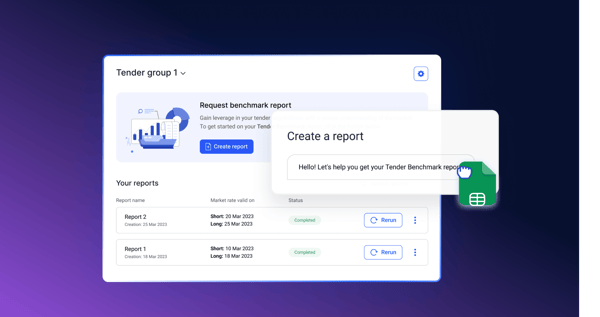
See how Nestlé cut manual work, compressed tender cycles, and elevated procurement decisions with real‑time data
Respond to volatility with data you can trust. Identify savings and service improvements, and give leadership the clarity they demand, on every lane and every shipment.
Trusted by the world's biggest chemical shippers
Procurement teams are being pushed to cut spend, avoid disruption, and defend strategy, without sacrificing performance on critical lanes.
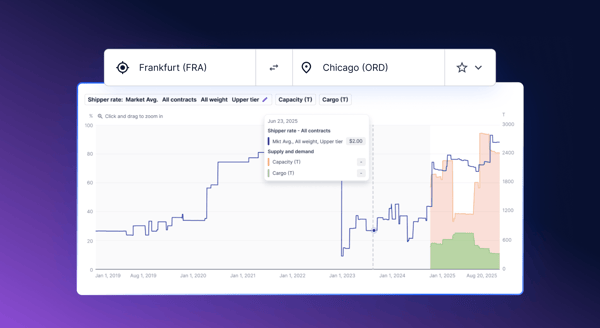
Xeneta gives you independent rate benchmarks and lane-level service performance data, so you can identify savings, select reliable carriers on critical trades, and back every freight decision with data.
Sebastian Wagner, Regional Category Buyer, Ineos Styrolution
One platform, two modes. Discover all you need to know about our Ocean and Air offering.
How do chemical companies manage freight procurement across complex, multi-commodity shipping requirements?
How do chemicals procurement teams justify freight spend to finance when raw material costs are highly volatile?
Chemical logistics procurement teams often face a recurring internal challenge: proving that freight spend is being managed effectively when raw material cost volatility is consuming most of leadership's attention. Monthly reporting on market position is one of the most common use cases Xeneta supports in the chemicals sector.
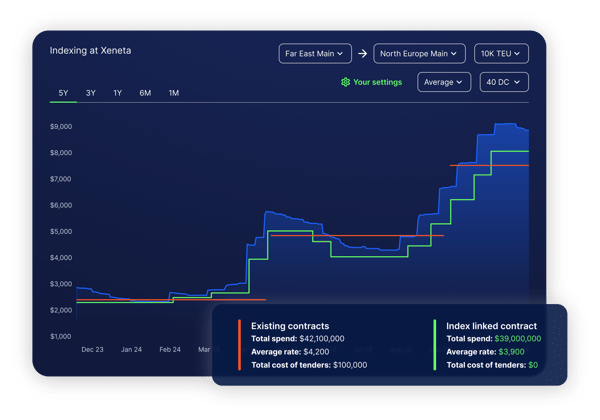
Xeneta's performance overview gives procurement teams a clear, exportable view of how contracted rates compare to the market average, market low, and market high across every lane. This turns a subjective internal update into a data-backed report that shows exactly where the team is ahead of market, where there is remaining savings potential, and how performance has trended over time. Xeneta also supports peer comparison against companies in the same industry segment, so procurement teams can benchmark their performance not just against the broad market but against comparable chemical shippers specifically. Learn more about how Xeneta supports forecasting and budget planning.
How does Xeneta support chemicals companies with complex equipment requirements like ISO tanks?
Chemical freight procurement often involves specialized equipment, including ISO tanks, which do not map directly to standard dry container benchmarks. Xeneta's ocean freight data is structured around standard container types, and ISO tank movements are typically benchmarked against the nearest comparable equipment type such as 20-foot dry containers.
While this means the comparison is an approximation rather than a direct match, it still provides a robust foundation for assessing whether base freight rates on key trade lanes are competitive, and for identifying corridors where contracts have drifted materially above market. For DG-classified cargo with specialized handling surcharges, Xeneta benchmarks the underlying freight rate rather than the full DG cost stack, which is worth understanding when scoping how benchmarking will be applied across your portfolio. Find out more about our data and methodology.
How should chemicals procurement teams approach carrier selection when reliability is as important as cost?
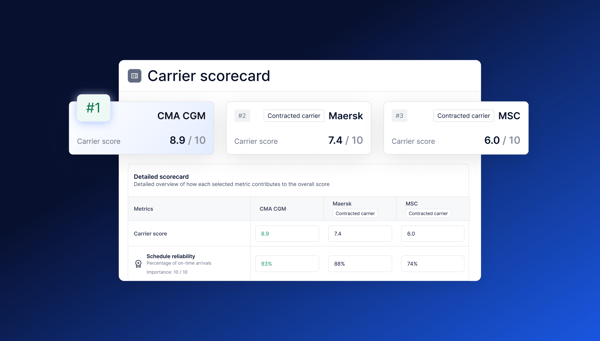
For many chemical products, supply chain reliability is non-negotiable. A missed shipment can halt a customer's production line, damaging commercial relationships far more expensively than any freight rate saving. Xeneta's Carrier Scorecard allows chemicals procurement teams to evaluate carriers on operational track record alongside rate competitiveness, covering schedule reliability and blank sailing frequency by trade lane.
This is particularly important when evaluating less established carriers offering below-market rates. Xeneta's performance data helps determine whether a cost saving justifies the operational risk before volume is awarded. Learn more about how Xeneta supports supplier performance evaluation.