


Our datasets
Xeneta Air Capacity, Load Factor & Demand Data
Capacity, cargo, and load factor utilization from airport level — see how tight supply is, where demand is shifting, and where the risks are.
Xeneta, trusted by the world's biggest buyers & sellers of containerized and air freight
Xeneta tracks supply and demand at airport-pair level across six datasets — how much space airlines are offering, how much cargo is actually moving, and how full flights are, by weight, by volume, and combined.
Alongside rate data in the same platform, you can connect capacity signals directly to pricing: seeing where risk is building, what's driving it, and how it's likely to move rates on your lanes.
Air Freight Rate Data at Scale
What make Xeneta’s Air Freight Rate Data Unique
Data sourced from actual rates paid by shippers and charged by airlines. Independently owned and funded, so benchmarks stay neutral.
Granular
View
See capacity, load factor, and demand by weight (tonnes) or volume (m³).
30k+
Airport Pairs Covered
Lane and corridor-level capacity, demand, and load factor data
Weekly
Updates
Capacity, cargo, and load factor data refresh weekly
XENETA AIR FREIGHT RATE DATA
What's in the dataset
Air capacity isn't a single number. Flights fill up on either weight or volume, whichever reaches its limit first — and dense vs bulky cargo change which one matters. Xeneta calculates capacity, demand, and utilization at airport-pair level, weekly, with weight and volume tracked separately or combined. The six datasets below give you supply and demand signals in the same place — each useful on its own, and powerful when paired with rate movements.
How full flights are on an airport pair — measured by combining weight and volume utilization into a single percentage. Unlike traditional load factors that look at weight or volume alone, DLF accounts for both at once.
The weight-based utilization share — how much of available weight capacity is filled. Usually high on lanes carrying dense cargo like metals or machinery.
Explore each data set
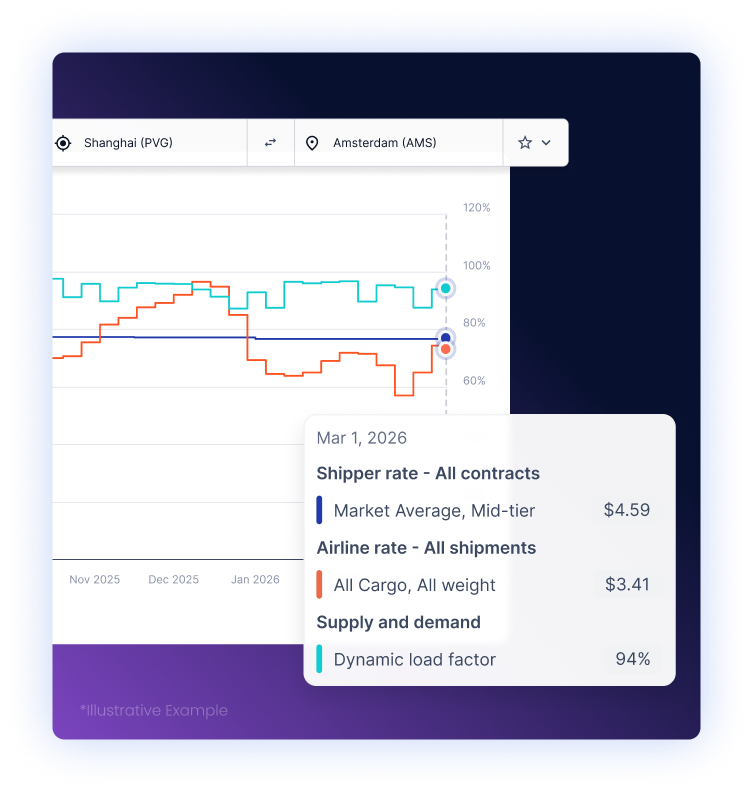
1. Dynamic Load Factor — DLF (%)
Measures aircraft utilization by accounting for both weight and volume simultaneously. It shows how full flights are once you consider whichever limit is reached first.
When DLF is at or above 80%, capacity is tight — space is scarce, and utilization risk is high. Below 80%, there's more available capacity relative to demand. The direction matters as much as the level: a rising DLF signals a tightening market, a falling DLF signals easing.
What's included
- Weekly DLF value per airport pair, as a percentage
- Searchable at airport and corridor level
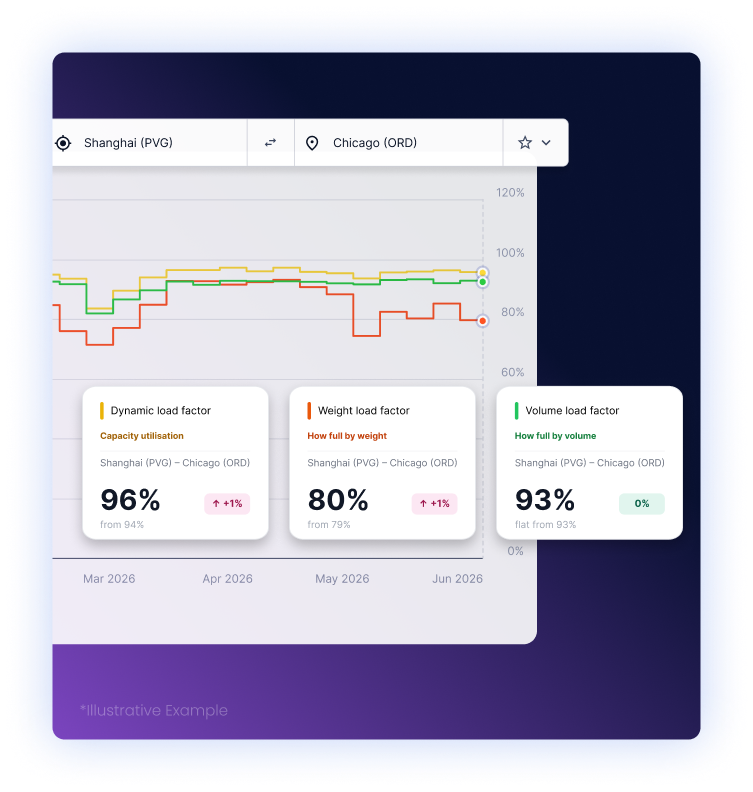
2. Weight Load Factor — WLF (%)
The share of available weight capacity that was filled, measured in tonnes. When WLF is higher than VLF, the lane is carrying dense cargo such as metals or machinery — weight is filling up first. That means there's spare volume on the aircraft, which can matter for booking and pricing decisions.
What's included
- Weekly WLF value per airport pair, as a percentage
- Searchable at airport and corridor level
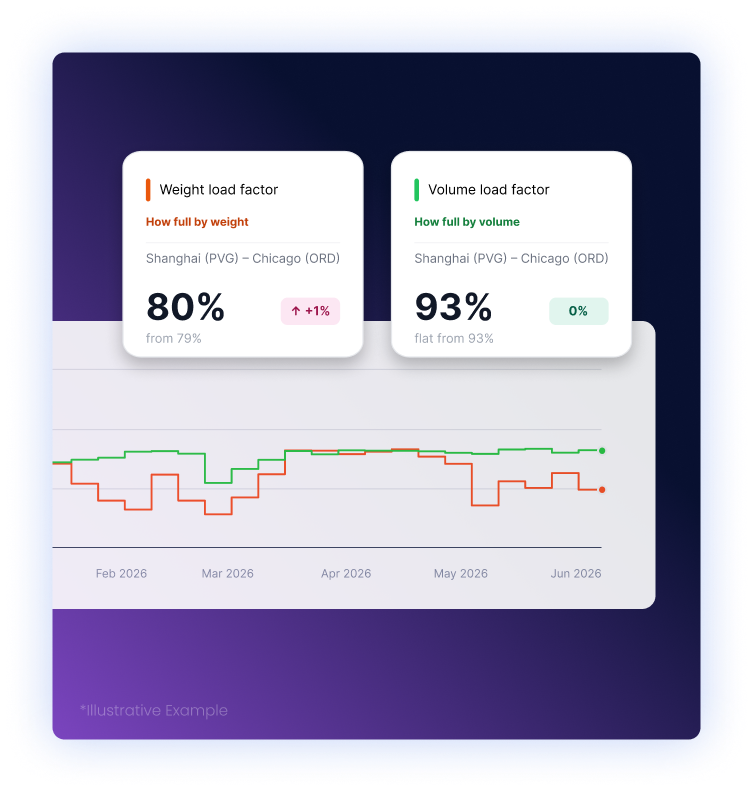
3. Volume Load Factor — VLF (%)
The share of available volumetric capacity that was filled, measured in cubic meters. Usually high on lanes carrying bulky-but-light cargo such as textiles. When VLF is higher than WLF, space is filling up first — and airlines may offer a density rebate to attract heavier cargo that uses the spare weight capacity.
What's included
- Weekly VLF value per airport pair, as a percentage
- Searchable at airport and corridor level
4. Capacity (tonnes & m³)
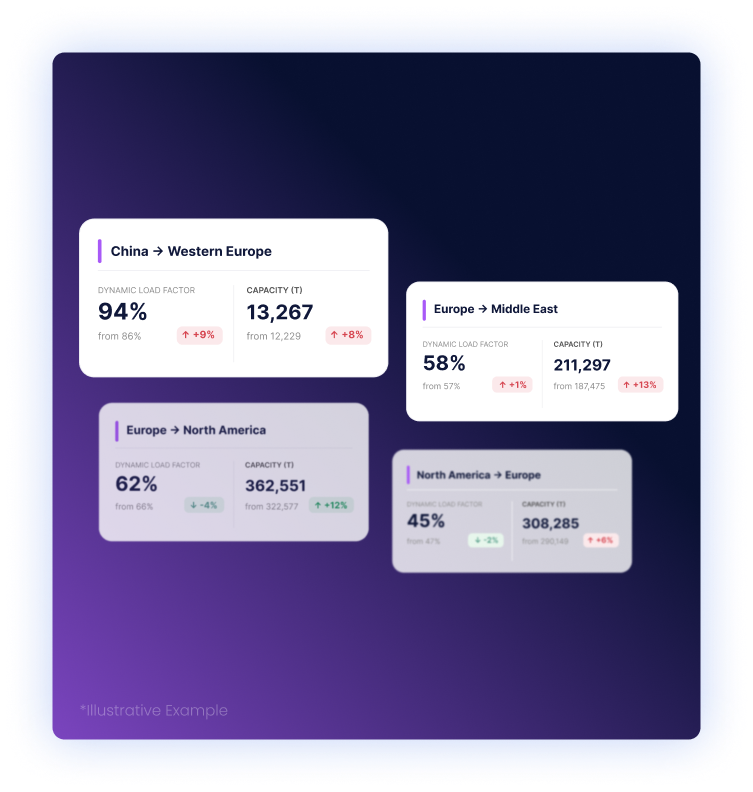
The total weight or volumetric space airlines make available on a route — the supply side. Available as two separate views: weight capacity in tonnes and volumetric capacity in cubic meters.
Shows you which lanes have space and which are filling up. Pair with Cargo and the relevant load factor to assess utilization and market tightness.
What's included
- Weight capacity in tonnes
- Volumetric capacity in m³
- Weekly refresh
- Searchable at airport and corridor level
5. Cargo (tonnes & m³)
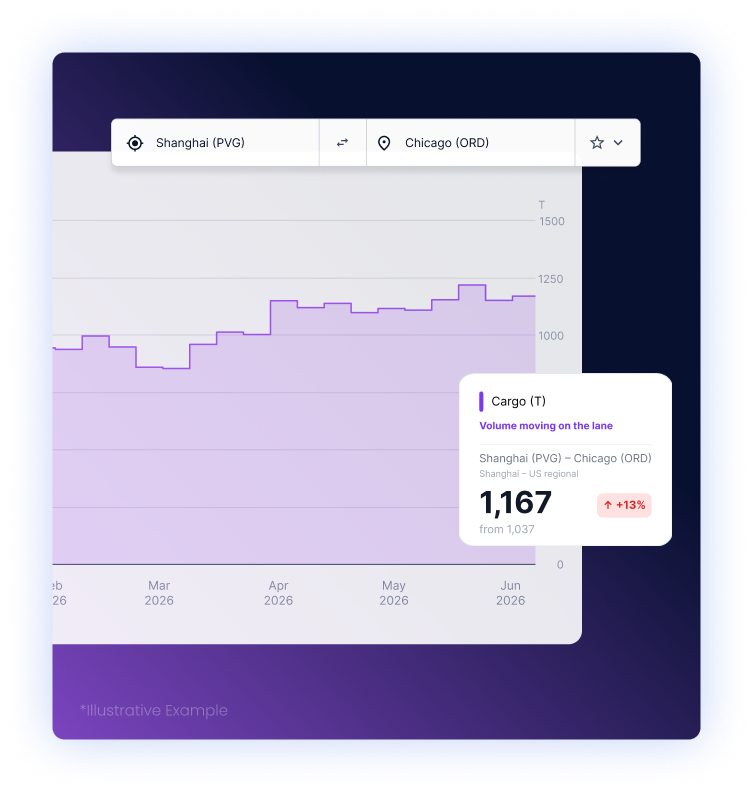
The total weight or volume of freight actually flown on a route — the demand side. Available as two separate views: cargo in tonnes and cargo in cubic meters.
Trend Cargo against Capacity to see whether demand is tightening or loosening: rising cargo with flat capacity lifts utilization and pressure; falling cargo eases the market.
What's included
- Total cargo flown in tonnes
- Total cargo flown in m³
- Weekly refresh
- Searchable at airport and corridor level
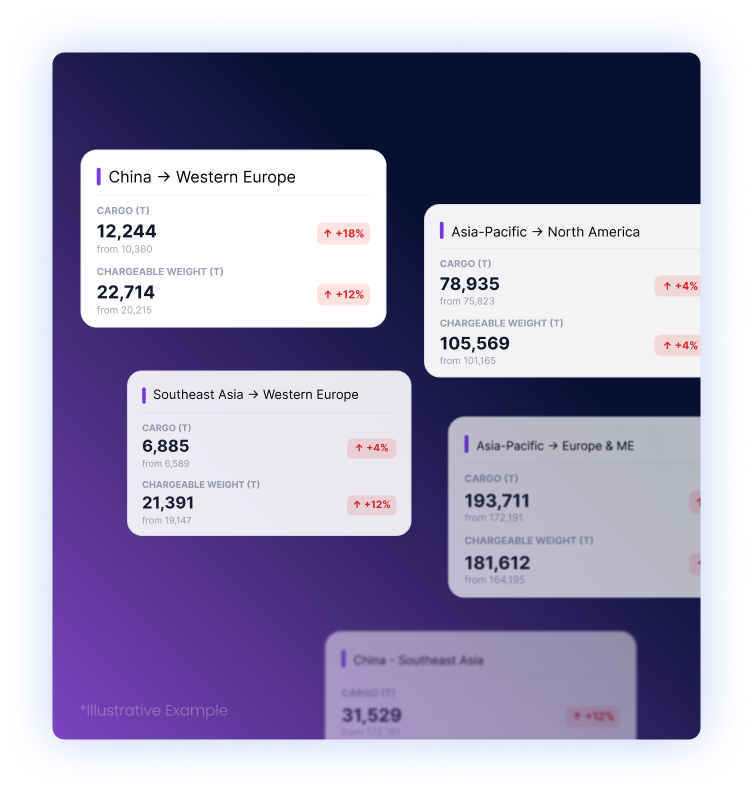
6. Chargeable Weight — CHW (tonnes)
The weight airlines and forwarders bill on — whichever is higher between actual weight and volumetric weight.
When chargeable weight is higher than actual weight, the cargo is bulky and light — volumetric weight drives the bill. When actual weight exceeds volumetric weight, the cargo is dense — actual kilograms drive the bill.
What's included
- Chargeable weight in tonnes per lane
- Searchable at airport-to-airport level
Use Case Scenarios
When you'll use this data
Market monitoring & risk management
Track capacity and cargo volumes across your key airport pairs to see where the market is tightening and where risk is building. Use DLF for the main utilization signal, and WLF vs VLF to see whether weight or volume is filling up first. Pair with rate benchmarks (see the Air Freight Rates page) to see whether prices have caught up with capacity conditions — or whether there's still time to act.
Spot buying / react to market shifts
Watch cargo volumes against available capacity on a lane. When cargo rises and capacity stays flat, space is getting scarce — DLF will show you how quickly. This gives you an early signal before tightness shows up in quotes or rate increases, so you can book early or shift to a less pressured lane.
Sourcing & Tendering
Run tenders with a clear view of the capacity environment on each airport pair. Tight markets (high DLF, rising cargo, flat capacity) call for shorter contracts to retain flexibility. Loose markets (low DLF, falling cargo) give you leverage to lock in longer-term commitments. Compare DLF across airport pairs to identify less utilised alternatives for the same corridor.
Mode shift support
When ocean disruption pushes cargo to air, capacity data shows whether air can absorb the surge — or whether market tightness will add a premium. Xeneta provides both air and ocean data in one platform, so you can compare capacity availability alongside the rate gap to make a defensible mode-shift decision.
Sources & data processing
How the data is processed
Xeneta's supply and demand data is sourced from Air Waybills (AWBs) from our partner airlines across our network — validated and structured into weekly benchmarks at airport-pair level, so you see actual market dynamics as they happen.
Get the data where you need it
Platform
API & Datalink Download
Reports
Our data standards
Trusted & Certified
Xeneta's data is built on enterprise-grade security, privacy, and independence — trusted by the world's largest shippers and quoted by leading global news outlets.
Frequently asked questions
The most common questions we hear teams evaluating Xeneta data.
Where does the data come from?
Our capacity, cargo, and load factor data is sourced from Air Waybills (AWBs) and shipment-level records provided by partner airlines showing both what capacity was available and what cargo actually moved. Xeneta calculates load factors (DLF, WLF, VLF) from the ratio between the two.
How often is the data refreshed?
Xeneta's air Freight capacity, cargo, and load factor data refresh weekly.
How does DLF differ from traditional load factor metrics?
Why does Xeneta show both Weight Load Factor and Volume Load Factor?
Why are Capacity and Cargo shown in both tonnes and cubic meters?