
<img height="1" width="1" style="display:none;" alt="" src="https://px.ads.linkedin.com/collect/?pid=502551789&amp;fmt=gif">
Skip to content

Xeneta, trusted by the world's biggest buyers & sellers of containerized and air freight

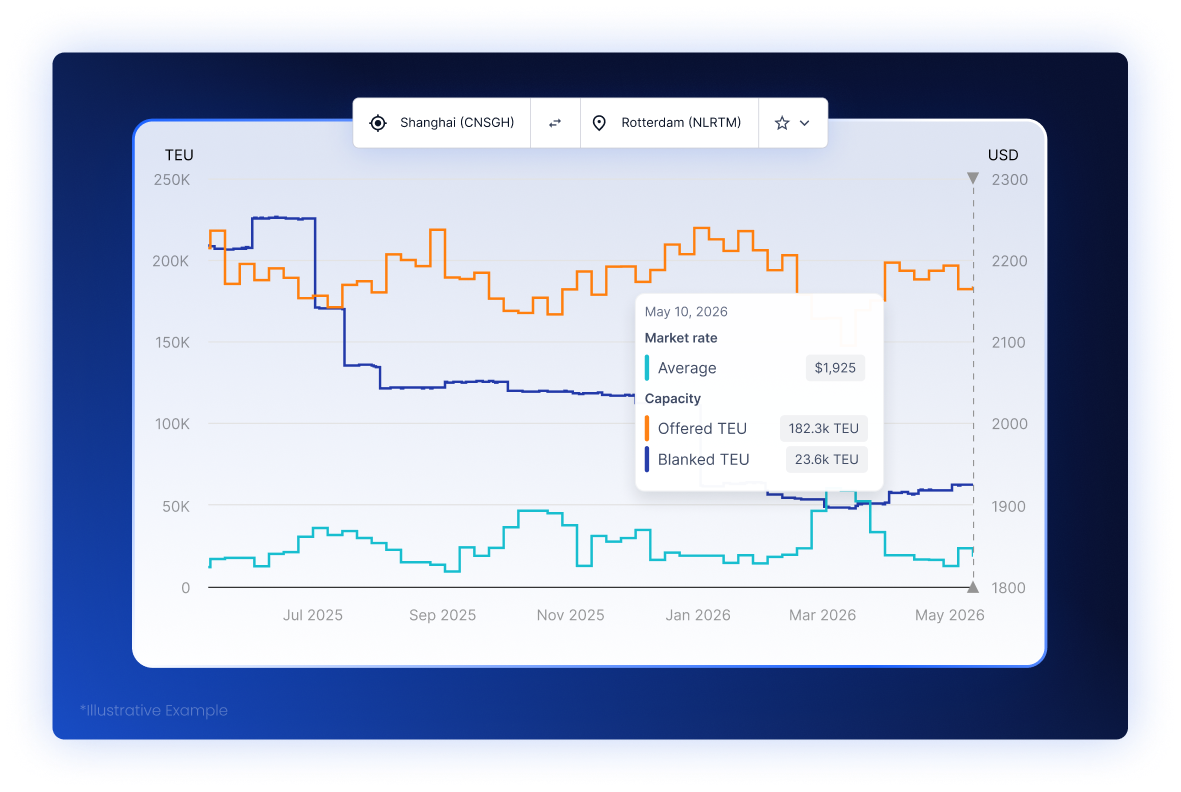
‘Capacity’ reflects the supply side of ocean freight — how much space, measured in TEUs, carriers schedule on a route. When capacity tightens, rates increase.


Unlike others, Xeneta tracks the current offered and blanked TEU capacity across 160,000+ port pairs, updated daily and with historical data and a 3-month forward view — for each carrier alliance.

Ocean Capacity Data at Scale

 What make Xeneta’s Capacity Data Unique

3-month

Forward visibility

On offered and blanked capacity

Daily

Updates

The 4-week rolling average is updated daily.

160k+

Port-to-port pairs

Offered and blanked capacity tracked at port-pair level and for each carrier alliance across the network.

XENETA CAPACITY DATA

What's in the dataset

Carriers adjust their scheduled supply through blanked sailings and schedule updates. Offered capacity reflects the carrier committed capacity on each trade, calculated from their proforma schedules. Blanked sailings, the cancelled voyages, are the primary way carriers reduce supply on a lane.

Historical and current TEU space carriers have scheduled on a corridor or port pair, plus a 12-week forward view, and for each carrier alliance.
Historical and current TEU volume of blanked sailings on a port pair — how much scheduled capacity carriers have pulled — and for each carrier alliance.
Ocean_Product_Capacity
Use Case Scenarios

When you'll use this data


01

Market monitoring & risk management

Track offered capacity and blanked sailings on your key corridors, or port pairs. Spot patterns early, flag the risk internally, and go into supplier conversations with data.

02

Spot buying / react to market shifts

Before making bookings, check offered capacity and blanked sailings on the lane.

03

Sourcing & tendering

Use the 3-month forward view to time your tender. If capacity is tightening into your contract window, move early. If supply looks loose, hold and let competitive pressure work in your favor.

04

Measure carrier & LSP performance

See which carriers and alliances are deploying capacity and which are pulling it on your lane. Use it to inform carrier selection and pressure-test how a carrier explains their pricing.

Sources & data processing

How the data is collected

Xeneta's offered and blanked capacity data is built on carrier proforma schedules — tracking which vessel is assigned to which sailing, on which route. Offered capacity in TEU is calculated from the registered specifications of each assigned vessel, standardised and cleaned across all carriers and services. When a sailing is blanked, that vessel's capacity is removed from the offered figure. The expansion of our data coverage is made possible by Xeneta's acquisition of eeSea in 2025.

01
Collect
Carrier Schedules + Vessel Registry Data

Carrier proforma schedules, vessel registry data, and port schedule feeds.

02
Cleanse
Error-checked

Schedule updates reconciled against the original plan, vessel assignments verified against IMO-registered specifications, blanked sailings flagged, and duplicates removed.

03
Normalize
Normalized

Map sailings to port pairs and trade lanes, translate vessel deployment into weekly TEU, and attribute capacity to carriers and alliances.

04
Validate
Quality gated

Cross-check against actual vessel movements from AIS, so the schedule-based capacity view stays honest when services run off-plan.

05
Process
Delivered how you need it

Offered capacity and blanked-sailing counts surface in the Xeneta platform, API, and reports.

Get the data where you need it

Platform

Monitor offered and blanked capacity on your lanes, compare alliances, and track the 3-month forward view.

API & Datalink Download

Feed offered and blanked capacity data directly into your planning system or BI stack for early-warning dashboards.

Reports

Tailored, executive-ready reports and advisory experiences — from Xeneta Advisory.
Our data standards

Trusted & Certified


Xeneta's data is built on enterprise-grade security, privacy, and independence — trusted by the world's largest shippers and quoted by leading global news outlets.

check_circle_icon
ISO 27001:2022 Certified
check_circle_icon
Quoted by WSJ, FT, Reuters
check_circle_icon
GDPR Compliant

Frequently asked questions

The most common questions we hear from procurement, supply chain, and freight forwarding teams evaluating Xeneta.  

What counts as a blanked sailing?

A blanked sailing is an entirely cancelled voyage — the vessel does not run on that rotation. Blanked sailings remove offered capacity from the market on the week they were scheduled to operate.

How far ahead can I see offered and blanked capacity?

Up to 12 weeks forward, based on the carrier’s published schedule. As carriers publish updates, the forward view refreshes daily — so you can see new blanks appear before they hit the market.

Why track blank sailings if I just care about rates?

Capacity moves before rates do. Carriers adjust deployment first, and spot rates typically follow within a few weeks. Watching blank-sailing volume — especially on major corridors — gives supply chain and procurement teams a leading indicator, not a lagging one.

Where does the data come from?

Xeneta's offered and blanked capacity data is built on carrier proforma schedules — tracking which vessel is assigned to which sailing, on which route. Offered capacity in TEU is calculated from the IMO-registered specifications of each assigned vessel, standardized and cleaned across all carriers and services. When a sailing is blanked, that vessel's capacity is removed from the offered figure. Data is cross-checked against actual vessel movements from AIS to ensure the schedule-based view stays accurate when services run off-plan.

Can I compare capacity across carrier alliances?

Yes. Offered capacity and blanked sailings can be broken down by carrier alliance on the same port pair — so you can see which alliance is deploying the most space and which is pulling back.