

<img height="1" width="1" style="display:none;" alt="" src="https://px.ads.linkedin.com/collect/?pid=502551789&amp;fmt=gif">
Skip to content
Our datasets

Xeneta Air Freight Rates Data

The only air freight rate benchmark combining shipper and airline data — neutral, with lane-level rates across 30,000+ airport pairs, for both long- and short-term contracts.

Xeneta, trusted by the world's biggest buyers & sellers of containerized and air freight

Air freight pricing is fragmented. Spot indices from one side of the market, monthly reports from another, supplier quotes with no independent reference.


 Having a full market view comes from seeing every side at once: what shippers pay, what airlines charge, how supply and demand are moving — lane by lane. Xeneta combines shipper and airline rate data across 30,000+ airport pairs, — so you can see how the market is actually trading.

Air Freight Rate Data at Scale

 What make Xeneta’s Air Freight Rate Data Unique

Data sourced from actual rates paid by shippers and charged by airlines. Independently owned and funded, so benchmarks stay neutral.

Complete

Market visibility

Shipper and airline rate data combined tracking 10m+ tonnes of air freight annually.

30k+

Airport Pairs Covered

Granular global coverage, not just major trade lanes.

Daily / Weekly

Rate Updates

Shipper rates update daily; airline rates refresh weekly.

XENETA AIR FREIGHT RATE DATA

What's in the dataset


Air freight measurements vary across the industry, making rates hard to compare. Weight brackets differ by carrier, and service level naming differs by forwarder.


To give you a reliable benchmark, Xeneta categorizes every rate into standardized weight categories and five service levels and combines data from every side of the transaction: what shippers pay forwarders, what airlines charge forwarders, and how the spot–contract mix is shifting. The four datasets below give you the fullest view of the market, each answering a different question — and together reveal dynamics no single-sided source can show.


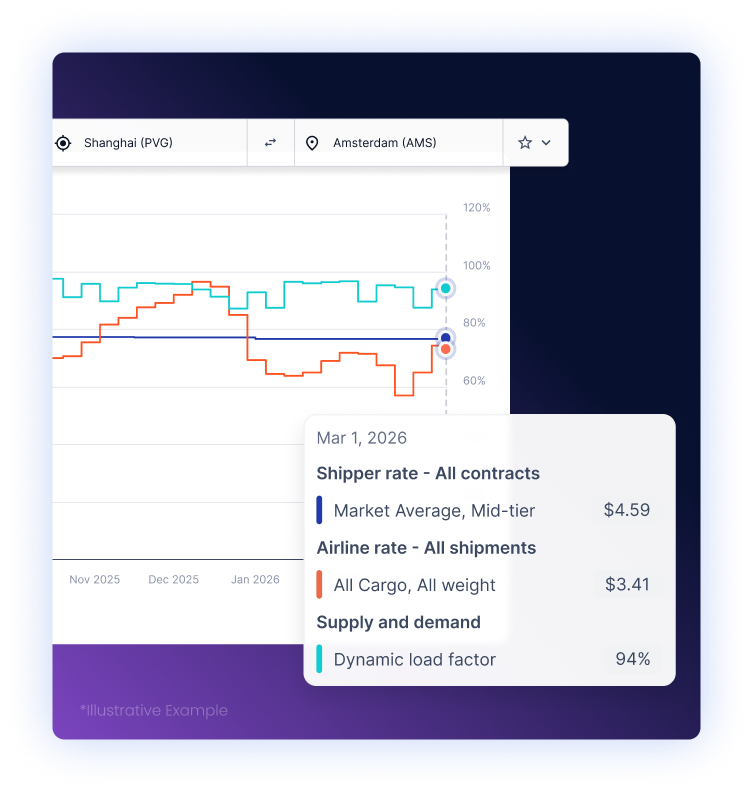
Long-term rates that shippers pay, anonymized and benchmarked across the market. Shows what shippers are actually paying on a specific airport pair — the benchmark for whether your contracted rates are in line with the market.

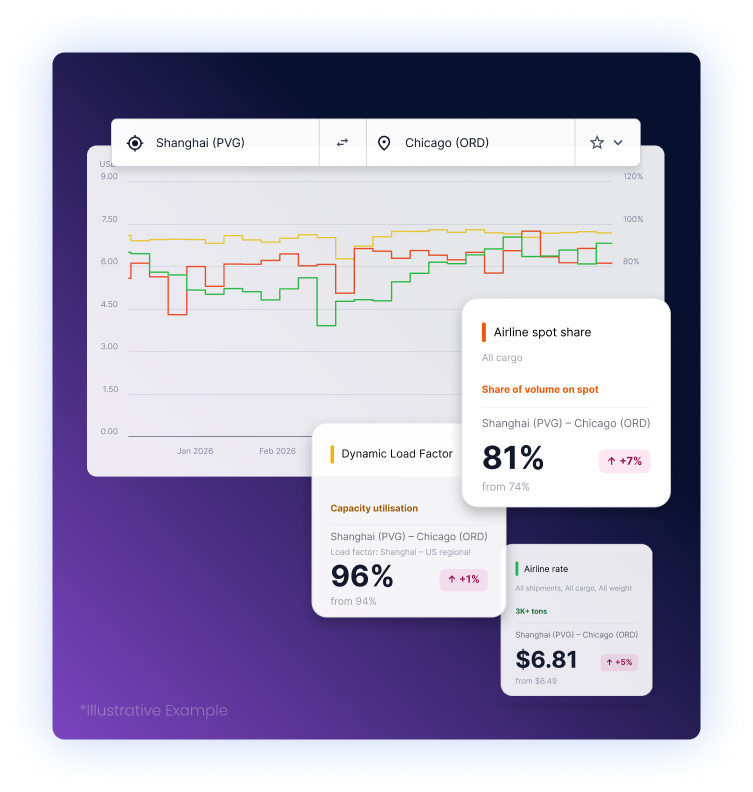
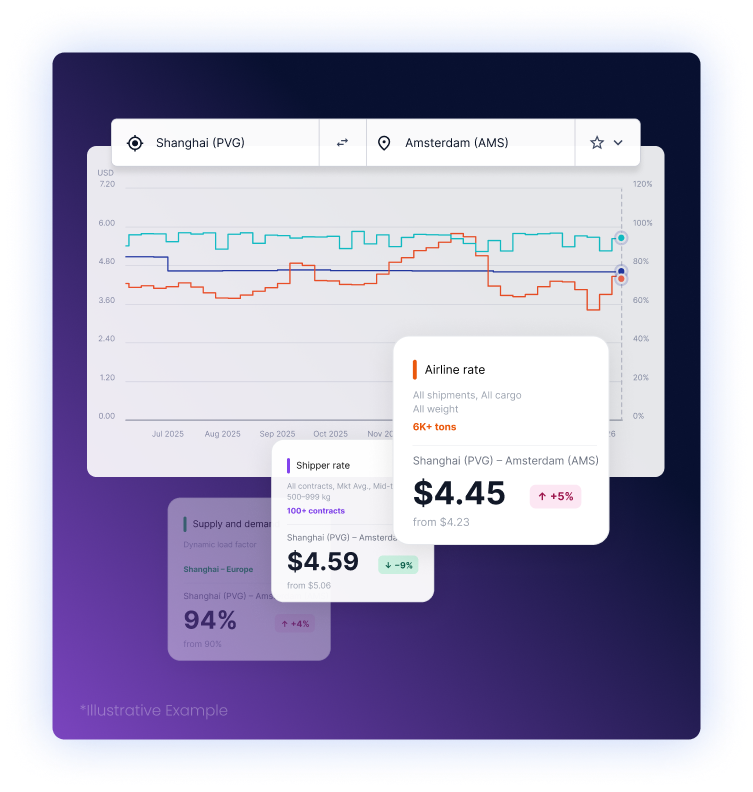
Rates airlines charge forwarders, split between spot and long-term. Reveals forwarders’ cost base on a specific airport pair.

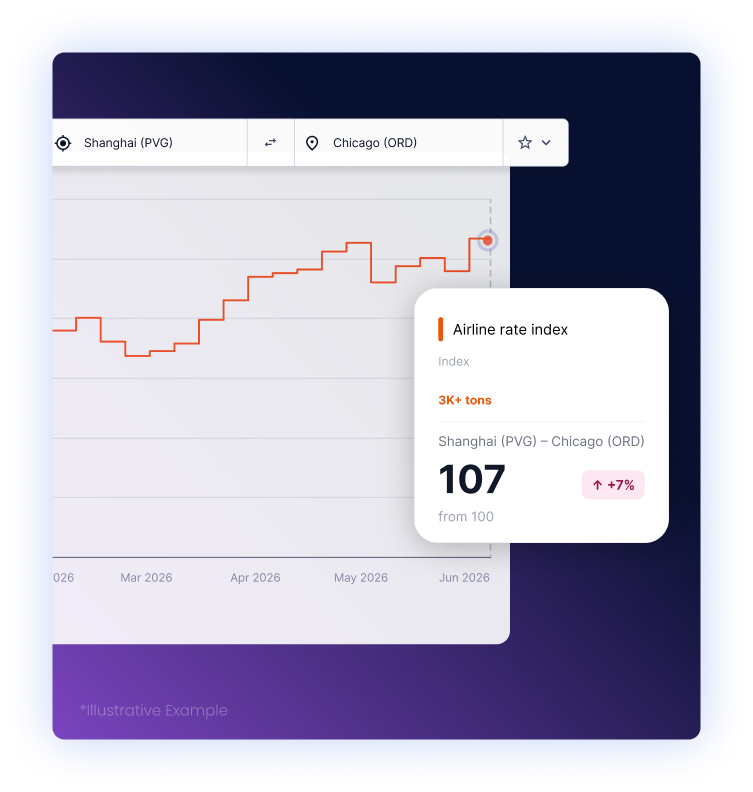
Weekly directional indicator of airline selling rates on a lane, indexed to 100. Tells you whether airline pricing is climbing, stable, or falling.
Share of airline volume sold on spot. Indicates how quickly prices can shift on a lane .

Explore each data set

1. Shipper buying rate

The contracted rates that shippers pay freight forwarders; the actual market price average for buying air freight, not a quote or an estimate.

Valid contracted rates on any given day are combined into a market benchmark, with high, average, and low positions visible across each airport pair.

What's included

  • Filterable by weight category and cargo (general cargo or temperature-controlled cargo)
  • Contract type: long-term
  • Benchmark positions: high, average, low
  • Searchable at airport-to-airport, country, region, or continent level
Air_Product_ShipperRate

2. Airline Rates

The rates airlines charge freight forwarders for moving cargo — available as short- (spot) or long-term rates.

What's included

  • Spot and long-term airline rates, shown separately
  • Filterable by weight category
  • General or special cargo (Pharma Passive, Perishables, Live Animals, Valuables, and Dangerous Goods)
  • Searchable at airport-to-airport level
Air_Product_AirlineRate

3. Airline rate index

This index shows changes in overall airline selling rates, with a starting value of 100%. It reflects the average across all weights, contract lengths, and cargo types.

It’s a weekly indicator of airline selling price levels on a lane, providing a quick read on the change in cost base that forwarders face.

What's included

  • Weekly index value per lane, base 100
  • Searchable at airport-to-airport (airport-pair) level
Air_Product_AirlineRateIndex

4. Airline spot share (%)

The proportion of airline cargo volume sold on a spot (ad-hoc) basis, expressed as a percentage. Shows how much is purchased on a lane occurs on the spot market versus long-term contracts.

What's included

  • Spot share % per lane
  • Searchable at airport-to-airport (airport-pair) level
  • General and special cargo filters
Air_Product_AirlineSpotShare
Use Case Scenarios

When you'll use this data


How the air freight market works


Air freight is bought and sold across two sides. Shippers contract with forwarders. Forwarders buy capacity from airlines — on long-term rates or spot. Market dynamics shift constantly, driven by capacity, seasonal demand, disruptions, and contract cycles. Having a complete data view gives you an understanding of: the real prices your shipper peers have paid, the carrier cost base, and being aware of market changes that will affect future prices (from the shipper perspective).


Capacity and demand add another layer. When flights fill up, airlines hold pricing power and rates rise. When demand drops, space opens up and rates follow. Xeneta's air supply and demand data tracks these dynamics alongside rates — see the Air Capacity, Load Factor & Demand page for more.


How our data helps

01

Sourcing & tendering

Rate benchmarks across 30,000+ airport pairs show where the market is before an RFQ goes out. The airline rate index tells you whether rates are rising or falling — so you can time the tender and evaluate each bid round against an independent reference, not just the quotes on the table.

02

Benchmark rates vs market 

See where contracted rates sit against the market — high, average, or low.

03

Spot buying / react to market shifts

When short-term capacity needs arise, spot share shows how quickly and how much prices can shift on a lane — so you can see how the market is moving before it shows up in quotes.

04

Rate Management

For airlines and forwarders managing rates, the airline rate index and shipper rate benchmarks show where the market is moving lane by lane — so rate decisions are grounded in real market data, not just internal targets.

05

Mode Shift Support

When ocean disruption pushes cargo to air, Xeneta provides both modes in one platform. Air rate benchmarks at airport-pair level let you compare the true cost gap and make a defensible mode-shift decision.

Sources & data processing

How the data is processed

Xeneta's air freight rate data is sourced from contracted rates from shippers and from partner airlines across our network — validated and structured into weekly benchmarks at airport-pair level, so you see actual market dynamics as they happen.

01
Collect
Actual rates

Gather rate data from contracts and waybills in partnership with our shipper customers and partner airlines.

02
Cleanse
Error-checked

Correct errors and remove anomalies before data enters the pool.

03
Normalize
Normalized

Structure data at airport-pair level, comparable across the network.

04
Validate
Quality gated

Check accuracy and quality before data is used to build benchmarks.

05
Process
Publish Benchmarks

Create market benchmarks and deliver in the Xeneta platform and make them available via API and reports.

Get the data where you need it

Platform

Explore rates, create reports, and share dashboards with your team.

API & Datalink Download

Feed air rate benchmarks directly into your TMS, procurement system, or BI stack via API.

Reports

Tailored, executive-ready reports from Xeneta Advisory that power your decisions and report on savings secured.
Our data standards

Trusted & Certified


Xeneta's data is built on enterprise-grade security, privacy, and independence — trusted by the world's largest shippers and quoted by leading global news outlets.

check_circle_icon
ISO 27001:2022 Certified
check_circle_icon
Quoted by WSJ, FT, Reuters
check_circle_icon
GDPR Compliant

Frequently asked questions

The most common questions we hear teams evaluating Xeneta data.

How does Xeneta calculate a daily benchmark rate?

Xeneta takes valid contracted rates on a given airport pair, weight bracket, and cargo type, then calculates benchmark positions — high, average, low — across the market. Shipper rates and airline rates are calculated and shown separately, so spot and contract markets never get blended into a single number.

What's the difference between shipper rate and airline rate?

Shipper rates are what shippers pay freight forwarders — the contracted price for buying air freight. Airline rate is what airlines charge forwarders — the cost base forwarders work from. Pairing the two reveals margin dynamics across the supply chain.

How frequent is Xeneta's air freight rate data updated?

Shipper rates update daily. Airline rates update weekly.

What is Xeneta’s air freight coverage?

Track prices across 30,000+ airport pairs — covering 14m+ tonnes of air freight each year, with data from shippers and airlines globally.

How does Xeneta keep data secure?

Xeneta is ISO 27001:2022 certified for information security. All contributed rates are anonymised and aggregated before entering the benchmark pool — no company-specific rates or supplier names are ever disclosed.

What's included in a Xeneta air rate?

Air rates are shown per kilogram and include four surcharges: fuel, security, peak season, and airline handling. Other surcharges fall outside Xeneta's rate definition. Rates are categorised by weight bracket and service level to make benchmarks directly comparable across the market.

How are Xeneta’s ocean freight rate benchmarks different from freight rate indices from other companies?

Public indices typically show spot prices on a handful of major routes, sampled weekly. Xeneta is built on 800M+ actual contracted rates — both short- and long-term — at port-pair level, updated daily. Indices give you a market signal; Xeneta tells you where your specific lanes, carriers, and contracts sit against what peers are actually paying.