

<img height="1" width="1" style="display:none;" alt="" src="https://px.ads.linkedin.com/collect/?pid=502551789&amp;fmt=gif">
Skip to content
Our Dataset

Xeneta Ocean Liner Reliability and On-time Performance Data

Global service reliability data across every major trade lane; updated daily, with unmatched visibility from service level down to individual vessels.

Xeneta, trusted by the world's biggest buyers & sellers of containerized and air freight

Procurement and logistics teams have traditionally relied on monthly industry schedule reliability reports—based on trade-lane averages and published weeks after.


Xeneta measures the reliability of the schedule by carrier at a port-pair level, updated daily. Built on neutral, AIS-based vessel movement data, and mapped against original published carrier schedules, it gives you an independent view of who is delivering.

Ocean Freight Data at Scale

 What make Xeneta’s Reliability Data Unique

Granular

BY ALLIANCE, SERVICE, CARRIER & VESSEL

400+ corridors, covering all major carriers and alliances.

Vessel-level

DATA

Based on terrestrial and satellite AIS data, tracking 7,000+ vessels and 50,000+ arrivals per month.

Daily

Updates

Updated daily, not monthly reports published weeks later.

XENETA RELIABILITY DATA

What's in the dataset


Xeneta's reliability data takes into consideration different datasets to paint a clearer view of actual carrier performance: on-time arrivals, cancellation rates, delays, waiting times, transit times, and port congestion. Together they answer: did the sailing run, did it arrive on time, when was it late and by how much, and where did the bottleneck occur?
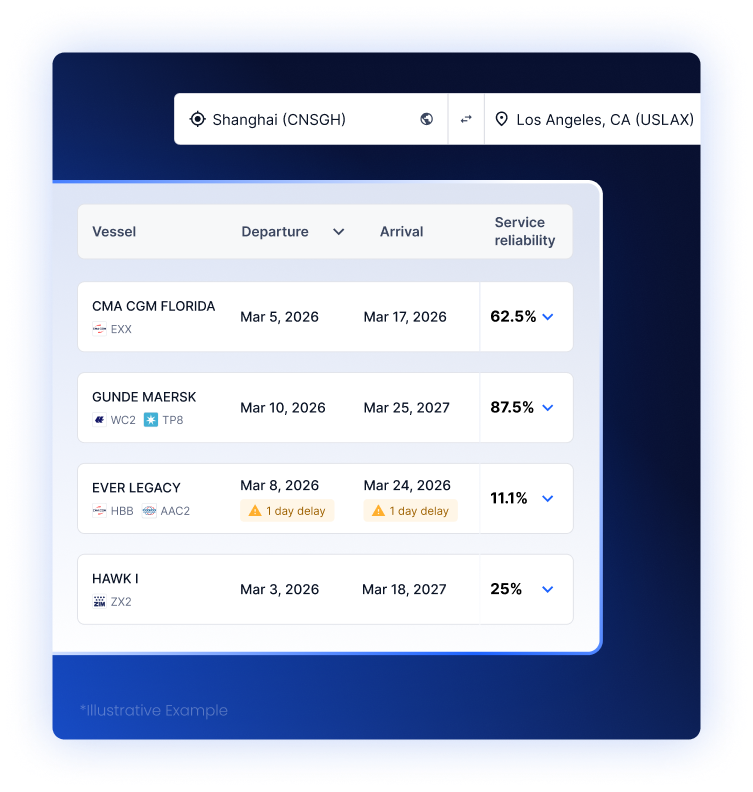
Planned services and vessel departures at port-pair level, validated against AIS-based vessel movements. See every planned service, departure, and blanked sailing across carriers operating that lane.
The percentage of sailings arriving within ±24 hours of the planned ETA, measured against the original carrier schedule — not updated, carrier ETAs.
The percentage of scheduled sailings that did not run — blanked, omitted, or skipped for any reason.
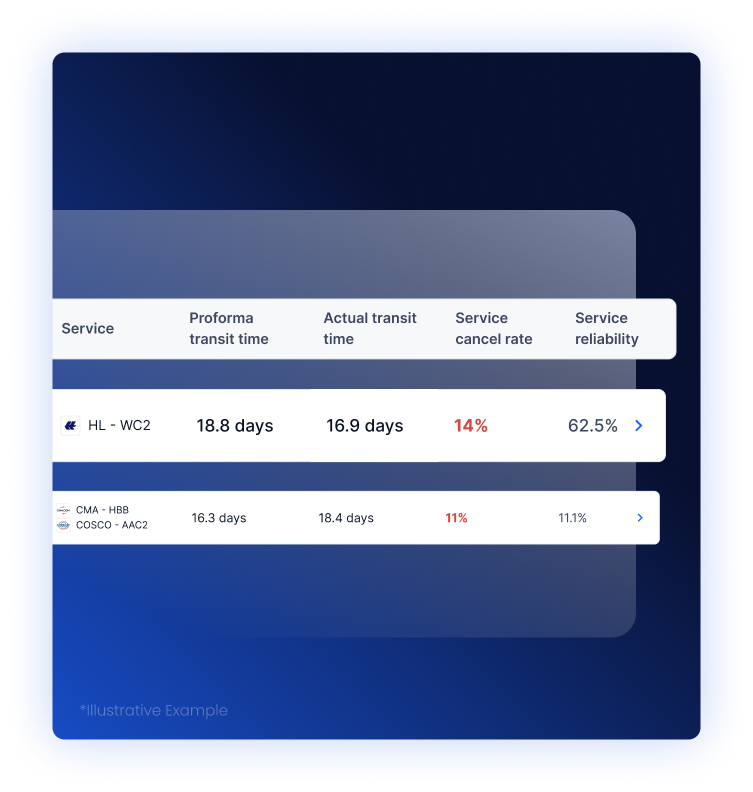
The carrier-announced transit time — the plan set at service launch, alongside the actual transit time, based on a 30-day rolling average of real vessel movements from AIS data.
The time-based gap between the announced schedule and actual vessel arrival, displayed in hours or days.
The port congestion ratio: vessels waiting versus actively moving and average wait time in hours, tracked across 654 ports globally in the last 30 days.

Explore each data set

1. Schedules Timetable Table

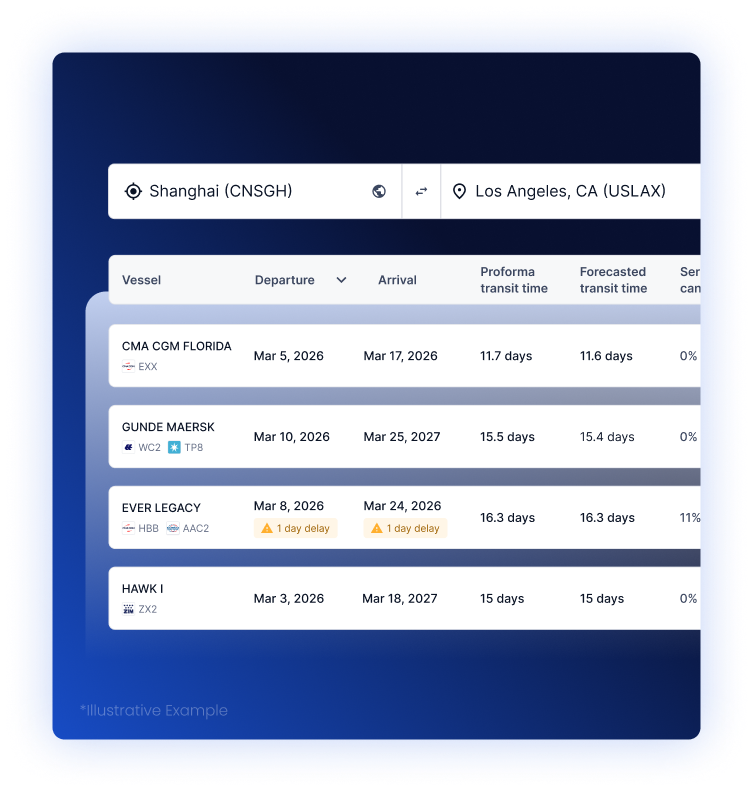
The Schedules Timetable aggregates published schedules across all carriers into a single view, with detailed vessel-level data validated against AIS-based vessel movements. Covering every planned service and departure at port-pair level — including blanked sailings — across every carrier operating that lane.

Covering:

  • Port-to-port pairs
  • All major carriers
  • Service / vessel
  • Planned departures and blanked sailings
Ocean_Product_SchedulesTimetable

2. Service Reliability (on-time arrivals %) data

Reliability is the percentage of on-time arrivals within ±24 hours of the originally planned ETA, updated daily. Coverage is by port pair, carrier, or alliance — with service and vessel-level detail available.

Covering:

  • Port-to-port pair
  • Carrier / alliance
  • Service- or vessel-level view
Ocean_Product_ScheduleReliability

3. Cancellation rate (%) data

The cancellation rate is the percentage of scheduled sailings that did not run because they were blanked, omitted, rerouted, or skipped. Complementary to on-time arrivals, cancellation rate tells you how many sailings ran at all, reliability tells you how many of those that ran arrived on time. A cancelled sailing is never counted as unreliable.

Covering:

  • Port-to-port pair
  • Carrier / alliance
  • Service- or vessel-level view
Ocean_Product_CancellationRate

4. Transit Times data

Transit time data is the port-to-port travel time from origin to destination. Xeneta shows two views side by side: the carrier-announced transit time (the plan set at service launch) and the actual transit time, based on a 30-day rolling average of vessel movements from AIS data.

Covering:

  • Port-to-port pair
  • Announced vs. actual transit time comparison
  • Carrier / service / vessel level
Ocean_Product_SchedulesTimetable

5. Delays data

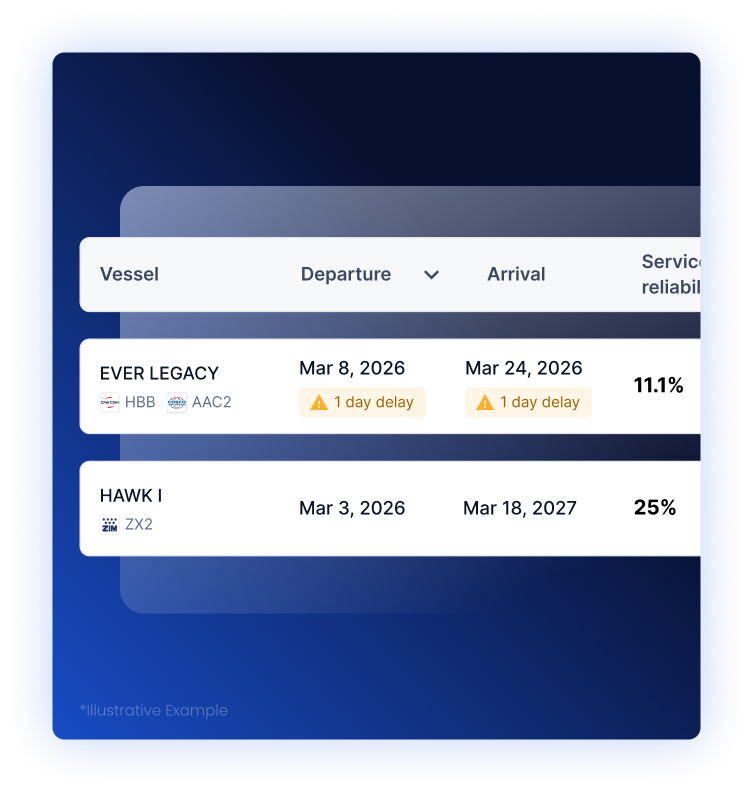
Delay data shows the time-based gap between the announced schedule and actual vessel arrival — not just whether a vessel was late, but by how much. It’s based on AIS-tracked vessel movements between port pairs and is displayed in hours or days.

Covering:

  • Port-to-port pair average delays
  • Delay displayed in hours or days
  • By carrier / service / vessel
Ocean_Product_Delays

6. Port Congestion data

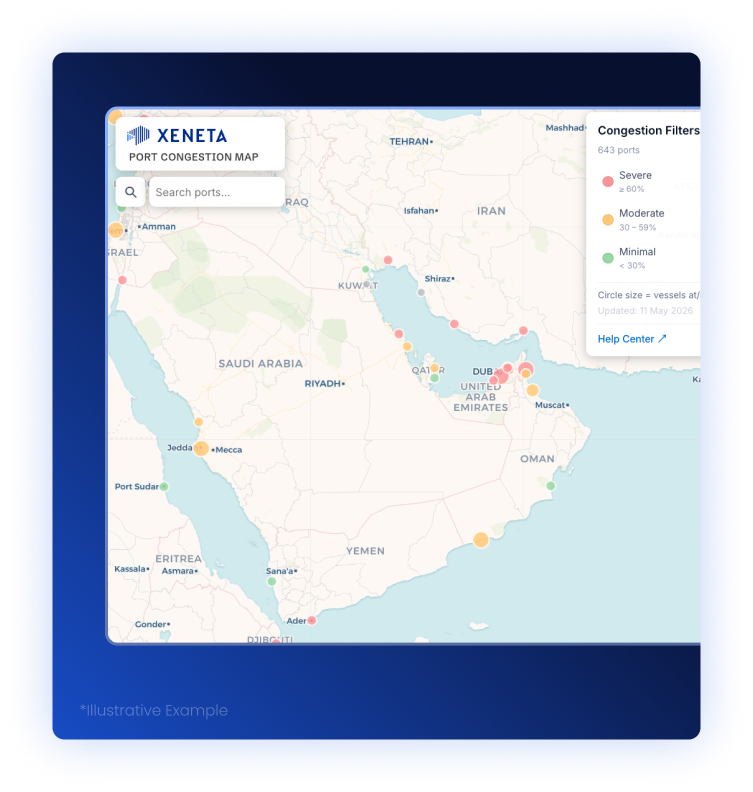
The port congestion ratio — vessels waiting versus actively moving — and average wait time in hours, tracked across 654 ports globally over the last 30 days.

  • Available by individual port
  • Congestion severity rating: Severe (>50%) · Moderate (30–59%) · Minimal (<30%)
  • 30-day trend
  • Average waiting times per port
Ocean_Product_CongestionMap
Use Case Scenarios

When you'll use this data


01

Measure carrier & LSP performance

Reliability (on-time arrivals %) and cancellation rate data give you a neutral scorecard for every carrier on every lane. Use it for QBRs and performance reviews where 'who actually delivered?' needs an independent answer, not a carrier-supplied one.

02

Sourcing & tendering

Updated daily, you can use port to port reliability data to factor real on-time performance and carrier scoring into tendering and supplier sourcing processes.

03

Market monitoring & risk management

Reliability and cancellation data allows you to monitor your lanes as disruption shows up in cancellation rate first, often weeks before it hits rates. Pinpoint exactly where the risk is: is it a port with congestion, a service that's structurally unreliable, or a carrier's performance across a whole corridor?

04

Crisis response

When disruption hits, reliability data helps you identify more resilient alternatives and reallocate volumes quickly. Independent, up-to-date data on which services and carriers are performing best gives you a basis for fast decisions under pressure.

05

Report & justify internally

When something goes wrong on a shipment, stakeholders want context. Use market-wide reliability and cancellation trend data to frame a single missed sailing against what the whole market is experiencing.


Sources & data processing

How the data is processed

Xeneta’s reliability data is based on neutral vessel movement data (from AIS signals) and carrier-published proforma schedules to deliver independent on-time performance— data. (Enabled by the 2025 acquisition of eeSea data, now part of Xeneta.)

01
Collect
Neutral AIS data + carrier proforma schedules

Vessel arrival data from terrestrial and satellite AIS, carrier-published proforma schedules (at service launch or their latest structural update) and port schedules, validated across multiple sources including carrier publications and advisories.

02
Cleanse
Noise-filtered

Remove invalid and duplicate AIS signals, reconcile port calls against the proforma, and validate ad-hoc data points not part of scheduled sailings.

03
Consolidate
Single view

Map every sailing to its origin-destination port pair and its originally planned ETA. Create a single structured service version as a baseline, so reliability is measured against the schedule the carrier committed to.

04
Validate
Quality-gated

Cross-check arrivals, include planned and ad-hoc cancellations in the cancellation rate. Ensure the dataset reflects AIS-based vessel movements, not just carrier-reported data.

05
Process
Generate Benchmarks

Create the market high, mid-high, average, mid-low, and low benchmarks, ready to publish in the Xeneta platform, and share via API and reports.

Get the data where you need it

Platform

Monitor reliability data on your lanes, compare carriers, and build watchlists for disruption-prone corridors.

API & Datalink Download

Pipe reliability data directly into your TMS, control tower, or BI stack for automated carrier scorecards.

Reports

Tailored, executive-ready reliability reports and advisory experiences — from Xeneta Advisory.
Our data standards

Trusted & Certified


Xeneta's data is built on enterprise-grade security, privacy, and independence — trusted by the world's largest shippers and quoted by leading global news outlets.

check_circle_icon
ISO 27001:2022 Certified
check_circle_icon
Quoted by WSJ, FT, Reuters
check_circle_icon
GDPR Compliant

Frequently asked questions

The most common questions we hear from procurement, supply chain, and freight forwarding teams evaluating Xeneta.  

How does Xeneta calculate service reliability (on-time arrivals %)?

Every sailing is compared against the original proforma ETA the carrier published when the service was set up (or its latest structural update). A sailing arriving within ±24 hours counts as on time. Reliability (on-time arrivals %) is measured at destination port, at port-pair level, down to service and vessel level — refreshed daily.

How are reliability (on-time arrival %) and cancellation rate related?

Both are part of the broader reliability picture, but they measure different things. Cancellation rate tells you how many scheduled sailings were blanked or skipped. On-time arrivals (%) tells you how many of those that ran arrived on time. A cancelled sailing is never included in the on-time calculation — a vessel that didn't sail can't be counted as late.

Where does the data come from?

Xeneta's reliability data is based on vessel movement data from terrestrial and satellite AIS, combined with carrier-published proforma schedules. These are sourced across multiple sources — third party providers, carrier publications, advisories, and port schedules — and mapped against original published carrier schedules to give an independent view of on-time performance.