
Freight procurement reinvented with index-linked contracts
Freight procurement is breaking under volatility. Xeneta Indexing replaces slow, unreliable tenders with market-tracking contracts, powered by trusted data.
Trusted by the world's largest
shippers, forwarders, carriers and airlines.












Tenders are too slow for today’s market
Fixed rates feel predictable until the market shifts. Then the renegotiation cycle begins.
RFQs collapse
RFQ cycles take months and fall apart as soon as the market shifts.
Budgets become guesswork
Wide gaps open between projected and actual freight costs.
Teams work in silos
Procurement, finance and suppliers disconnect, slowing decisions.
Index-linked contracts replace the renegotiation cycle
Your rate moves with a neutral market index, within boundaries both sides agree upfront. Finance gets stability, procurement gets time back.
Simulate visual
This page could not be loaded. Please try again later.
Test contracts before they go live
Run your own lanes through the simulator to see how costs would have moved, with real market data behind every number.
Simulate rules, triggers and adjustments
Ceilings and floors tested on your lanes
A business case built on real data
Set up visual
This page could not be loaded. Please try again later.
Start with market-aligned rates
Benchmark starting rates against live market data, then replace long RFQs with quick, standardised index-linked agreements.
Starting rates benchmarked to market
Standardised index-linked agreements
Begin with a few lanes, then expand
Monitor visual
This page could not be loaded. Please try again later.
Track every adjustment automatically
Index Live Contract Manager calculates formula adjustments, tracks performance against the index and keeps audit logs.
Automatic formula adjustments
Audit logs in the platform
One shared view for shipper and carrier
See an index-linked contract from simulation to live
A Xeneta specialist simulates an index-linked contract, tests scenarios, then sets it up and monitors it against live market data.
Every index is built on real contracted rates
Carriers and shippers both need to trust the index. Xeneta's is built on rates shippers and forwarders actually paid.
- Contracted rate data points
- 900M+
- Ocean port pairs
- 170k+
From fixed rates to indexed and hedged
Rethinking ocean procurement with index-linked contracts and hedged strategies.
Index-linked contracts in practice
Where hedging fits in your strategy
Watch on demand, free
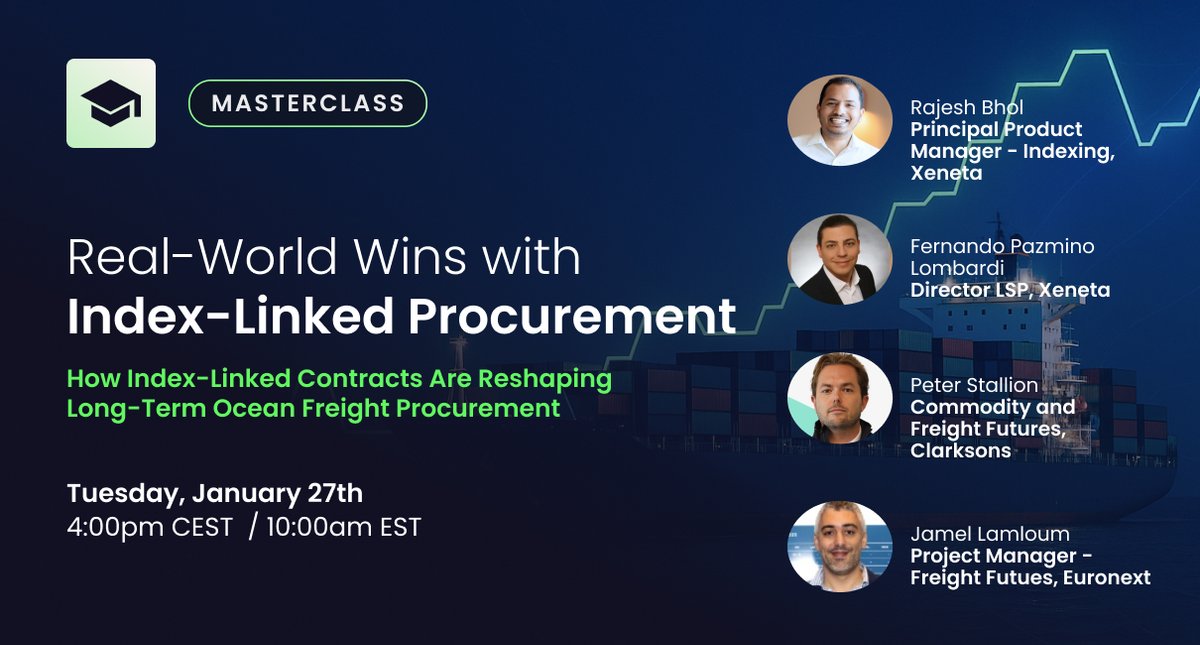
How global leaders use index-linked contracts
A practical certification course on how freight and finance professionals manage volatility with index-linked contracts and clear governance frameworks.
A practical certification course
Index-linked contracts and governance frameworks
For freight and finance professionals

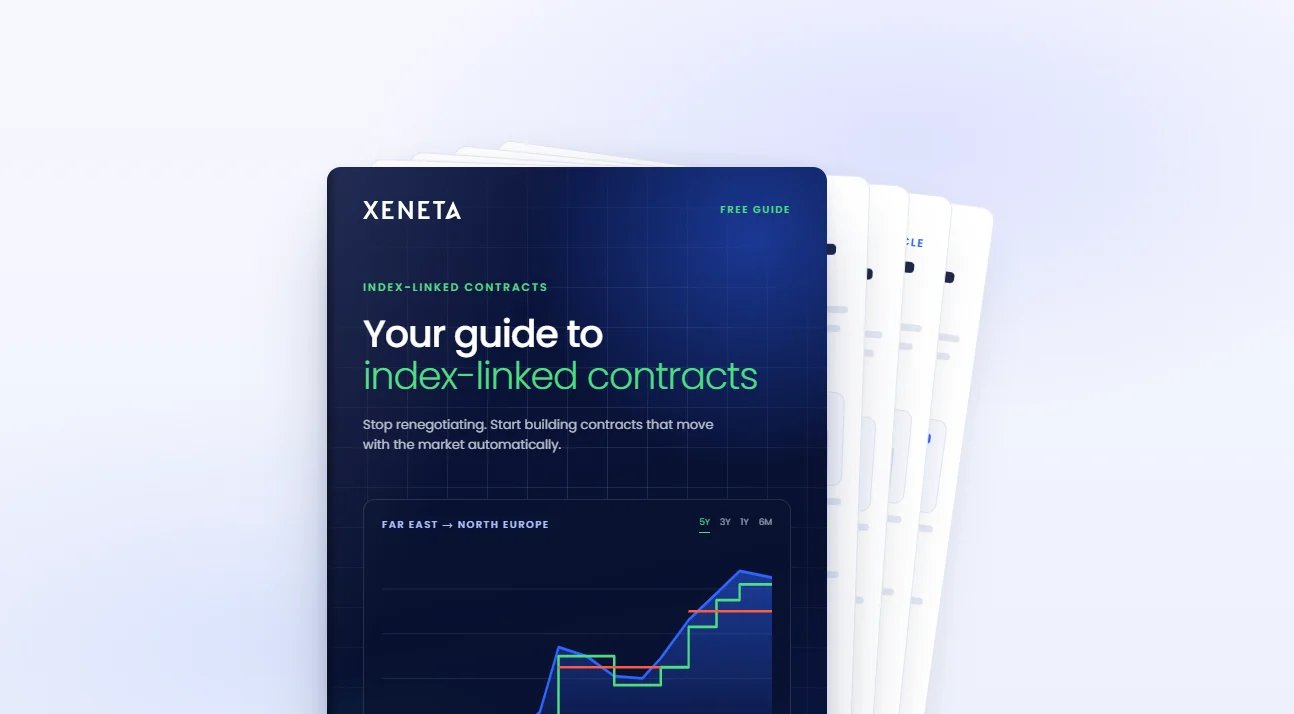
Your guide to index-linked contracts
Stop renegotiating. Start building contracts that move with the market automatically.
How index-linked contracts work
Why they end the renegotiation cycle
Free to download
Not sure where to start? Watch this first
Spiralling cost risk, fear of missing a well-timed tender, internal processes that aren’t ready. Bjørn Vang Jensen tackles the three reasons shippers resist index-linked contracts, and why none of them has to be a dealbreaker.
What’s driving the resistance?
Why so many shippers hesitate to move away from fixed-rate contracts.
Watch on YouTube
The key reasons, explained
Bjørn works through the objections shippers raise most often.
Watch on YouTube
The key reasons, continued
The remaining objections, and why none has to be a dealbreaker.
Watch on YouTubeIndexing, answered
What is an index-linked freight contract and how does it work in practice?
An index-linked freight contract ties contracted rates to a published, transparent market index, such as Xeneta's ocean freight benchmarks, rather than fixing a rate for a defined period. Typically, a base rate is agreed at contract inception, and a periodic adjustment mechanism (quarterly, semi-annually, or annually) resets the rate in line with market movement. If rates fall, the shipper benefits automatically; if rates rise, the carrier is protected. The mechanism eliminates the adversarial cycle of frequent re-tendering while ensuring neither party is systematically disadvantaged by market movements. It is particularly valuable for multi-year carrier relationships where both parties want stability without exposure to market divergence.
Why are some carriers hesitant about index-linked contracts, and how does Xeneta address this?
Index-linked contracts remain a minority of total ocean freight contracting but adoption has grown significantly among sophisticated shippers and forward-looking carriers. Carrier hesitancy typically stems from concerns about revenue predictability and a preference for fixed-rate contracts that allow better capacity planning. However, carriers with a long-term view increasingly recognize that index-linked contracts reduce churn, shippers who pay market-reflective rates are less likely to exit contracts mid-cycle when market conditions change. The key to successful adoption is selecting a credible, independently governed index, one that carriers trust as a fair representation of market conditions rather than a shipper-advantaged benchmark.
How do index-linked contracts improve budget predictability for finance teams?
Counterintuitively, index-linked contracts can improve budget predictability by replacing the uncertainty of annual re-tendering with a structured, forecastable adjustment mechanism. Rather than not knowing what rates will be after the next tender cycle, finance teams can model freight cost scenarios using the index trajectory, building in upside and downside ranges based on observable market data. For companies with product pricing strategies that cannot absorb sudden freight cost spikes, an index-linked contract with a defined cap or collar structure provides the stability of a fixed rate while maintaining market alignment over time. Xeneta's forecast data supports the scenario modeling needed for this planning approach.
How does Xeneta support the ongoing management of index-linked contracts once they are in place?
Signing an index-linked contract is the beginning, not the end. Xeneta's Index Live Contract Manager automates the ongoing administration, calculating formula adjustments, tracking performance against the agreed index, and maintaining audit logs directly in the platform. This removes the manual work of managing rate adjustments in spreadsheets, reduces the risk of calculation errors or disputes, and gives both shipper and carrier a shared, transparent view of how the contract is performing. For procurement teams managing multiple index-linked contracts across different trade lanes, having this in one place, alongside live market benchmarks and rate data, creates a single source of truth for freight rate management across the business.
How do I get internal leadership buy-in for index-linked freight contracts?
Leadership resistance to indexing often stems from concerns about potential upside cost exposure, the fear that rates could rise significantly above what a fixed contract would have provided. This concern is addressable with scenario analysis: using Xeneta's historical rate data, you can model how an index-linked contract would have performed in previous market cycles compared to a fixed-rate approach. In most scenarios, the combination of downside rate capture and reduced tendering frequency produces better outcomes over a three-to-five year horizon than fixed contracts. Presenting this analysis with independent market data, rather than carrier-provided forecasts, is typically the most effective way to build the internal case.