
Our Dataset
Xeneta Ocean Freight Surcharges Data
See how BAF, EU ETS, peak season, congestion, and Red Sea surcharges have moved and, compare your charges to what peers are paying.
Xeneta, trusted by the world's biggest buyers & sellers of containerized and air freight
Surcharges were once a predictable line on the invoice. Now there are more of them, they change more often, and carriers calculate and name them differently. The result: a growing share of your ocean spend sits in charges that are hard to audit or compare.
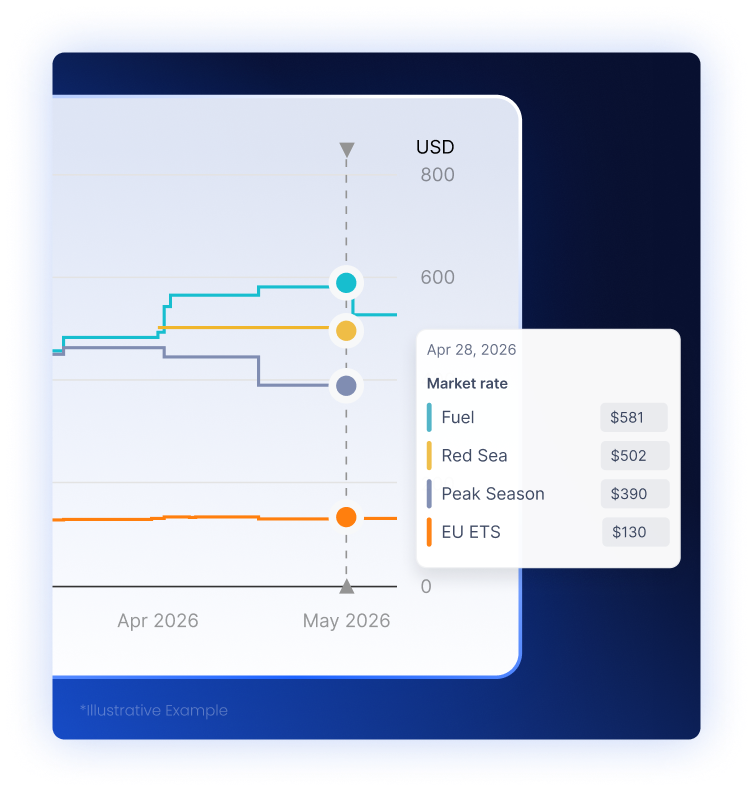
With Xeneta, each surcharge is tracked individually — BAF, EU ETS, peak season, congestion, Red Sea — normalized across carriers, shown at market high, average, and low: all built from actual contracts.
Ocean Freight Rate Data at Scale
What make Xeneta’s Ocean Freight Rate Data Unique
Data sourced from actual rates paid by shippers and forwarders — not carrier data — and independently owned and funded, outside of the industry, so benchmarks stay neutral.
800m+
Rates
5 Major surcharges — see what your peers actually paid
160k+
Port Pairs Covered
Granular global coverage, not just major trade lanes.
Daily
Rate Updates
Live benchmarks, not quarterly snapshots.
XENETA SURCHARGE DATA
What's in the dataset
An ocean freight surcharge is a variable charge, added to the base freight rate, to cover costs that change outside the underlying shipping service and driven by: fuel costs, regulatory compliance, seasonal demand, and route-specific risks. Xeneta breaks down each major surcharge individually, normalized across carriers and benchmarked at market levels, so you can clearly see how each cost is moving.
Explore each data set
1. Bunker Adjustment Factor (BAF) / Fuel Surcharge
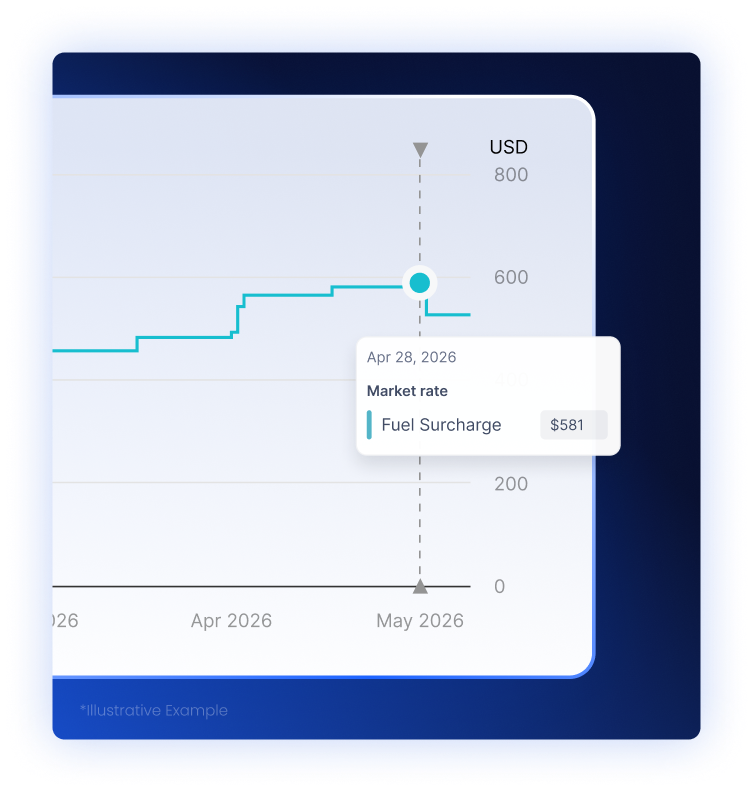
Bunker Adjustment Factor (BAF) is the fuel surcharge ocean carriers apply to cover changes in bunker fuel prices — typically indexed to VLSFO and updated monthly or quarterly. Also known as fuel adjustment factor, fuel surcharge, or bunker surcharge depending on the carrier.
Xeneta tracks how BAF moves across the market and over time, so you can see whether today's charge is in line with market norms or reflects a lag in carrier adjustments.
What's included
- Historical and current BAF levels
- Market high, mid-high, average, mid-low, low tiers
2. EU ETS surcharge
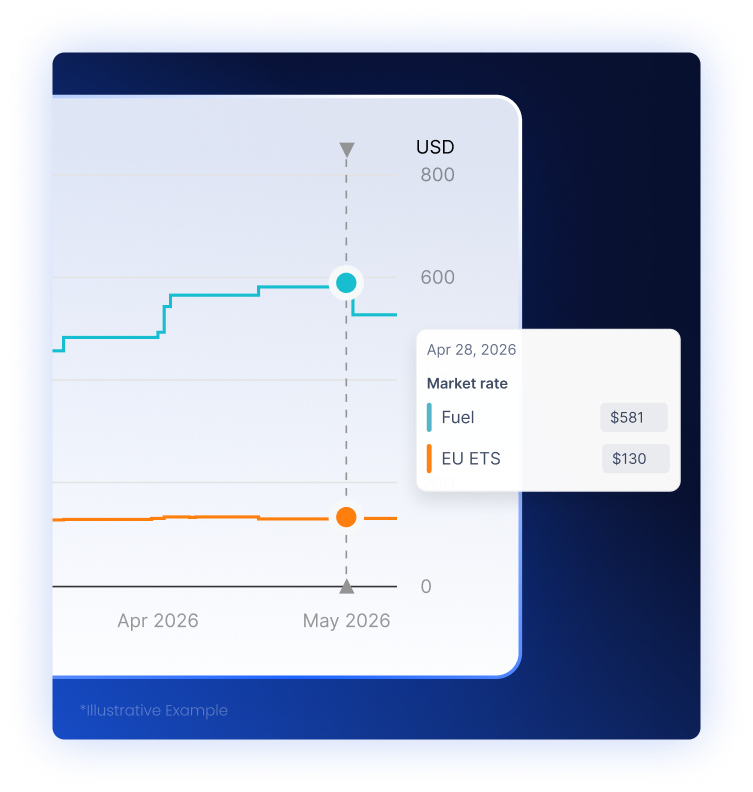
The EU ETS surcharge is the charge ocean carriers apply to recover the cost of EU emissions allowances on EU-linked voyages. Since January 2026, it covers 100% of verified CO₂ emissions, with methane and nitrous oxide now in scope. Also called emissions surcharge, carbon surcharge, or ETS levy.
Carriers calculate EU ETS differently. Some use a fixed quarterly allowance price, others, the live market rate. Xeneta standardizes the data to give you a consistent view across lanes and carriers.
What's included
- Historical and current EU ETS levels
- Market high, mid-high, average, mid-low, low tiers
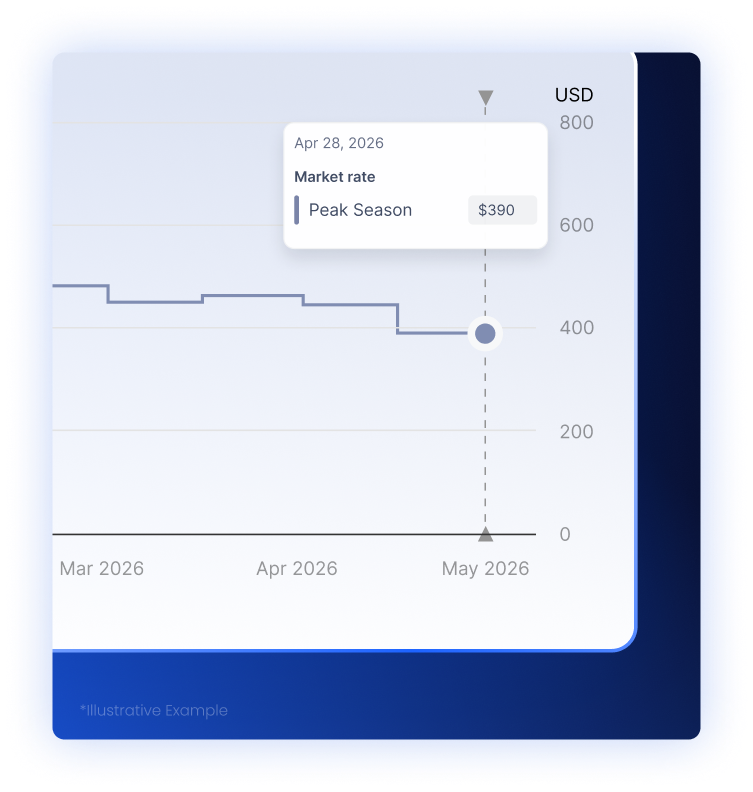
3. Peak season surcharge
Peak Season Surcharge (PSS) is a temporary charge applied during high-demand periods — typically ahead of Golden Week, Chinese New Year, and the Q3–Q4 holiday peak — to reflect tighter capacity.
Xeneta tracks PSS across lanes and seasons, so you can see what the market is paying and challenge the charge when it sits above the benchmark.
What's included
- Historical and current PSS levels
- Market high, mid-high, average, mid-low, low tiers
4. Congestion surcharge
A congestion surcharge is applied when port or regional disruption (vessel bunching, labor action, equipment shortages, or infrastructure issues) increases operating costs. Also called port congestion surcharge or PCS.
Xeneta tracks congestion surcharges by port and region, so you can compare yours to the market range.
What's included
- Historical and current congestion surcharges by affected port / region
- Market high, mid-high, average, mid-low, low tiers
5. Red Sea surcharge
The Red Sea surcharge is the charge ocean carriers apply to cover the extra cost of avoiding the Red Sea and Suez Canal. Rerouting via the Cape of Good Hope adds thousands of nautical miles, longer transit times, and higher fuel and insurance costs. Applied on Asia–Europe, Asia–Mediterranean, and other lanes that would normally transit the Suez.
Xeneta tracks the Red Sea surcharge across affected lanes and over time, so you can see how the market is pricing it.
What's included
- Historical and current Red Sea surcharges
- Market high, mid-high, average, mid-low, low tiers
Use Case Scenarios
When you'll use this data
Payment Validation (auditability)
Carrier invoices list surcharges line by line, but without an independent reference it’s hard to verify whether they are in line with the market. Xeneta provides an auditable benchmark to validate these surcharges and identify potential overcharges.
Sourcing & tendering
Surcharges can represent a significant share of total ocean spend. Going into a tender without historical surcharge visibility means negotiating on base rates alone. Xeneta shows how each surcharge has moved so you can negotiate the full cost, not just the base rate.
Forecasting & budgeting
Freight budgets that ignore surcharge trajectories miss a meaningful chunk of the total cost picture. Xeneta gives finance a market-aligned view of each surcharge, so budgets reflect where the market is heading.
Report & justify internally
When carriers announce surcharge increases, stakeholders such as finance or leadership require clear justification and market context. Xeneta provides an independent benchmark to support these discussions with data.
Sources & data processing
How the data is processed
Xeneta's surcharge data is sourced directly from actual customer contracts, across the world's largest shippers and freight forwarders, that are validated and enriched to create an accurate view of the ocean freight market.
OUR DATA STANDARDS
Trusted & Certified
Xeneta's data is built on enterprise-grade security, privacy, and independence — trusted by the world's largest shippers and quoted by leading global news outlets.
Frequently asked questions
The most common questions we hear from procurement, supply chain, and freight forwarding teams evaluating Xeneta.
How are surcharge benchmarks calculated?
Xeneta extracts surcharges from shipper and freight forwarder contracts, standardizes them by type, and aggregates a market-wide view, separated from Xeneta’s freight rates, and across major surcharge categories. Valid data points for a given corridor, and date, are grouped into market tiers: high, mid-high, average, mid-low, and low. Each major surcharge is shown independently, enabling visibility into how components such as BAF, EU ETS, congestion, peak season, and Red Sea surcharges move across the market.
Why do carriers call the same surcharge different things?
Carriers use different terminology for the same underlying charge. EU ETS might appear as EMS, ESS, Emissions Surcharge, or Energy Transition Surcharge depending on the carrier. Xeneta normalizes naming conventions so you can compare charges across the market.
Are surcharges already included in Xeneta's ocean freight rate benchmarks?
Yes. The rates shown in our main freight rate benchmarks include the major surcharges as part of the total port-to-port cost — as that's how shippers buy. The surcharge dataset breaks them out separately for analytical purposes: when a rate moves, it lets you see which surcharge component drove the move.
How does Xeneta show EU ETS surcharges?
EU ETS is the EU's carbon pricing scheme for shipping. From 1 January 2026, carriers must cover 100% of verified emissions on EU-linked voyages, with methane and nitrous oxide now in scope alongside CO₂. Q1 2026 saw many carriers raise ETS surcharges by 40–50%. Xeneta shows the market range, average, and movement for EU ETS surcharges on each lane.
Carriers calculate ETS differently: some use a fixed quarterly price for EU allowances, others the live market rate at bill of lading issuance, so figures vary widely. The benchmarks give you a reference point to check what you're being charged against the market.
How does Xeneta show BAF?
BAF (Bunker Adjustment Factor) is the fuel surcharge carriers add to cover bunker fuel costs, typically indexed to VLSFO and updated monthly or quarterly.
Xeneta shows the market range, average, and movement for BAF on each lane. Formulas differ between carriers, so the figure you pay can sit well above or below the market — the benchmark gives you a reference point to check it against.
Are surcharges negotiable?
Some are, some aren't. BAF and EU ETS are harder to negotiate because they track external cost drivers — fuel prices and carbon allowances. But the level at which they're applied varies, and that's what you can challenge with benchmark data.
Peak season, congestion, and security surcharges are more often negotiable — especially when the market context (low utilization, no active disruption) doesn't support the level being charged. Xeneta's data shows you which surcharges are sitting above the market, which gives you the evidence to push back.
How often is the data updated?
What surcharges are included in Xeneta's freight rates?