
See how Nestlé cut manual work, compressed tender cycles, and elevated procurement decisions with real‑time data
The most comprehensive and independent freight data — built for teams that can’t afford guesswork.
Xeneta, trusted by the world's biggest buyers & sellers of containerized and air freight
Your decisions are only as strong as the data behind them.
In a volatile market, teams still rely on manually pieced-together spreadsheets to guide pricing, performance, and supplier decisions, often leading to costly outcomes and fragile supply chains.
Accurate, independent data isn’t a nice-to-have — it’s essential.
Trusted. Independent. Unmatched.
We collect actual contracted rates from our community of the worlds largest shippers, freight forwarders, and airlines. This includes:
Shipper contracts
Freight forwarder agreements
Long-term and short-term rates
Port-to-port, airport-to-airport, and lane-level detail
To complement rate data, we integrate operational data, from credible sources, such as:
AIS vessel tracking
Published carrier schedules
Actual transit time and service performance records
Reported capacity and utilization data
Verified airway bills
Xeneta houses the largest normalized dataset in the industry, updated continuously and validated for accuracy, creating:
Reliable live benchmarks
Global market trends
Better forecasting
True visibility across carriers and lanes
Benchmark rates update in real time with 90% data ingested and processed within 1 day.
We validate over 15M ocean and 1M air rates monthly using machine learning and expert review, ensuring accuracy across contracts, container types, and cargo sizes.
Accurate rates for 170k ocean and 60k air lanes, with data on rates, reliability, capacity, load factors, surcharges, emissions, and more across key trades.
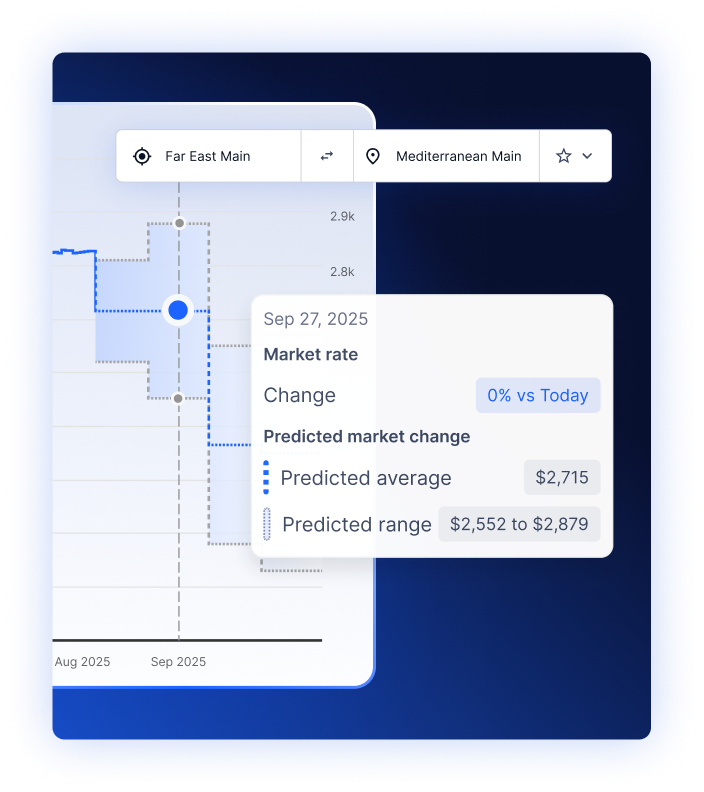
Current and future contracted rates booked to 3 months ahead and 10 days for spot rates, and market rate outlooks for key trades, up to 6 months.
700 shipper, airline, freight forwarder and specialist data partners.
ISO 27001:2022 accredited for standards on information security.
Xeneta’s large, accurate dataset enables you to:
Data becomes your advantage — not your uncertainty.
Including the world’s top shippers, forwarders, and airlines.
Because accurate data delivers real-world impact.
Our data and insight powers freight coverage in the world’s leading media.

Where does Xeneta's freight rate data come from, and how is it kept accurate?
Xeneta's benchmarks are built from real contracted and spot freight rates contributed on an anonymized basis by thousands of shippers and forwarders globally. Contributors upload their actual negotiated contract rates across a range of agreement types, from short-term spot bookings through to multi-year fixed contracts, creating a dataset that reflects what the market is genuinely paying rather than indicative or estimated price levels.
Before any benchmark is published, Xeneta requires a minimum of five rates per route, per day, per equipment type. On mature trade routes with extensive data collection, benchmarks are built from several hundred valid rates per day. This threshold approach means Xeneta only publishes a benchmark when there is sufficient data to make it statistically meaningful, and confidence increases as more data accumulates on a given lane.
How is the market average, market low, and market high calculated from Xeneta's dataset?
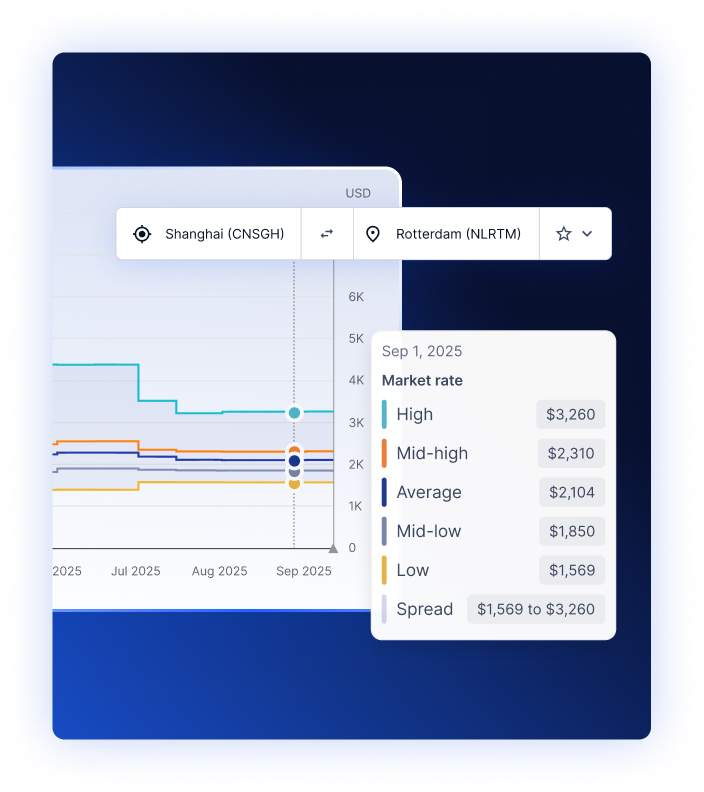
Xeneta's three core benchmarking metrics give procurement teams a view of the full distribution of market rates, not just a single average figure. The market average is the arithmetic mean of all contributed rates valid on a given trade lane on a particular day. The market low represents rates at the 2.5th percentile of the market, reflecting what the most competitively positioned shippers are achieving. The market high represents rates at the 97.5th percentile, indicating the upper range of what the market is paying.
Together, these three reference points allow procurement teams to understand not just where the average sits, but the realistic floor of what is achievable with strong negotiating leverage, and the ceiling that signals significant overpayment relative to peers. Knowing where your contracted rates sit across this distribution is the starting point for every meaningful renegotiation conversation.
How does Xeneta protect the confidentiality of contributed rate data?
Data confidentiality is foundational to Xeneta's model. Without it, shippers would not contribute their rates, and the platform would have no data. All contributed rates are fully anonymized and aggregated before they enter the benchmark dataset. No company-specific rates or supplier names are disclosed to other platform users or published to the broader market at any point.
Xeneta's data governance goes further than anonymization alone. Carriers, freight forwarders, and NVOCCs are explicitly prohibited from contributing data to Xeneta's database or to any indices Xeneta publishes. This structural exclusion is what preserves the integrity of the benchmarks: the dataset reflects what shippers pay, not what carriers want the market to believe is being paid. Xeneta is also committed to remaining ownership-neutral, with no carriers, forwarders, or NVOCCs holding or able to hold an ownership stake in the platform.
How does Xeneta's dataset differ from publicly available freight indices?
Publicly available spot indices track rate movements based on spot market samples and provide useful directional signals about where the market is trending. What they do not reflect is the contracted rates that shippers with volume and negotiating leverage are actually paying under long-term agreements, which is a fundamentally different number and the one that matters for procurement.
Xeneta's dataset aggregates real contracted rates, the rates that appear on actual invoices across short-term, annual, and multi-year agreements. Benchmarks cover port-to-port FCL rates including all ocean freight related surcharges such as BAF, LSS, PSS, PCS, CAF, and ISPS, while excluding inland costs and non-ocean surcharges that would make like-for-like comparison unreliable. This surcharge-inclusive, port-to-port definition ensures that when you compare your contracted rate against Xeneta's benchmark, you are comparing equivalent cost components rather than mixing different rate constructions. Find out more about Xeneta's data and methodology.
How does Xeneta ensure benchmark accuracy across a wide range of trade lanes and geographies?
Xeneta's geographic coverage is built around a geo-hierarchy developed to reflect how the freight industry actually prices different connections rather than simply grouping ports by physical proximity. Ports are grouped based on price correlation, validated using the millions of rate data points in Xeneta's database, which means benchmarks reflect genuine market pricing relationships rather than arbitrary geographic clusters.
On the highest-volume trade lanes, such as Asia to North Europe and Transpacific corridors, benchmarks are supported by the deepest statistical pools and carry the strongest confidence. Coverage extends to Latin America, Africa, the Middle East, and intra-Asian trades, with data depth varying by lane. Xeneta is transparent about confidence levels for each benchmark, allowing users to assess how many data points underpin a given rate reference before relying on it in a high-stakes negotiation. Find out more about Xeneta's data and methodology.