Xeneta for Manufacturers
Build a More Resilient Manufacturing Supply Chain
Get the real-time ocean and air freight intelligence you need to control costs, protect margins, and keep production running.
Trusted by the world's biggest manufacturers
The CHallenge
Volatility, long lead times, and rising costs are straining manufacturing supply chains
With global disruptions reshaping trade patterns, manufacturers face shifting routes, inconsistent service levels, and mounting margin risk—making visibility and control essential across every lane.
Unreliable transit times disrupt production schedules
Volatility creates margin uncertainty and planning challenges
Inconsistent freight costs make budget accuracy and cost control difficult
Get the visibility to assess carrier reliability, compare service levels, and allocate volumes confidently, long before disruptions threaten delivery timelines.
Why Xeneta
Built to keep production moving and deliveries on schedule
Xeneta gives you real-time freight rate benchmarks and carier reliability data, helping you choose dependable partners, manage delays proactively, and keep critical components and finished goods moving on time.
700m+
170k+
60k+
Use cases
What manufacturers can do with Xeneta
Secure reliable capacity and stay ahead of delays with real-time freight intelligence.
5 out of the top 10 manufacturers in the world use Xeneta to optimize their freight.
“Without the platform, we’d be blind going into the market. Xeneta helps us negotiate better and track savings in the range of 3-5% which accounts for a multi-million-dollar spend when you consider our scale.” businesses"
David Lenaers, Global Director of Logistics Sourcing, Stanley Black & decker
Customer Story
Discover how Stanley Black & Decker saved millions in freight costs with Xeneta.
Find out more about our solutions
One platform, two modes. Discover all you need to know about our Ocean and Air offering.
Ocean
Air
Frequently asked questions
How does Xeneta help manufacturers know whether their forwarder or 3PL rates are actually competitive?
Many manufacturers rely on a 3PL or freight forwarder to manage their ocean and air freight, which means the rate they see is the rate their provider chose to offer them. Without an independent benchmark, there is no way to know whether that rate reflects the market or simply the margin their provider wanted to protect.
Xeneta gives manufacturing procurement teams a lane-level market reference built from contracted rates actually paid by thousands of shippers, so when a forwarder quotes a rate for a lane, you can see immediately where it sits relative to what comparable shippers are paying. This is not about replacing the forwarder relationship, it's about entering every conversation with the data to validate their pricing and push back where the gap is material. Find out more about Xeneta's ocean and air freight benchmarks.
How does Xeneta support procurement centralization across multi-site manufacturing groups?
Many manufacturing groups are transitioning from decentralized procurement, where regional plants manage their own freight independently, to a centralized model that leverages group volume for better rates and standardized processes. Without a common benchmarking framework, it is impossible to assess whether freight costs across plants and regions are competitive or identify where consolidation would generate leverage.
Xeneta provides a single, objective market reference that allows headquarters to compare freight performance across the entire network, identify where regional procurement is generating above-market costs, and build the evidence base for centralization decisions. Once centralization is in place, the platform gives central procurement teams the ongoing monitoring capability to track regional performance and maintain group standards across every lane. Learn more about network and supplier strategy with Xeneta.
How does Xeneta help manufacturers manage both ocean and air freight across the same supply chain?
Manufacturing supply chains often use a mix of ocean for regular planned volumes and air for urgent replenishment, expedited components, or time-sensitive finished goods. Managing both effectively requires understanding not just the rate on each mode, but where the market is moving and when a mode shift makes commercial sense.
Xeneta covers both ocean and air freight in a single platform, with benchmarks, trend data, and market outlooks across both modes. This allows manufacturing procurement teams to model the cost differential between modes on specific lanes, monitor whether air rates are softening enough to reduce the premium of emergency shipments, and make mode decisions with market data rather than forwarder quotes as the reference point.
How do manufacturers build the internal business case for freight intelligence investment?
In manufacturing organizations under cost pressure, every procurement tool needs to demonstrate a return that is concrete and quantifiable, not theoretical. The challenge is that without access to the platform, it is hard to know exactly how much above market your current rates are.
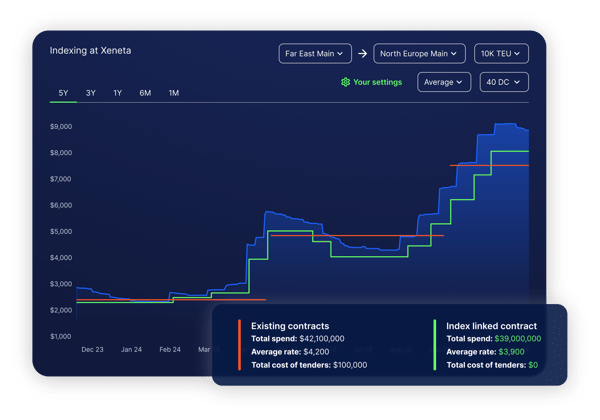
Xeneta addresses this through a pre-purchase lane analysis, where your contracted rates are compared against current market benchmarks on a representative sample of lanes to identify specific savings opportunities before any commitment is made. For a manufacturer spending $20M annually on ocean freight, a 3 to 5 percent improvement in contracted rates through benchmark-informed negotiation generates $600,000 to $1M in savings, typically several times the annual platform cost. Stanley Black and Decker, with over $100M in annual logistics spend, consistently track savings in the range of 3 to 5 percent using Xeneta. Read their case study.
How does Xeneta help manufacturers monitor carrier reliability and manage supply chain risk before it disrupts production?
For manufacturers, a freight delay is rarely just a logistics problem. A late component shipment can halt a production line, push back a customer delivery, and trigger penalty clauses, all at a cost that dwarfs the freight rate itself. The risk is not just that rates are uncompetitive, it is that the carriers moving critical components are not performing to the service levels that the production schedule depends on.
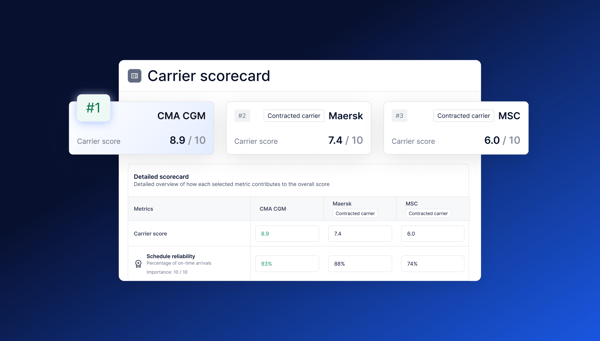
Xeneta's Carrier Scorecard gives manufacturing procurement and supply chain teams continuous visibility into carrier performance by trade lane, covering schedule reliability, blank sailing frequency, and actual versus announced transit times. When a carrier's reliability starts to deteriorate on a lane feeding a production site, that signal is visible in Xeneta before it has already caused an operational failure, giving teams time to reallocate volume, engage a backup carrier, or flag the risk to planning teams before it becomes a crisis.
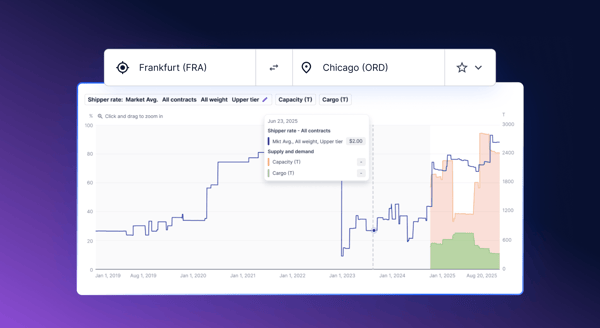
Alongside carrier performance, Xeneta's market monitoring capability tracks capacity signals and rate movements that often precede service disruptions. Sudden rate spikes on key inbound lanes, sharp increases in blank sailing rates, or capacity tightening on specific trade corridors are all early indicators that service levels may be about to deteriorate. For manufacturers managing lean inventory buffers or just-in-time production schedules, having these signals in advance is the difference between a proactive response and an unplanned production stoppage.