
See how Nestlé cut manual work, compressed tender cycles, and elevated procurement decisions with real‑time data
Trusted by the world's biggest buyers & sellers of ocean and air freight

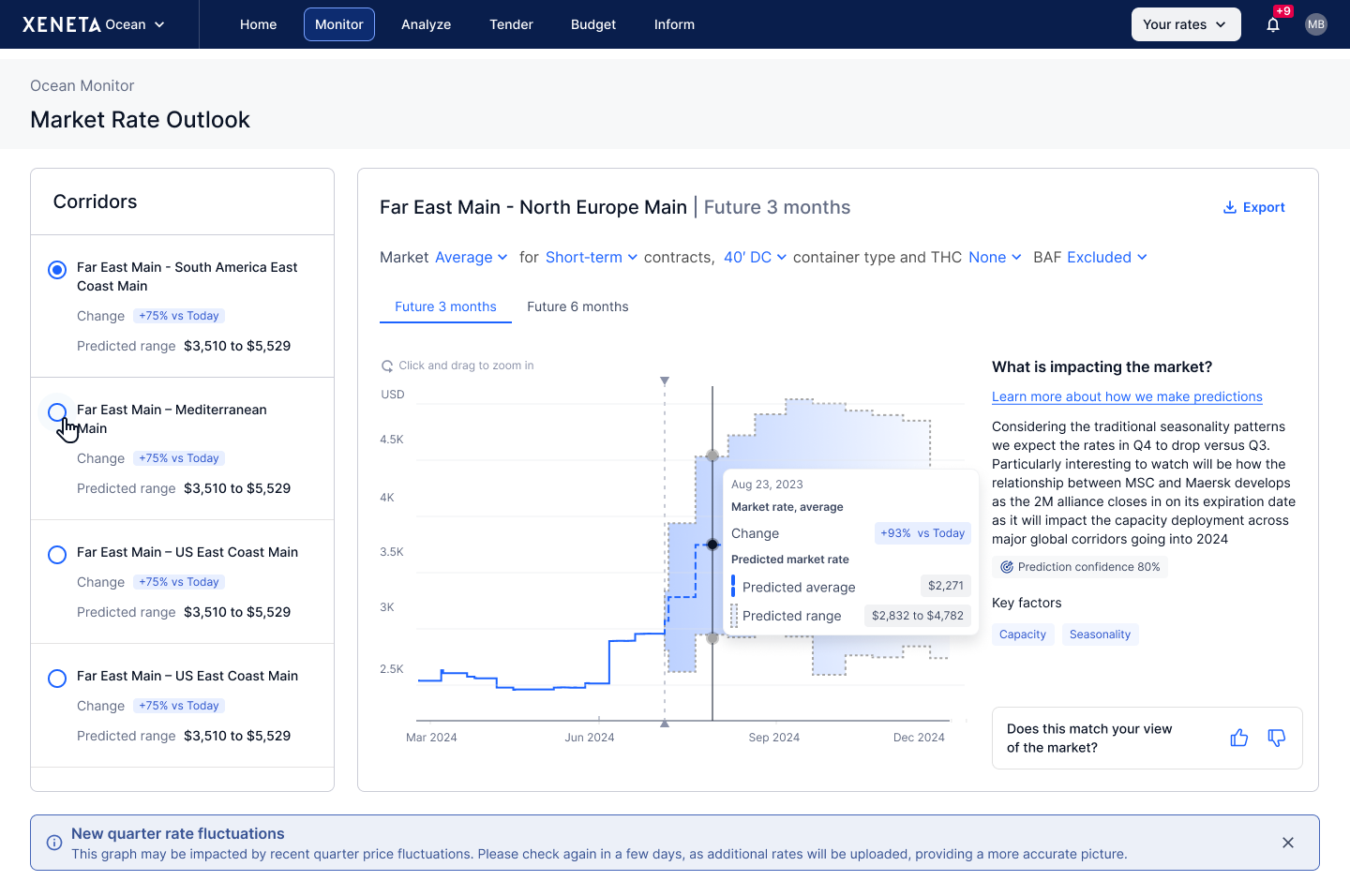
Detect early signals of cost spikes, capacity tightening, and declining carrier reliability.
Use predictive market movements and risk indicators to negotiate at the right moment.
Track priority and long-tail lanes with watchlists, alerts, and AI-driven anomaly detection.
Surface reliability issues and misaligned performance before they impact service or spend.
Maintain continuous oversight to safeguard cost stability and operational performance.
One platform, two modes. Discover all you need to know about our Ocean and Air offering.
How do I monitor freight market developments without spending hours tracking news and indices?
Manual market monitoring means aggregating carrier bulletins, published indices, industry news, and forwarder updates, none of which tell you whether your specific contracted lanes are actually at risk.
Xeneta focuses the monitoring on what matters to your portfolio: tracking the rate gap between your contracts and the live market, alerting you when specific lanes are diverging, and surfacing opportunities and anomalies across your network through AI Agents that analyze freight data continuously.
The Spend Optimization Agent identifies saving opportunities across high-spend corridors, the Supplier Optimization Agent compares suppliers on cost, reliability, and capacity, and the Capacity Planning Agent helps allocate volume dynamically based on real-time trade capacity. Rather than manually tracking thousands of lanes, your team gets the signals that matter with recommended next steps already surfaced.
How does Xeneta help during major supply chain disruptions like geopolitical events or rerouting?
Major disruptions such as Red Sea rerouting cause rapid and significant rate movements on affected trade lanes. Understanding whether your contracted rates remain competitive in a disrupted market requires real-time data, not published indices that lag actual conditions.
Xeneta aggregates contributed rate data continuously, meaning benchmarks reflect what shippers are actually paying in response to new market realities. During disruption events, this live view is essential for assessing contract exposure, identifying which lanes carry the most risk, and deciding whether and how to renegotiate before cost impact hits the P&L.
How do I know when to renegotiate mid-cycle rather than wait for the next tender?
Three signals suggest mid-cycle renegotiation is warranted. First, when contracted rates are significantly above the current market average on key lanes. Second, when spot rates have fallen substantially below your long-term contract rate, indicating conditions have shifted in your favor. Third, when a carrier's service performance has deteriorated to the point where the contracted rate no longer reflects the value being delivered.
Xeneta also helps you separate market-driven cost increases from contract-specific underperformance. By comparing your rate trajectory against the market on the same lanes, you can determine how much of a cost increase is unavoidable versus addressable. This distinction matters both for the renegotiation conversation with carriers and for reporting internally.
How does Xeneta help protect freight budgets from unexpected cost spikes?
Continuous benchmarking shows in real time whether contracted rates remain competitive, while rate trend data and predictive market signals give advance notice of conditions that could put budget assumptions at risk.
For procurement teams required to report on supply chain risk to senior leadership, Xeneta provides the external data foundation needed to quantify and communicate freight rate exposure, moving the conversation from subjective concern to evidence-based risk assessment.
Can Xeneta flag underperforming suppliers before they impact operations?
Yes. Xeneta surfaces carrier and forwarder reliability data alongside rate benchmarks, meaning you can identify performance issues such as declining reliability rates, increasing transit time variances, or blank sailing patterns before they create operational problems.
A carrier pricing above market on a lane where a credible alternative exists, or one whose reliability is declining while rates hold firm, is both a commercial and operational risk. Xeneta makes this visible continuously, giving supply chain teams the evidence to act before a performance issue becomes a service failure or an unplanned cost.