

Our Dataset
Xeneta Ocean Freight Transit Times Data
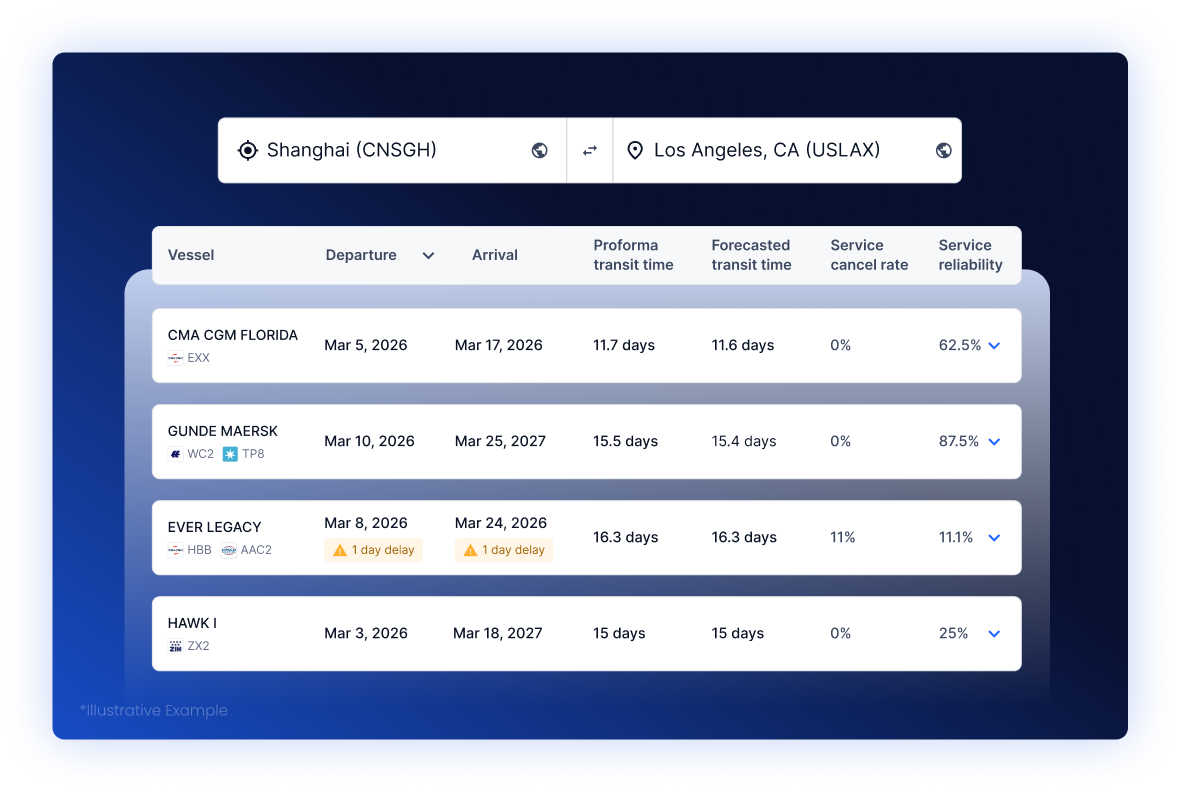
Compare carrier-announced, port-to-port transit times, with actual vessel performance, using tracking data at a port-to-port, service, and vessel level, to reveal accurate transit time gaps.
Xeneta, trusted by the world's biggest buyers & sellers of containerized and air freight
Much of the transit data available today is based on carrier-published or advertised schedules. These show the plan, not what actually happened.
Xeneta brings both into view: the announced transit time and the actual transit time based on vessel movements over the past 30 days—putting real service performance on the table and exposing where promises meet reality.
Ocean Freight Data at Scale
What make Xeneta’s Transit Times Data Unique
2 views
Announced + actual
See carrier-announced transit times alongside actual transit times as well as real-time delays.
400+
Detailed corridors
Port-to-port reliability, not just trade-lane averages.
Vessel-level
DATA
Based on terrestrial and satellite AIS data, tracking 10,000+ vessels and 50,000+ arrivals per month.
XENETA TRANSIT TIMES DATA
What's in the dataset
The transit time is the port-to-port travel time of a container, from origin to destination. Xeneta provides two views: announced and actual.
Announced transit times are based on the carrier-published schedule and reflects planned services. Actual transit time is based on actual vessel movements, tracked in real time using AIS tracking data, calculated on a 30-day rolling window to reflect current conditions.

Use Case Scenarios
When you'll use this data
Market monitoring & risk management
Track actual transit times on your lanes to spot when performance starts to drift from what was announced. This helps you understand where delays are building and how they may impact your supply chain.
Sourcing & tendering
Use announced transit times to compare services side by side during tenders, then validate carrier claims against actual vessel performance. Combine this with rate data to evaluate options based on both price and reliability.
Measure carrier & LSP performance
Compare what a carrier promised to what their vessels actually deliver, alongside your rates and carrier rates. This gives you a clear, objective view of performance and the trade-off between cost and reliability—helping you make better carrier allocation decisions.
Sources & data processing
How the data is collected
Xeneta’s transit times data is based on neutral vessel movements, derived from data (AIS) and carrier-published proforma schedules, validated across multiple sources to deliver an independent view of on-time performance—made possible by the 2025 acquisition of eeSea, now part of Xeneta.
Our data standards
Trusted & Certified
Xeneta's data is built on enterprise-grade security, privacy, and independence — trusted by the world's largest shippers and quoted by leading global news outlets.
Frequently asked questions
The most common questions we hear from procurement, supply chain, and freight forwarding teams evaluating Xeneta.
What's the difference between announced and actual transit time?
Announced transit time is the planned port-to-port travel time from the carrier's originally published schedule. Actual transit time is the 30-day rolling average of real vessel transit times on the same port pair, calculated from AIS arrival and departure data. Announced tells you the plan. Actual tells you what's really happening.
Why does actual transit time sometimes look very different from announced?
Vessels run faster or slower depending on weather, port congestion, bunker economics, and how laden ships are. Blank sailings and rerouting also shift actual transit. On some lanes the gap between announced and actual is small and stable; on others — especially during disruption — it can be significant. That gap is the point of showing both.
Where does the data come from?
Xeneta’s transit time data is based on neutral vessel movement data from terrestrial and satellite AIS, combined with carrier-published proforma schedules. Announced transit times reflect the original schedule, while actual transit times are calculated from real vessel arrivals and departures—providing an independent view of performance.
How often do transit times update?
Actual transit time updates continuously on a 30-day rolling window, reflecting recent vessel movements. Announced transit time only changes when the carrier redesigns the entire service — for example, a new port rotation — so it stays stable enough to be used as a baseline.