See how Nestlé cut manual work, compressed tender cycles, and elevated procurement decisions with real‑time data
Ensure compliance, safeguard lead times, and respond to market shifts with the reliable data your pharma logistics demand.
Trusted by the leaders in Pharma
Use real-time market intelligence to secure reliable logistics partners, mitigate disruption risks, and ensure life-critical products reach patients on time, without compromising cost, compliance, or cold chain requirements.
Xeneta gives pharma logistics and procurement teams the data clarity to benchmark rates, evaluate carrier reliability, and anticipate risks, so temperature-sensitive and time-critical products move safely, compliantly, and on schedule.
Secure reliable capacity and stay ahead of delays with real-time freight intelligence.
Sebastian Wagner, Regional Category Buyer, Ineos Styrolution
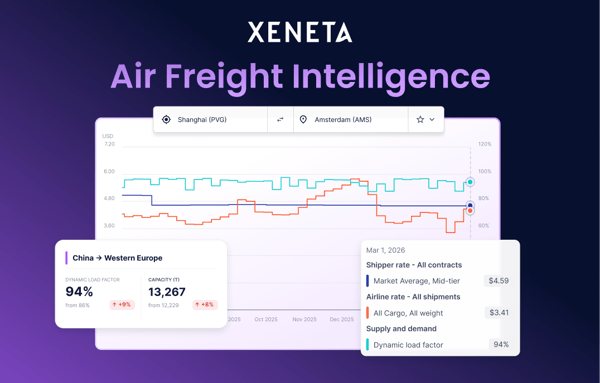
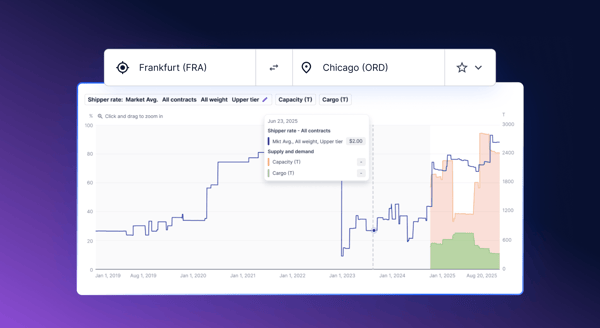
One platform, two modes. Discover all you need to know about our Ocean and Air offering.
How does Xeneta help pharma teams evaluate logistics service providers on service and cost without relying on self-reported metrics?
In pharma logistics, a service provider that delivers poor reliability creates regulatory and commercial consequences far more costly than any freight rate saving. Temperature excursions, documentation errors, and late shipments can affect clinical trials, product launches, and patient supply. Yet carrier selection processes that rely on self-reported performance metrics or references provided by the carrier themselves give procurement teams limited ability to challenge what they are being told.
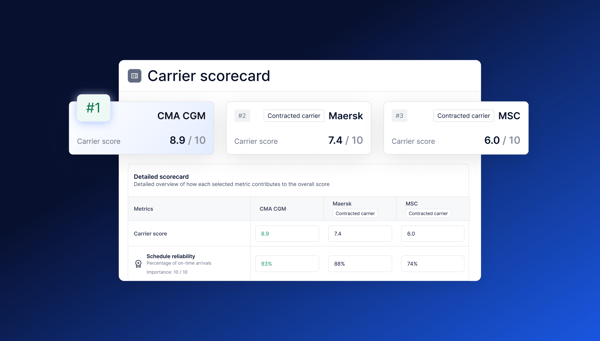
Xeneta's Carrier Scorecard brings independent rate benchmarks and carrier performance data together in one view, covering schedule reliability, transit time consistency, and blank sailing frequency by trade lane. This gives pharma procurement teams an objective basis for evaluating logistics service providers on both cost and service quality, and for weighting service performance appropriately in supplier selection rather than defaulting to lowest bid. Learn more about evaluating supplier performance with Xeneta.
How does Xeneta help pharma companies manage carrier reliability risk?
In pharma logistics, the consequences of a carrier failure go beyond operational disruption. A delayed or mishandled shipment can affect patient supply, compromise a clinical trial timeline, or trigger regulatory consequences that no rate saving could offset. When service level is genuinely non-negotiable, the question is not just whether a carrier is compliant on paper, it is whether their actual operational track record justifies the volume you are putting with them.
Xeneta gives pharma procurement and supply chain teams continuous, independent visibility into how carriers are actually performing on specific trade lanes, covering schedule reliability rates, blank sailing frequency, and actual versus announced transit times. This matters both at the point of carrier selection and throughout the contract period. A carrier whose reliability starts to deteriorate on a lane carrying temperature-sensitive or time-critical product is a risk that needs to be visible before it has already caused a supply failure, not after.
Xeneta's Carrier Scorecard allows teams to weight performance metrics according to what matters most for pharma supply chains, prioritizing schedule adherence and transit consistency over cost where the cargo demands it. Combined with market monitoring that tracks capacity signals and blank sailing patterns on key lanes, this gives pharma logistics teams the early warning capability to reallocate volume or engage backup carriers before a reliability issue becomes a supply chain crisis.
With compliance requirements limiting my carrier options, how does Xeneta still deliver value?
When GDP compliance, temperature control requirements, and documentation standards narrow your carrier pool, the traditional levers of competitive tendering become less effective. You cannot simply threaten to move volume to a new provider if the shortlist of compliant carriers is already short. Carriers in this position know it, and they price accordingly.
Xeneta delivers value precisely in this situation. Even within a constrained carrier pool, independent benchmarks show where rates on your specific lanes sit relative to what other pharma shippers are paying for comparable compliant services. That data shifts the negotiation from a conversation where the carrier holds most of the cards to one where you have an objective, third-party reference that is difficult to dismiss. The carrier may have leverage on availability, but Xeneta removes their leverage on market knowledge.
Beyond rate negotiation, Xeneta's Carrier Scorecard gives you the performance data to hold existing carriers accountable within the relationship, and to make volume allocation decisions across your compliant carrier pool based on who is actually delivering rather than who is simply on the approved list. Find out more about Xeneta's ocean and air freight benchmarks.
How does Xeneta help pharma procurement teams justify freight costs to finance when rates are higher than the general market?
Pharma procurement teams regularly face finance scrutiny over freight rates that appear higher than general market benchmarks. The challenge is communicating the full context, GDP compliance requirements, cold chain limitations, restricted carrier pools, in a way that satisfies leadership without independent data to back it up.
Xeneta gives procurement teams the evidence to have that conversation on solid ground. Where a premium is genuinely justified by the market for compliant services, Xeneta's benchmarks confirm it. Where the premium goes beyond what the market supports, they identify it. Either way, the conversation with finance moves from a subjective defense of costs to a data-backed explanation that demonstrates the procurement team understands exactly what they are paying and why. Learn more about forecasting and budget planning with Xeneta.
How does Xeneta support pharma companies evaluating China-plus-one or nearshoring strategies?
Many pharma companies are actively evaluating supply chain restructuring, from China-plus-one sourcing to nearshoring active pharma ingredient production, driven by resilience concerns and geopolitical risk. Each option carries different freight economics, and the difference between a strategy that works commercially and one that does not often comes down to whether the freight cost assumptions were grounded in market reality or a single carrier quote.
Xeneta provides lane-level benchmarks across a wide range of trade corridors, including emerging sourcing origins in Asia, Eastern Europe, and Latin America, giving pharma procurement teams market-validated rate data to model total landed cost before committing to a sourcing shift. This is particularly relevant when evaluating routes where independent rate data is harder to find and carrier pricing power is correspondingly higher. Learn more about network and supplier strategy with Xeneta.