
Our Dataset
Xeneta Detention & Demurrage Data
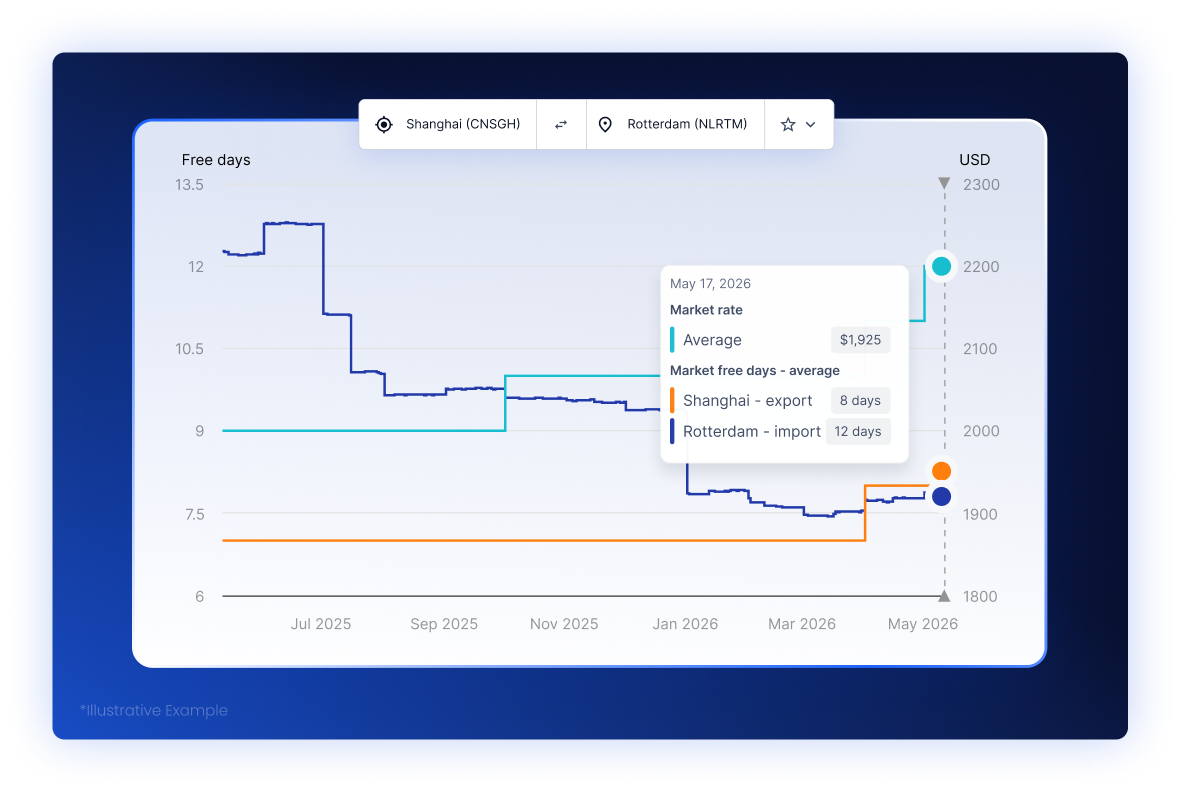
See free days at origin and destination ports from actual negotiated contracts — so you know what other shippers have secured, not just what carriers publish.
Xeneta, trusted by the world's biggest buyers & sellers of containerized and air freight
When ports congest, equipment shortages hit, or customs delays stack up, free days are the buffer between an on-time shipment and a surprise invoice. But there's limited visibility into how peers negotiated them. Carrier tariffs show the published figures, not what was actually secured.
Xeneta shows what other shippers have negotiated, so you know which ports have shorter allowances, which carriers offer above average, and where your free-day clauses are not in line with the market.
XENETA DETENTION & DEMURRAGE DATA
What's in the dataset
Free days are the calendar days a container can sit at port (demurrage) or stay out with a consignee (detention) under the contract terms before charges accrue. Xeneta benchmarks the free days peers have contracted — separately for demurrage, detention, and combined pools — sourced directly from shipper contracts and freight forwarder agreements..

Use Case Scenarios
When you'll use this data
Sourcing & tendering
Going into a tender without peer visibility on free days means negotiating from the carrier's published tariff. See what the market is actually securing, by port and container type, and use it to assess carrier bids.
Benchmark rates vs market & market monitoring
Your contracted free-day clauses are part of your total cost position, not separate from it. See where yours sit against the market — high, average, or low — and track how terms are moving so you're not caught off guard when your next renewal lands in a tighter market.
Measure carrier & LSP performance
Carriers set very different free-day terms on the same lane. Compare them with rate and reliability data so decisions rest on evidence, not relationships.
Sources & data processing
How the data is collected
Xeneta’s data is sourced in partnership with our customers, including some of the world’s largest shippers and freight forwarders, drawn from actual contracts that we validate and enrich to deliver an accurate, independent view of the market.
Our data standards
Trusted & Certified
Xeneta's data is built on enterprise-grade security, privacy, and independence — trusted by the world's largest shippers and quoted by leading global news outlets.
Frequently asked questions
The most common questions we hear from procurement, supply chain, and freight forwarding teams evaluating Xeneta.
How does Xeneta calculate free days for a specific port?
We average the free-day clauses across all valid contracts on a given lane and container type, then publish market high, average, and low numbers. If port-level data volumes don’t meet data quality required standards, you'll see the closest regional average instead.
How do Xeneta's free-day benchmarks compare to carrier-published free days?
Carrier-published free days are the standard allowance stated in the carrier's tariff. Xeneta shows what shippers and forwarders negotiated into their contracts. The gap between the two is where peer benchmarking creates negotiation leverage that the tariff alone can't.
How do you handle combined demurrage + detention allowances?
Some shippers negotiate a single pool of free days usable for either. Xeneta shows those as they were negotiated — we never combine demurrage and detention into a synthetic combined figure.
What's a typical number of free days?
There's no single industry-standard figure — free days vary significantly by trade lane, port, container type, volume commitment, and market conditions. Destination and origin free days are usually negotiated separately, and longer contracts or higher volumes typically unlock more days. Xeneta's benchmarks show the market high, average, and low for each corridor, so you can see what peers are securing by lane