

The numbers tell the story. Spot rates from the Far East to the US West Coast are up 343% in October compared with 28 February, the day before the Middle East crisis began. That is just 14% short of the all-time high set in 2022 during the pandemic era spike. Every major fronthaul out of the Far East, to North Europe, the Mediterranean and the US East Coast, has seen triple-digit spot rate increases during 2026.
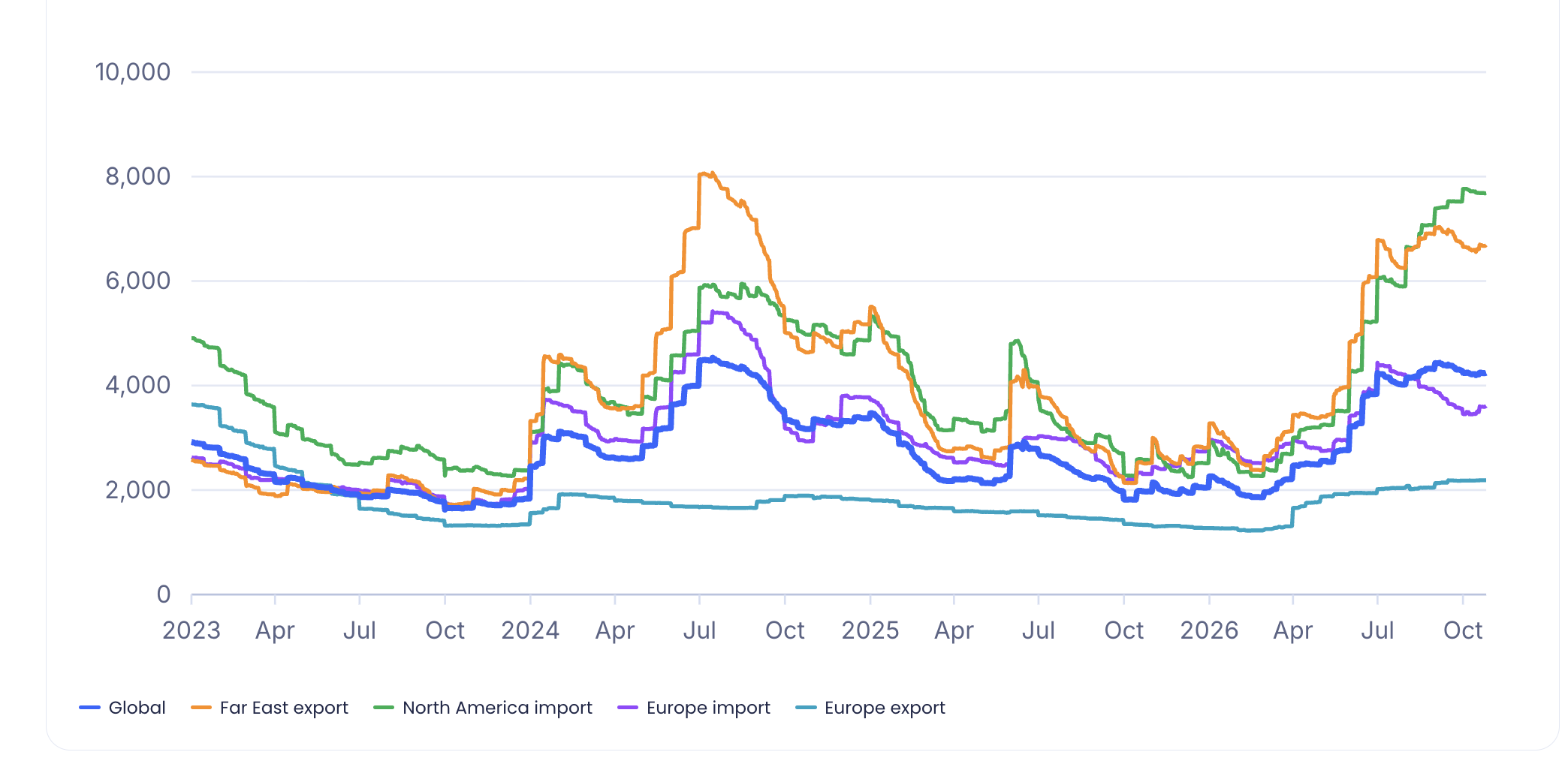
Source: Xeneta
Shippers did not only pay more in the wake of the Middle East crisis. They waited longer, or did not receive their cargo at all. Global on-time arrivals fell to 27% in Q3 2026, with the average delayed container arriving six days late.
So what does 2027 look like? The Xeneta Ocean Outlook 2027 forecasts global average spot rates to fall 30% and long-term contract rates to fall 5% across the full year, measured against a Q3 2026 baseline. The fundamentals point down. The question is whether something else gets in the way again.
The case for softening rates in 2027
A forecast for softer rates rests on supply outrunning demand. Xeneta expects the global container fleet to grow 6.8% in 2027, with 2.9m TEU of new capacity arriving against 0.5m TEU scrapped. Demand will grow 2.5% to 4%. That gap is wide enough to loosen the market on its own.
The demand number needs context. Volumes grew 4.7% in the first eight months of 2026, but much of that was frontloading. Shippers pulled cargo forward to beat fuel surcharges and the risk of further disruption. Far East to US volumes rose 11% in August while inflation-adjusted US retail sales grew 1.9%. That gap will close. Expect a slow start to 2027 as summer inventories are drawn down, followed by a weaker peak season.
Supply gets a second boost from the Red Sea. Weekly capacity crossing the Red Sea reached 467,297 TEU in October, half the level seen before the crisis began in 2023. Shorter Suez loops need fewer ships, and 599,000 TEU of nominal capacity has already been released back into the global fleet in 2026. More will follow in the first half of 2027 as carriers convert one-way strings into full loops.
One structural shift works in carriers' favour. Growth is concentrated on fronthaul trades, where a container earns far more than on the return leg. Fronthaul volumes are up 37% on 2019 while backhaul volumes are down 8%. China now exports six containers for every laden container it imports, up from 3.3 in 2019. This imbalance absorbs capacity and will hold up rates on the busiest lanes even as the global average falls.
The risks that override the fundamentals
Xeneta has named "the unknown" as a key risk in every Ocean Outlook since 2024. Each year it arrived. A forecast built on supply and demand is the right starting point, but recent history shows how quickly a single event overpowers it.
The known risks for 2027 start with fuel. Singapore high sulphur bunker prices are up 107% since 27 February. Carriers passed that on, and the average fuel surcharge on long-term contracts across the four major Far East trades rose 42% to USD 820 per FEU. If fuel prices ease in 2027, shippers need to check that surcharges fall with them.
The Gulf remains closed to most container traffic. Before the conflict, 99 services called at Arabian Gulf ports. Jebel Ali went from 423,000 TEU of weekly arrivals to 9,000. Even if the Strait of Hormuz reopens, carriers will keep their footholds in Jeddah, Khor Fakkan and Sohar rather than return in full.
Tariffs have gone quiet without going away. US imports from China are down 9% on 2024 while imports from South East Asia are up 31%. Shippers moved their sourcing rather than cutting volumes, and sector-specific tariffs will keep them on alert through 2027.
Then there is the Panama Canal. El Niño puts water levels back on watch for the dry season at the start of 2027. Some carriers are already charging Panama surcharges despite minimal restrictions.
Reliability will improve, but check what sits behind the number
Global on-time arrivals ended Q3 2026 at 27%, with Far East to Europe falling to 4% in September after four typhoons closed Chinese ports in quick succession. Xeneta expects a rebound in the first half of 2027 as new ships arrive and demand softens, but with a ceiling of around 40%.
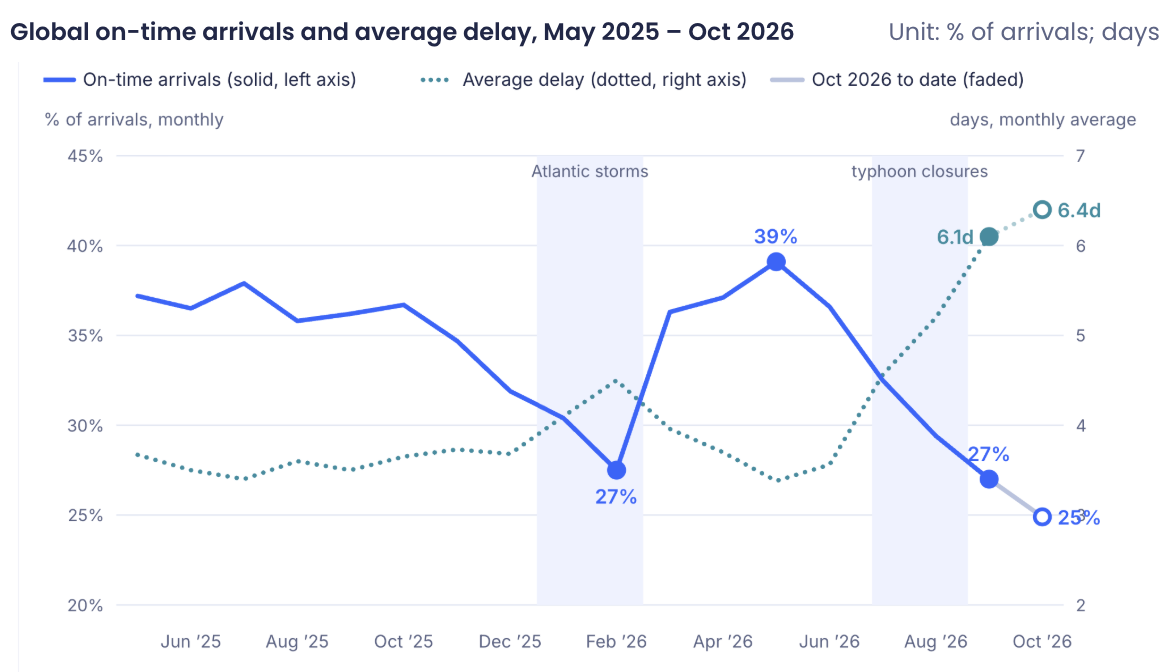
The quality of that rebound matters as much as its size. Carriers can lift on-time percentages by blanking sailings or padding published transit times. In Q2 2026, China to US West Coast sailings arrived almost four days ahead of schedule. A better on-time number achieved through fewer sailings is not a more reliable service.
Gemini Cooperation will keep its reliability lead in 2027, but by a narrower margin. Its on-time rate fell from 70% in June to 40% in September, and it now sits 4 percentage points ahead of non-alliance services. A premium that has fallen this far will be harder to defend in 2027 tenders.
What this means for your freight
A 30% fall in the global spot average is not a 30% fall on your lanes. The right forecast for your business depends on which corridors you ship, whether you sit on a fronthaul or a backhaul, how exposed you are to Gulf routing, and how your contracts handle fuel surcharges and routing changes. The six themes in the full report, from fleet composition by trade lane to carrier-level reliability, were written to answer those questions, and they land differently for every shipper.
The analysts behind the Outlook, including myself, Emily Stausbøll and Destine Ozuygur, have one piece of advice for 2027: use data and intelligence to assess risk continuously, in calm periods and in crises. Market intelligence means you negotiate from a stronger position and understand the context you are operating in.
This article is the short version. The full Ocean Outlook 2027 (available in IQ Hub for Xeneta customers) covers six themes in depth, with lane-by-lane rate forecasts, fleet and capacity analysis by trade, chokepoint scenarios and carrier-level reliability data. It is not published openly. Our commercial team walks shippers through it one to one, mapping the forecasts against your trade lanes, your contracts and your 2027 tender timeline.