

Contracted freight rates are not just a procurement asset. The moment a tender closes, those rates become operational data: used by logistics teams to make routing decisions, by finance to validate invoices, and by procurement to track what was agreed versus what is being charged. The problem is that most organizations store rates in a format built for one person, not three teams.
Who needs the rates, and when
Procurement negotiates the rates and owns the master file. But they are rarely the only ones who need it.
Logistics teams need current rates to compare routing options and make cost-effective decisions on live shipments. Finance needs them to check carrier invoices against contracted prices. And when a carrier submits an amendment, everyone working from a copy of the old file is immediately out of sync.
A logistics manager at a global apparel brand described the goal plainly: "Everybody would have common access to one file, visible to all of them. Nobody needs to maintain it individually." That is the requirement. The reality, for most teams, is a shared folder with multiple versions of the same spreadsheet, each maintained by a different person, each slightly different.
The version problem
When rate data lives in Excel, version control is informal at best. Files get copied, renamed, and emailed. A carrier submits a BAF adjustment, procurement updates their copy, and the logistics team spends the next two weeks making decisions based on the old rates. Nobody knows this is happening until an invoice comes in wrong.
An automotive procurement team raised exactly this concern during an IRM evaluation: "Will it keep track of all the changes that I keep uploading?" In a spreadsheet, the answer is no. Changes overwrite previous data, amendment history is lost, and there is no audit trail if a dispute arises.
At a specialty chemicals company managing index-linked contracts, rate changes are not periodic events, they are continuous. Their assessment: "It's a lot more manual work. Everyone is so used to using Excel." The manual workload is not just the initial data entry. It is the ongoing effort of keeping multiple teams aligned on what the current rates actually are.
What a shared platform changes
When contracted rates are held in a single platform, the version problem disappears. There is one rate record. When a carrier submits an amendment, it gets uploaded once, and every team sees the update. Change history is preserved automatically. If a dispute arises over what rate was in effect on a given date, the answer is in the system.
The access model changes too. Procurement, logistics, and finance all work from the same rate record. When a carrier submits an amendment, it gets uploaded once and every internal team sees the update immediately. There is no coordination overhead, no risk of a colleague making a decision based on last quarter's rates.
A freight forwarder working with multiple shipper accounts captured the underlying logic well: "If everything is good, then it's one source feeding both the rate management side and the benchmark, right?" One source means one version of the truth, available to every team that needs it.
The compounding cost of fragmentation
The cost of fragmented rate data is rarely visible as a line item. It shows up as time: the logistics analyst who spends an hour tracking down the current rate before making a routing decision, the finance team that manually cross-checks invoices against a spreadsheet, the procurement manager who fields calls from forwarders asking which version of the file is current.
A global consumer goods company described their process without prompting: "We are storing all the rates in an Excel file for internal use purposes. Every time a person needs to do the data entry manually and maintain that file." That maintenance burden is distributed invisibly across the organization. It does not appear in any budget. It is just the cost of doing business with a tool that was not designed for the job.
A single platform with controlled access, change tracking, and a clear audit trail does not just reduce that burden. It eliminates the coordination layer that exists only because the data is fragmented in the first place.
It's over for the spreadsheet.
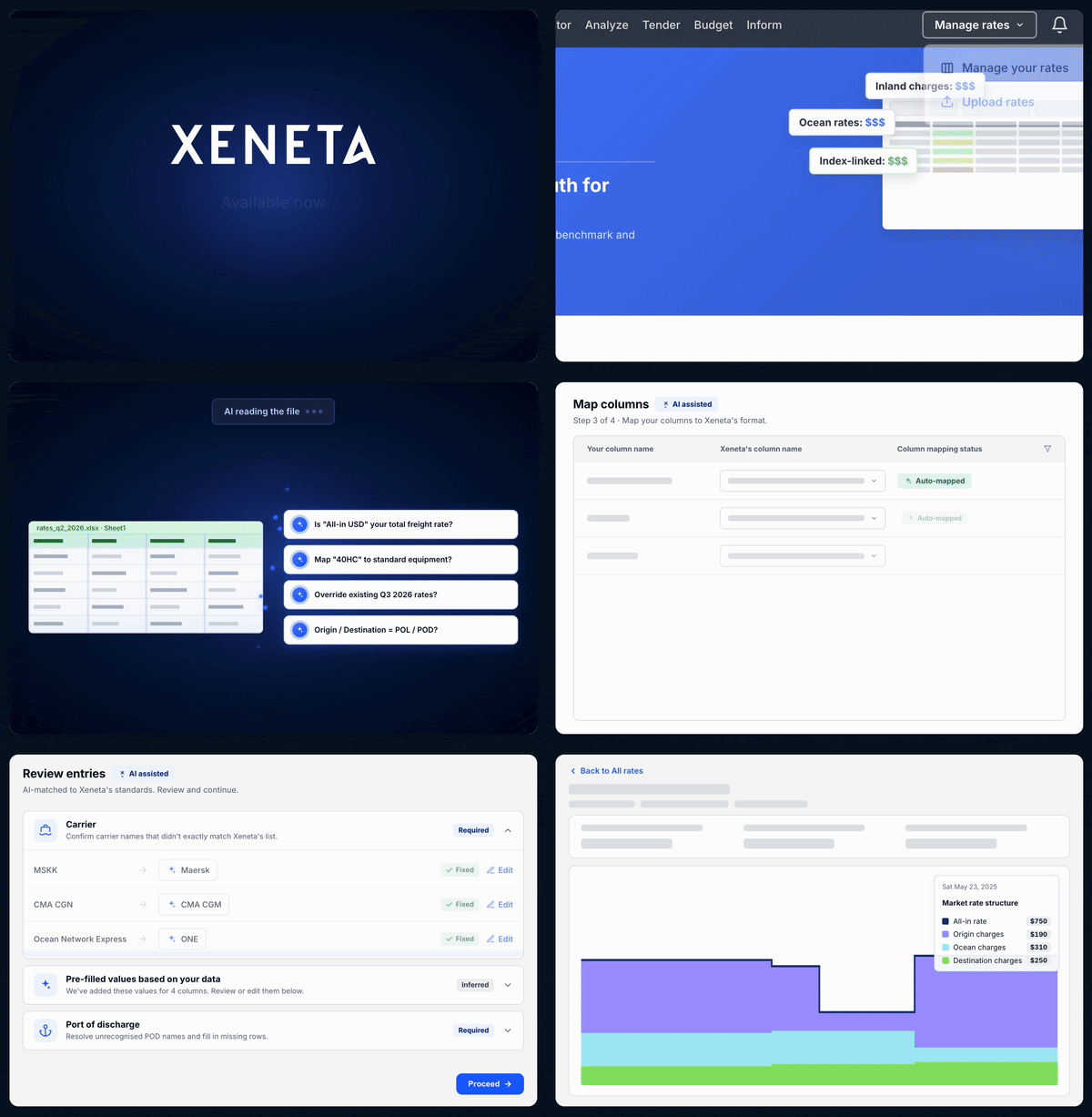
Xeneta's Integrated Rate Management transforms freight rate chaos into one source of truth. Upload your rate sheets, apply surcharge updates in seconds, and benchmark your contracted rates against the market — all in one place, now available in platform.
If your team is still managing rates manually, the market is not waiting for you to catch up.