Surcharges are the most-raised distinctive signal in this segment. Peak-season surcharges, bunker adjustment factors, EU Emissions Trading System costs, all stacking on top of a base rate that was already negotiated across a huge multi-carrier tender. When you're running that many carriers across that many lanes, checking every surcharge line by line against a market reference isn't optional. It's the only way to know whether the tender you just signed is still the tender you're paying.
Price-led growth is over, and the freight category is exposed
FMCG has spent the last few years growing revenue mainly by raising prices, not by selling more.
That's getting harder to do.
Consumers are trading down, private label is winning more of the shelf, and retailers have less patience for absorbing a brand's cost increases the way they used to.
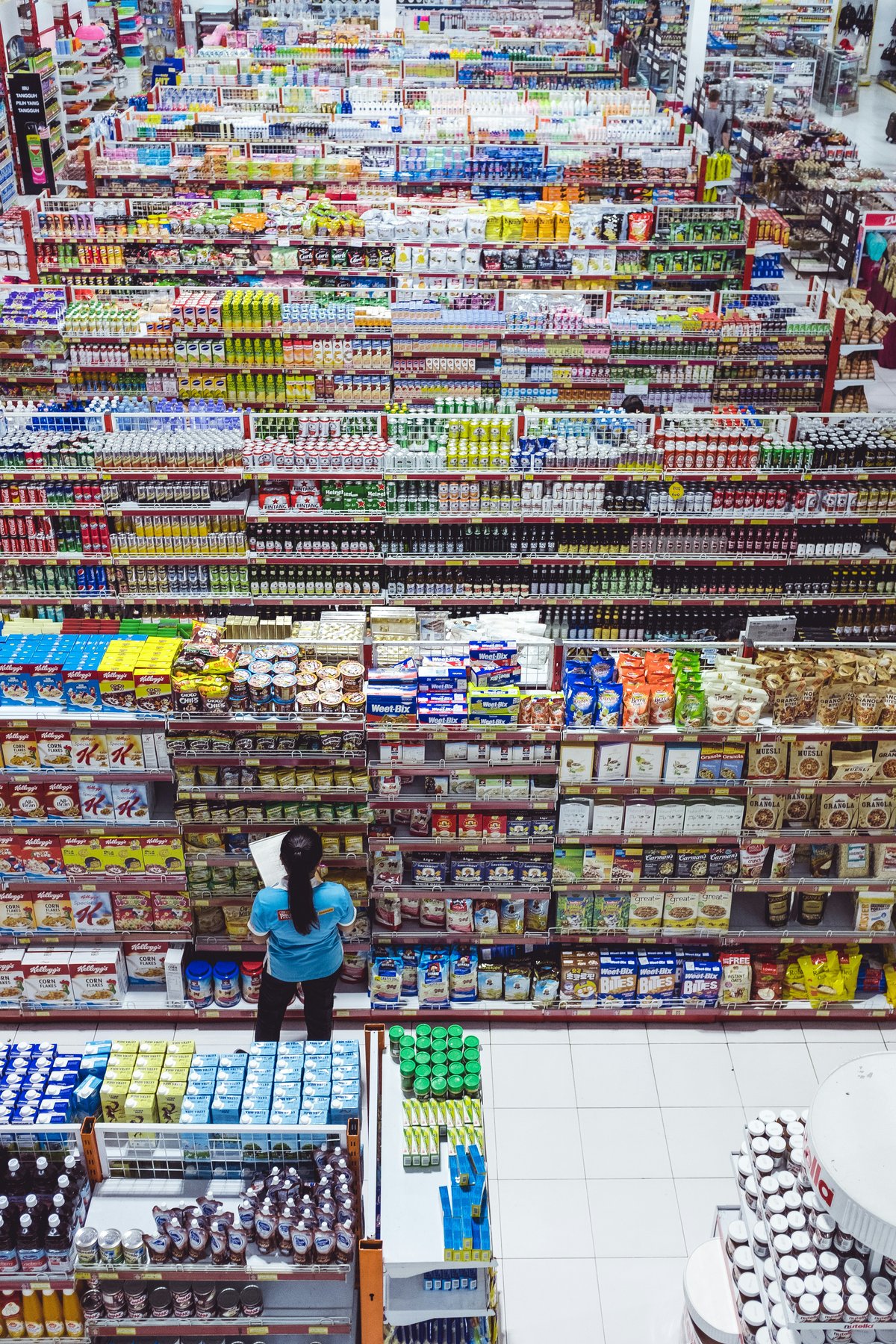
Growth in 2026 has to come from selling more units at a fair price, which means the cost side of the business, including freight, has to carry more of the weight it used to hand off through price increases. Private label has crossed a 50 percent unit share across Europe's six biggest grocery markets for the first time, according to Circana. This means: out of every 100 individual products sold in supermarkets across France, Germany, Italy, the Netherlands, Spain, and the UK, 50 of them are now the store's own brand (think Tesco's own-label pasta, or Carrefour's own-label yogurt). That's never happened before — branded and store-brand products are now splitting the shelf exactly 50/50 by volume, per Circana's research.
NielsenIQ puts its value share at nearly 39 percent across the 17 European markets it tracks for PLMA, squeezing branded players from below.
Retailers are also building retail media into a major revenue line of their own: the channel reached $196.7 billion in global ad spend in 2026, 16 percent of all ad spend, overtaking linear and connected TV combined for the first time, according to WARC. Some UK supermarkets are already using that same loyalty data to charge FMCG brands for the right to reach shoppers the retailer already "owns" through its loyalty programme, not just for shelf space; a dynamic that's steadily narrowing how much commercial leverage brands have left.
Every one of those pressures lands on the same question: which cost lines can procurement actually still move?
Freight is one of the largest, most controllable answers, especially at the scale FMCG runs it, across a diversified multi-carrier tender covering huge volume. But controllable only holds if procurement can see what it's actually paying, not just what it agreed to pay in round one.
A tender is a moment. The surcharge stack is a whole year.
Most procurement teams have no independent way to check a surcharge against the market as it lands. They're trusting the line item on the invoice, because the alternative, cross-referencing every carrier's surcharge terminology across every lane in a global tender, has historically been too slow to do at scale. Fuel surcharges get renamed. Peak-season increases get applied inconsistently across carriers on the same lane. A charge that looks standard in isolation can be well above what the rest of the market is paying on that exact corridor, and there's no way to know without checking.
This is compounded by how rarely FMCG teams revisit the number once it's signed. Rigid annual or fixed-cycle tendering is one of FMCG's most-cited process challenges in Xeneta's 2026 Freight Report, and it's the direct reason a surcharge stack has eleven months to quietly build before anyone looks at it again.
Two ways this plays out over a contract year
One, a FMCG procurement team signs its annual Q4 tender, locks in a diversified carrier mix, and takes each carrier's surcharge and reliability claims at close to face value. Through the year, surcharges creep, service claims quietly underperform, and by the time anyone notices the pattern, it's showing up as a retail replenishment problem, not a freight line item. Nobody connects the two until a QBR forces the question.
Two, another team runs the same scale of tender, but validates every carrier's rate and every surcharge against independent market data as the contract runs. When a bunker surcharge shows up that doesn't match what the rest of the market is seeing on that lane, it gets challenged immediately instead of quietly absorbed into COGS. And when a carrier's actual on-time performance drifts from what they promised during the tender, that gap gets caught within the same quarter, not discovered a year later.
Neither team necessarily negotiated a worse opening rate. Both probably did fine in round one. What split them apart was whether they kept tracking the surcharge stack and on-time delivery against the market for the following eleven months. On-time delivery and service performance ties as FMCG's top measure of procurement success in the same report, at 42% against a 33% average across all industries. A drift like that isn't a footnote. It's the metric FMCG says matters most, and it's exactly the one most likely to sit unchecked for months at a time.
What a tender you can actually trust looks like
Walk into your next Q4 tender holding a full year of validated performance data on every carrier in your current mix, real surcharge patterns against announced ones, real transit times against promised ones, and the conversation changes. Carriers who consistently added charges that didn't hold up against the market have a harder question to answer before they get the same pitch again. Carriers who stayed in line have an easier case for more of your volume, backed by data instead of relationship alone.
That's a fundamentally different negotiating position than starting from a blank slate every tender cycle and hoping this year's surcharges behave better than last year's did.
The rate was never the whole story. What actually gets added on top of it, and whether anyone's checking, is the number that decides whether your tender was a win or a slow-motion problem you haven't noticed yet.
See what this looks like in practice. Read the 2026 Freight Intelligence Buyers' Guide for the questions every FMCG procurement team should ask before their next annual tender, or see how Xeneta validates and controls freight rates and runs tenders on neutral market data, all year round.