

"I see, when things in the market changed, the contract rate spiked. It's not because they negotiated it. They inserted a new rate that they had to execute." An energy shipper said that about a carrier surcharge, and it captures something that comes up again and again in this industry: a rate goes up, and there was never really a discussion about it. A new charge gets published, the carrier applies it, and the shipper is left to figure out afterward whether it was fair, often digging through an old Excel file just to check.
That's the everyday reality for the recurring freight lines in oil and gas. Another reality is that a lot of what this industry ships can't be benchmarked the way most freight can, which means the honest starting point is drawing a clean line between the two before talking about what fixes anything.
There are two kinds of freight here, and only one fits a benchmark
Oil and gas freight splits into two very different piles. One is project cargo: drilling equipment, subsea modules, turbines, oversized structural units. This moves as specialized, oversized freight, quoted per shipment through specialist brokers, and no general market benchmark prices it well. That's simply the nature of the cargo, not a gap in the data.
The other pile is maintenance and spares, often shortened to MRO (maintenance, repair, and overhaul): valves, pumps, instruments, pipe, and consumables. These move in standard containers, with air freight covering urgent parts when a facility risks going down. This flow is recurring, it's containerized, and it's genuinely large. The global market for oil and gas MRO was valued at $68.4 billion in 2025 and is projected to grow at roughly 5.7 percent a year through 2034, driven largely by infrastructure that keeps operating well past its original design life. Aging assets need more parts, more often, and that demand doesn't slow down just because capital budgets do.
Capital spending is cautious, so the freight line gets watched harder
Producers are focused on shareholder returns right now, not aggressive new spending. Deloitte's 2026 oil and gas outlook points to more than $50 billion in offshore greenfield projects getting pushed to 2026 or later, largely because tariff-driven cost increases are hard to pass through in a market where prices aren't set on a cost-plus basis. The same report notes that between 2022 and mid-2025, close to 45 percent of US oil and gas companies' cash flow went to dividends and buybacks rather than new investment. Tariffs are also pushing more sourcing toward domestic or non-tariffed suppliers, including more local fabrication of pipe and subsea components, since roughly 40 percent of the pipe the US uses still comes from abroad.
None of that touches the MRO freight budget directly. But when capital spending is this disciplined, every recurring cost gets a harder look, and MRO freight, container and air both, is one of the few lines procurement can actually manage without waiting on a capital decision from someone else.
Surcharges arrive as announcements, not conversations
Surcharges are among the most-raised issues in oil and gas freight conversations, and the pattern described at the top – a new charge inserted and applied rather than negotiated – is especially common on long-haul routes and lanes near the Middle East. When a carrier can publish a surcharge and simply apply it, the only real check a shipper has is knowing what other shippers on the same lane are actually paying.
Without that check, a shipper is just trusting the carrier's math. With it, a surcharge that looks inflated becomes something worth pushing back on, and one that's genuinely in line with the market becomes something to accept without wasting time fighting a number that was never unreasonable to begin with.
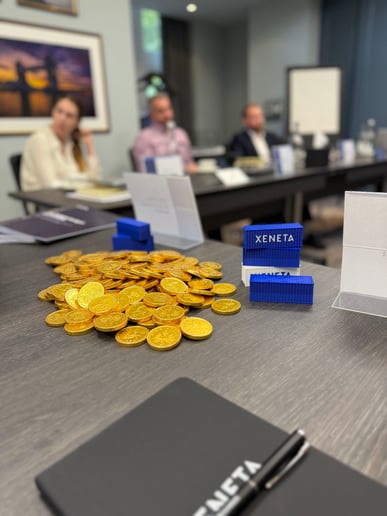
This isn't a problem unique to oil and gas, either. At a Xeneta-hosted freight roundtable in New York this June, shippers and carriers spent much of the room's time on this exact question: emergency surcharges landing with little explanation of how the figure was calculated, sometimes ranging from $150 to $600 per container for what was supposedly the same charge.
One tactic that came up again and again was informal by nature: comparing notes with peers during a roundtable, at a conference, on a peer-to-peer industry call... to sanity-check whether a number felt fair. That instinct is the right one. Benchmarking against people who've seen the market is exactly what good procurement looks like. It's just limited to the handful of people you know well enough to ask, whoever they happen to be, and whatever they happen to have seen recently.
A live market benchmark does the same check at scale. Instead of a handful of peers, it's every account and every lane Xeneta sees, refreshed continuously. And the same instinct that drives the peer check in the hallway drives Xeneta's own model: transparency between shippers, built into the data itself. The same shippers comparing notes informally are often the ones sitting in the same room at Xeneta's annual Summit, or on the same call in a regular roundtable, doing on purpose what used to happen by accident.
Where a clear-eyed approach actually pays off
When a shipper treats these two freight types differently, project cargo stays what it is: quoted per shipment, handled by specialists, outside any standard benchmark. But the MRO flow, the recurring container and air freight, gets benchmarked against real market data every time a surcharge lands or a contract comes up for renewal.
That means when a carrier inserts a new charge and calls it non-negotiable, procurement has a benchmark showing what similar shippers are actually paying on that lane, right now. And when a critical part needs to fly out to avoid a shutdown, the rate gets checked against the market within days, not left in a spreadsheet to be reviewed whenever someone finds the time.
What this actually changes
Next time a surcharge notice lands, instead of accepting it because the carrier said so, a team with the right data checks it against a live benchmark built for exactly this kind of freight. The next MRO tender starts from where the market actually sits, not last year's contract. And as aging infrastructure keeps pushing MRO budgets higher, the freight function can defend what it's spending, lane by lane, instead of accepting whatever a carrier decides to insert.
Project cargo will keep running on its own rules, and that's fine. The freight underneath it, the parts and maintenance flow that never stops, doesn't have to run on a carrier's word alone.
See what this looks like in practice. Read the 2026 Freight Intelligence Buyers' Guide for the questions every energy-sector procurement team should ask about MRO freight and surcharge validation, or explore Xeneta's market monitoring and risk management tools for volatile long-haul lanes.