



The Xeneta Weekly Ocean Container Shipping Market Update provides data and intelligence including the latest freight rate and capacity movements across global trades with supporting insight from Peter Sand, Xeneta Chief Analyst.
Xeneta analyst insight: Capacity increasing after weeks of turmoil - but why did it take so long?
Peter Sand, Xeneta Chief Analyst:
“It has been a long time coming, but carriers have finally responded to spiralling spot rates and supply chain disruption on major ocean container shipping trades out of Asia by deploying significantly more capacity this week. This raises an uncomfortable question from shippers – why has it taken until now for carriers to act when they have endured months of triple-digit freight rate increases and delays in getting containers on board ships?
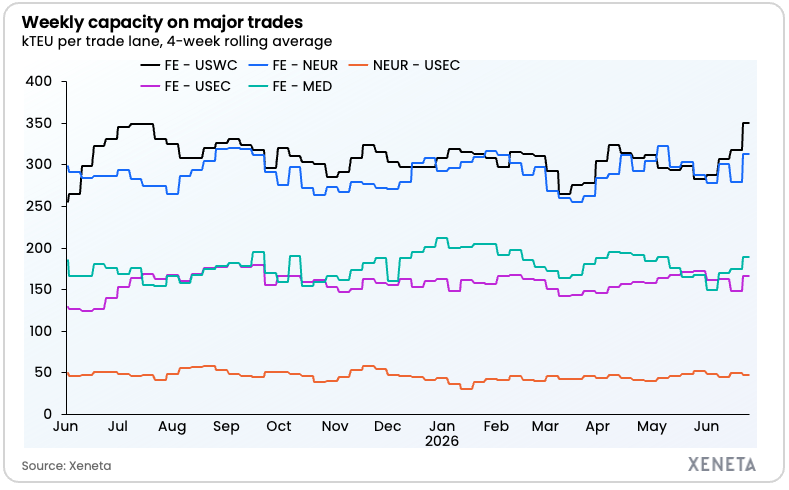
“Offered capacity on Far East to US West Coast is up 10.5% from a week ago, US East Coast is up 12.1% and North Europe is up 11.9%. These are substantial weekly increases and the largest seen since the Strait of Hormuz closure at the end of February.”
Motivation for carriers:
“This is not an act of kindness by carriers - they are compelled to make their move on the back of spot rates which are now up 214% from Far East to US West Coast since the escalation of conflict in the Middle East at the end of February – the root cause of this supply chain crisis. Spot rates are up 176% into US East Coast, 115% into North Europe and 82% into Mediterranean.
“The capacity injection is not only a response to very high freight rates. Carriers are positioning themselves for the official peak season, which begins on 1 July, and deploying capacity now to be ready for when seasonal demand really takes off. That is a practical decision, but shippers will want to know why capacity has been essentially flat for months while they have been enduring so much operational and financial pain.”
Impact on rates:
“For shippers, more capacity is always welcome and will help them to get supply chains moving more reliably, but they should not expect this to translate into falling freight rates. The only good news for shippers is that the situation is not as bad as it would otherwise have been, with spot rates expected to climb further heading into July but with slower growth compared to recent weeks.”
Strait of Hormuz: container shipping still absent:
“There has been significant attention on the prospect of the Strait of Hormuz reopening, but the data tells a more nuanced story. Over the past seven days, the number of daily transits (all ship types) have ranged from 22 on Sunday to 60 yesterday, Wednesday.
"After months of very few containership transits, Wednesday saw seven transits recorded. Only one was inbound to the Arabian Gulf, meaning the industry is still on a mission to bring trapped seafarers out of the region, rather than re-establishing networks.
“Reconnecting container services requires a fundamentally different risk assessment than one-off transits by other vessel types. Carriers need a safe, permanent corridor before they will commit networks and we are not there yet.”
Data highlights
Market average spot rates – 25 June 2026
-
Far East to US West Coast: USD 5 909 per FEU (40ft container)
-
Far East to US East Coast: USD 7 313 per FEU
-
Far East to North Europe: USD 4 763 per FEU
-
Far East to Mediterranean: USD 6 044 per FEU
-
North Europe to US East Coast: USD 2 350 per FEU
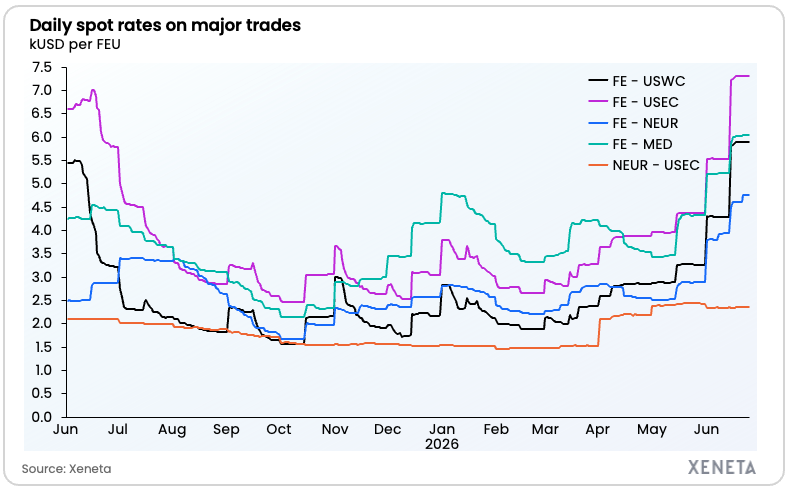
Spot rate changes since the end of February (pre-crisis) – 25 June vs 28 February 2026
-
Far East to US West Coast: +214%
-
Far East to US East Coast: +176%
-
Far East to North Europe: +115%
-
Far East to Mediterranean: +82%
-
North Europe to US East Coast: +59%
Spot rate changes over the past month – 25 June vs 25 May 2026
-
Far East to US West Coast: +81% (USD 3 267 to USD 5 909 per FEU)
-
Far East to US East Coast: +67% (USD 4 375 to USD 7 313 per FEU)
-
Far East to North Europe: +65% (USD 2 887 to USD 4 763 per FEU)
-
Far East to Mediterranean: +40% (USD 4 326 to USD 6 044 per FEU)
-
North Europe to US East Coast: –4% (USD 2 453 to USD 2 350 per FEU)
Offered capacity on major fronthaul trades (4-week rolling average) – w/c 22 June 2026:
-
Far East to US West Coast: +10.5% from a week ago
-
Far East to US East Coast: +12.1% from a week ago
-
Far East to North Europe: +11.9% from a week ago
-
Far East to Mediterranean: +8.3% from a week ago
-
North Europe to US East Coast: −5.2% from a week ago
Ends