


The Xeneta Weekly Ocean Container Shipping Market Update provides data and intelligence including the latest freight rate and capacity movements across global trades with supporting insight from Peter Sand, Xeneta Chief Analyst.
Peter Sand, Xeneta Chief Analyst: Shipping capacity is returning to Red Sea while rates from China to Jeddah and Khor al Fakkan break Covid-19 records
“The wider Middle East conflict has impacted two major ocean shipping waterways – the Red Sea and the Strait of Hormuz. They have both been compromised due to the geopolitical situation in the Middle East region, but they are contributing to the ocean container shipping market in two very different ways.”
Red Sea: Shipping capacity is returning
“Capacity transiting the Bab el-Mandeb strait in August doubled compared to 12 months ago, but still sits at just 23% of pre-Red Sea crisis levels in August 2023. This return of capacity to the Red Sea is the single biggest variable in the ocean freight market.
“The flare-up in conflict between Saudi Arabia and Houthi militia does not appear to be deterring carriers from returning services to the Red Sea and this is good news for shippers, but network and service changes bring uncertainty and supply chain risk.
“Carriers assess these risks differently and they will be selective about which services and ships go through. These nuances matter enormously. Some carriers are transiting on one leg of East-West services primarily into the Mediterranean, while MSC’s return is a commitment with a written reversibility clause rather than a full network change.
“Routing through the Red Sea rather than around the Cape of Good Hope can cut transit time by 11 days on a typical service from China to Genoa. Unless shippers are fully on top of these changes – and the potential for last minute re-routings – they risk supply chain disruption.”
Strait of Hormuz: spot rates exceed Covid-19 peak and set new record high
“The Strait of Hormuz has now been closed to container shipping for more than half a year and alternative land bridges into the Middle East, particularly via ports in Jeddah and Khor al Fakkan, are fully established.
“This has brought stability, but it is also coming at a cost for shippers, with average spot rates from China to Jeddah and Khor al Fakkan up 256% and 479% respectively since 28 February. These extraordinary increases have seen spot rates on these trades surpass the previous record highs set during the Covid-19 disruption.
"The increased cost is in addition to longer transit times and worse reliability, but while the Strait of Hormuz remains effectively closed to container vessels, shippers have little other option to get their goods into the Gulf region.”
Data highlights
Market average spot rates – 10 September 2026
-
Far East to US West Coast: USD 7,738 per FEU (40ft container)
-
Far East to US East Coast: USD 10,955 per FEU
-
Far East to North Europe: USD 4,333 per FEU
-
Far East to Mediterranean: USD 4,764 per FEU
-
North Europe to US East Coast: USD 2,953 per FEU
-
China to Jeddah: USD 10,870 per FEU
-
China to Khor al Fakkan: USD 10,626 per FEU
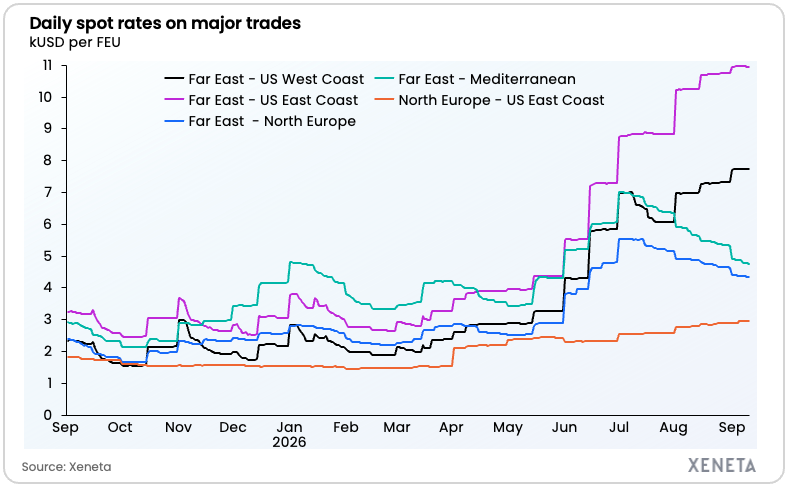
Spot rate changes since the end of February (pre-Hormuz crisis) – 10 September vs 28 February 2026
-
Far East to US West Coast: +312%
-
Far East to US East Coast: +313%
-
Far East to North Europe: +95%
-
Far East to Mediterranean: +43%
-
North Europe to US East Coast: +100%
-
China to Jeddah: +256%
-
China to Khor al Fakkan: +479%
Capacity transiting the Bab el-Mandeb strait (average weekly capacity):
-
August 2023: 930,679 TEU
-
August 2026: 212,636 TEU
Ends
Read the full Xeneta report on the return of capacity to the Red Sea: www.xeneta.com/reports/red-sea-recovery
Journalists can be added to the distribution list for Xeneta Weekly Market Updates by emailing press@xeneta.com.