



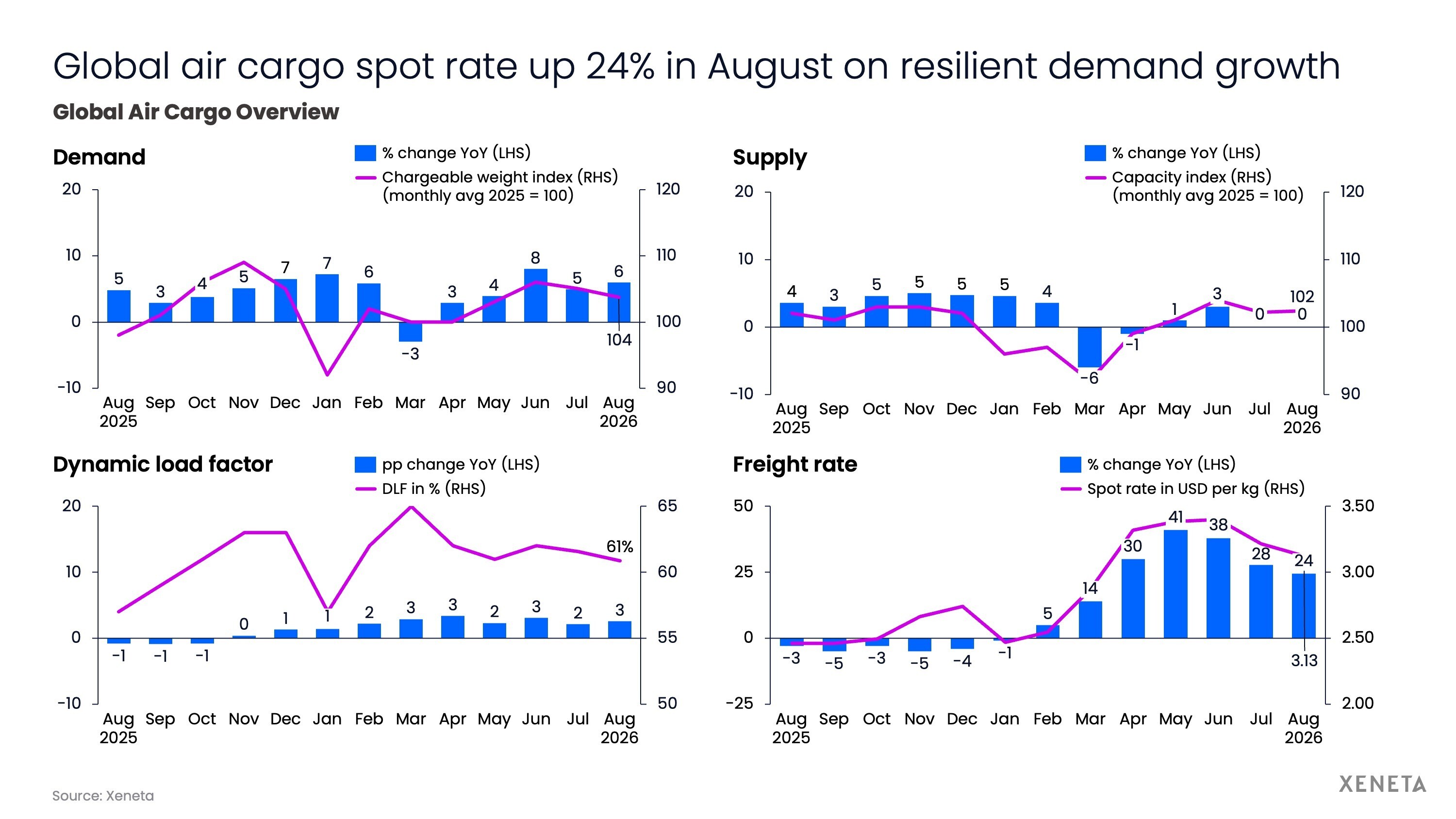
Global air cargo demand remained strong in August, with volumes up +6% year-on-year, meaning shippers must wait a little longer to see a bigger drop in still-elevated freight rates, say industry analysts Xeneta.
OSLO, Norway, 4 September 2026
Air cargo's 'hot summer' of 2026 continued last month after the +5% year-on-year rise in volumes recorded in July, underlining the market's resilience through the traditionally quieter summer months. Year-on-year spot rate growth is easing again but global air cargo spot rates (valid for up to one month) remained +24% higher year-on-year in August at an average of USD 3.13 per kg.
The pace of rate growth eased for a third consecutive month, following +28% in July, +38% in June, and the +41% peak in May. Spot rates also fell -3% month-on-month, a smaller step down than July's -6% decline.
“How you see the market depends on where you sit,” said Xeneta’s Chief Airfreight Officer, Niall van de Wouw. “Rates are easing their way down month-on-month, and the gap to last year’s levels is narrowing, perfectly in line with what we expected, and airlines will be hoping to hold on at the current level until the busier season starts.”
“But shippers still feel they’re owed and want to push rate levels down. If you were buying something that is +24% more expensive now than a year ago, and that has a big effect on budgets, you wouldn’t be happy. But we are not picking up signals on a big uptick in demand in the coming months, and we think air freight rates will go down further, just not as quickly as shippers want to see. It remains a seller’s market,” he added.
In the meantime, shippers continue to buy more capacity on the short-term market, waiting to see if the month-on-month downward trend in rates accelerates to deliver more budgetary relief. But with demand growth continuing to outpace supply and jet fuel prices rising again in recent weeks, the descent is being taken in small steps.
Capacity in August was flat year-on-year, leaving Xeneta’s dynamic load factor - its measurement of capacity utilisation based on the volume and weight of cargo flown alongside available capacity - three percentage points higher versus August 2025 at 61%.
China’s e-commerce exports to Europe fall -25% as EU duty bites
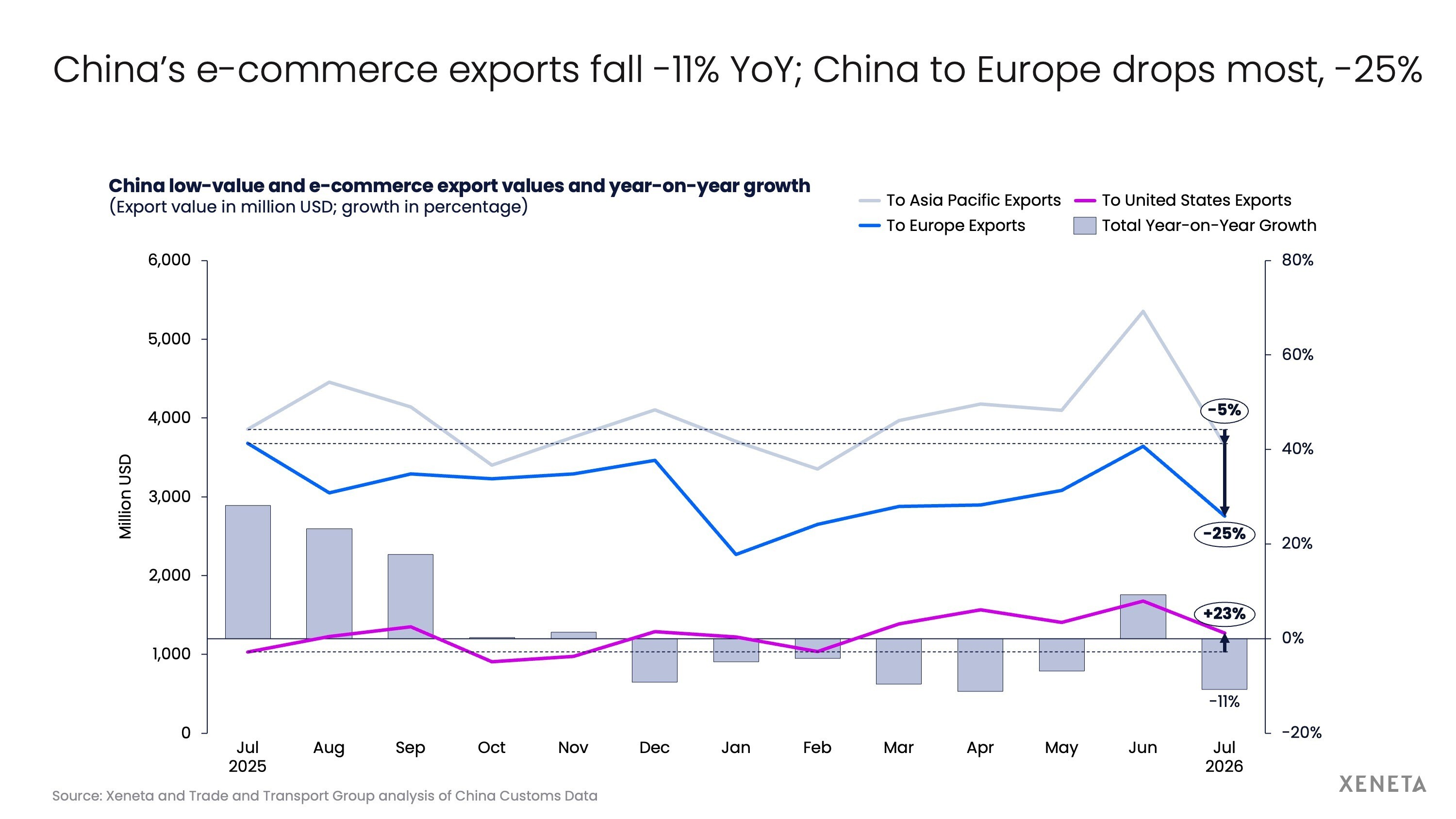
The clearest structural shift in the data is driven by a decline in e-commerce. China’s low-value and e-commerce exports fell -11% year-on-year in July 2026, according to Xeneta and Trade and Transport Group analysis of China Customs data. Exports to Europe dropped the most, down -25% compared to a year ago - the steepest decline of any region. This was almost certainly a knee-jerk reaction to the EU’s removal of its €150 duty-free threshold for low value goods on 1 July 2026 and its introduction of a flat €3 per item customs duty.
This negative market reaction is likely to be short-lived, van de Wouw said.
When the US removed its de minimis threshold in 2025, China’s e-commerce exports to the US also saw an initial dip but have since recovered to stand +23% higher year-on-year in July 2026 – albeit from a lowered base. Van de Wouw expects to see a similar recovery in China-Europe e-commerce volumes.
“It’s way too early to know what the longer-term impact will be on e-commerce volumes from China-Europe, but a positive longer-term indicator, in any case, is how quickly China-US shipments recovered.”
Consumers unlikely to change buying habits
He continued: “Right now, I think a lot of e-commerce shippers may be incurring the extra cost in their product while they work out the best way to sell it: whether to make their product more expensive or to separate customs duty as a handling fee. But consumers are not going to stop buying on the big Chinese e-commerce platforms.
“I think if you had asked 10,000 Temu users ‘What is de minimis?’ they would have had to look it up. The price differential of goods is also so much in many cases versus products made in Europe, that consumers are unlikely to change their buying patterns.”
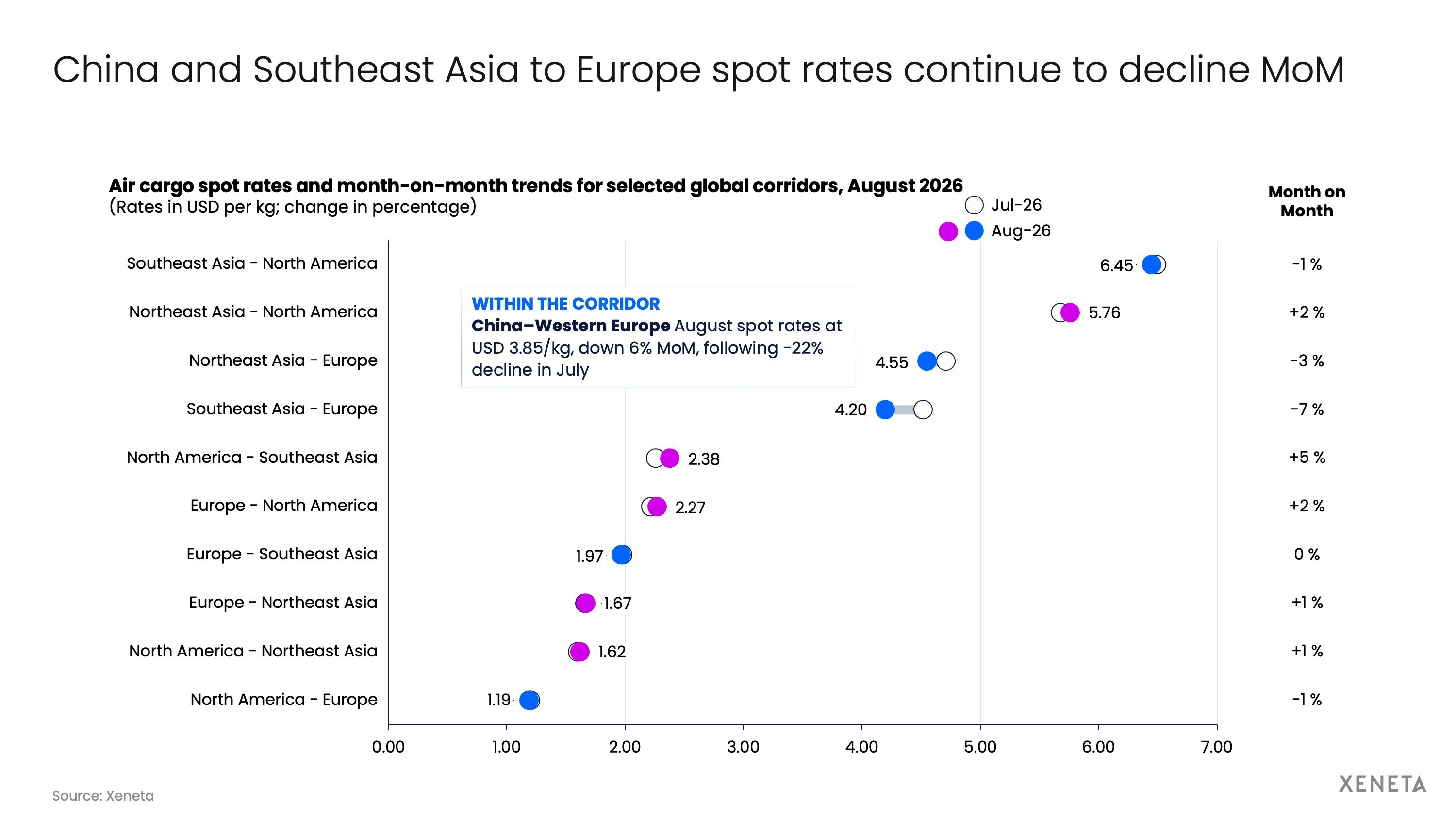
But the impact of lower volumes, however short-term they may be, is already visible in the freight market. China to Western Europe spot rates averaged USD 3.85 per kg in August, down a further -6% month-on-month following July’s steep -22% decline. Northeast Asia to Europe spot rates fell -3% month-on-month, with Southeast Asia to Europe down -7% to USD 4.20 per kg.
Corridors diverge beneath the global rate
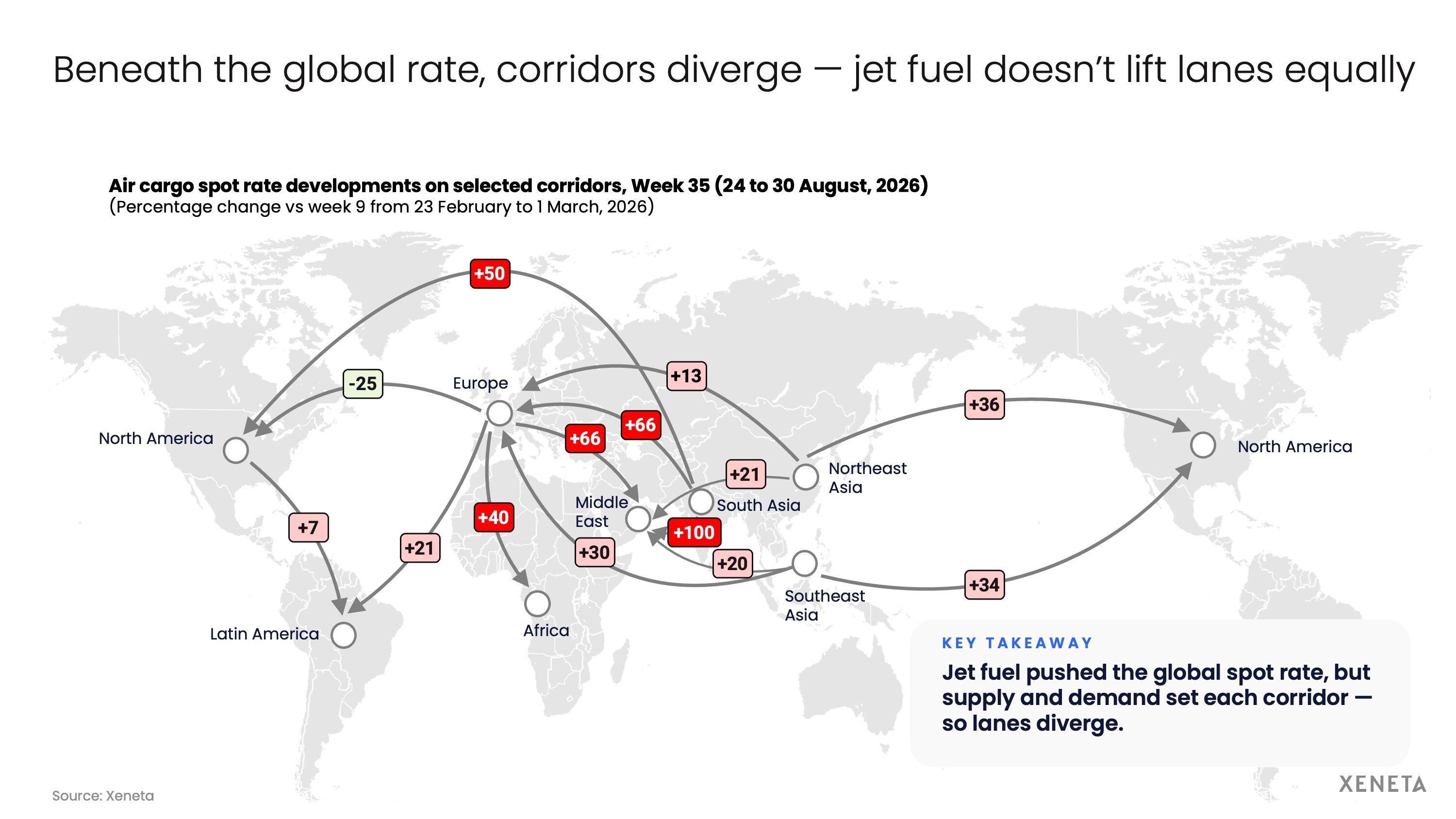
Elsewhere, corridor-level rates continued to be set by supply and demand rather than fuel prices.
In week 35 (24–30 August), spot rates into the Middle East remained far above late-February pre-conflict levels, up +100% from South Asia, +66% from Europe, +21% from Northeast Asia, and +20% from Southeast Asia. On the transpacific, AI-related shipments continue to underpin the market, with Northeast Asia and Southeast Asia to North America spot rates +36% and +34% above late-February levels respectively, and Northeast Asia to North America averaging USD 5.76 per kg in August, up +2% month-on-month.
It was a different story on transatlantic lanes, where abundant summer belly capacity kept Europe to North America spot rates -25% below late-February levels, although the corridor showed early signs of firming with rates up +2% month-on-month in August.
Cut out the noise and enjoy the resilience
Only external events can tip the current favourable headwinds behind air cargo’s resilience, van de Wouw said.
While there remains a lot of noise in the market and some industry observers looking to hang trends on just a few days’ data, he believes global air cargo market growth remains on course for +4% in 2026 – better than expected at the end of 2025 when forecasters were giving their predictions for the New Year.
“The market has been performing at a relatively stable level for several months. Yes, of course, shippers want to pay less for capacity, but versus some of the major disruptions we have seen, a period of relative calm should be celebrated, and the resilience of air freight appreciated,” he stated.
-ends-