
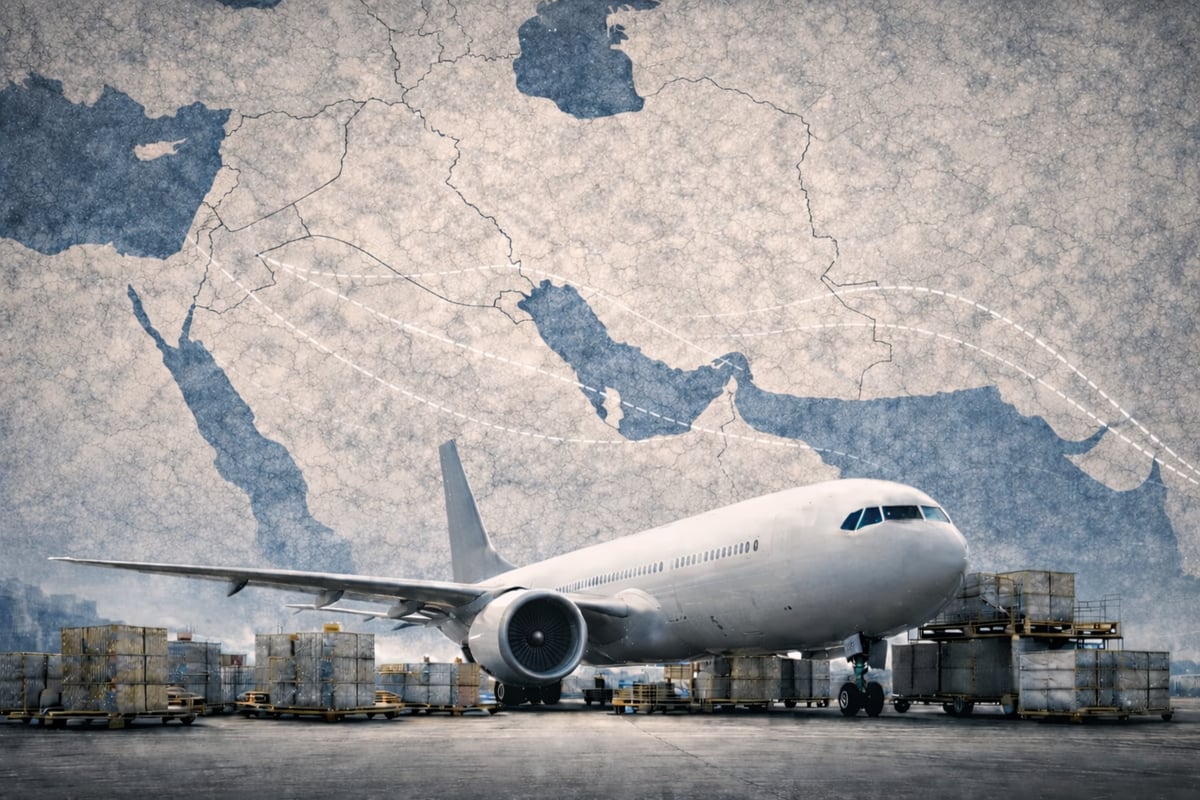
Escalating conflict in the Middle East has caused airspace closures and flight cancellations that removed 16-18% of global air cargo capacity without almost no warning. The headline figure is only part of the story. The disruption is highly concentrated, and in some markets the loss of capacity is far more severe, with immediate implications for rates, service options, and shipment planning.
In this interview, Xeneta’s Director of External Communications, Philip Hennessey, speaks with Chief Air Freight Officer, Niall van de Wouw, to unpack what is happening on the most affected corridors and what shippers can do to keep supply chains moving.
They also cover what this means for procurement decisions right now, including whether it may be smarter to pause longer-term tenders and stay close to forwarders until there is more clarity.
Q: Airspace closures and cancellations took around 16 to 18% of global air cargo capacity out of the market almost instantly. Put that into context. What does it mean in reality?
Niall: The numbers hide the more dramatic impact, because 16-18% on average might sound like “quite a lot, but not that dramatic”. But that’s the average. It’s very localized. In certain markets the impact is far more dramatic.
The key example is India. Capacity out of that market is dominated by Qatar, Emirates, and Etihad combined, and they are no longer able to serve that market. If you told people a week ago that Emirates and Etihad will not be serving the Indian market, that’s the reason nearly for panic.
So that 16-18% means low single digit impact in certain markets and 50, 60, 70% in other markets.
Q: So what does that mean for rates on the affected lanes?
Niall: If we look back at what happened in COVID, the reasons were very different, but we had a very abrupt decrease in capacity. We saw rates double, triple, quadruple in certain markets. And I think that is likely to happen in these markets as well if the situation prolongs.
Q: Is it fair to compare the shock to COVID, at least for air freight?
Niall: Yes. I’m also not a sensationalist, but the number one and two global carriers from an air freight perspective, UPS and FedEx on the parcel side, they’ve been crippled. They were no longer able to operate their services. That has a dramatic impact. And there’s the uncertainty, because we do not know how long this might take.
Q: How quickly do those price changes show up for shippers?
Niall: When this happened over the weekend, goods that were ready to be transported already had an agreed rate. This was so sudden. But as of now, if you need to move something tomorrow, or it’s very urgent, a new rate will likely be agreed because the fundamentals have changed completely. The changes are happening now.
The industry always finds a way. Companies will see opportunities, try to readjust their schedule, to benefit from this. But it will come at a cost.
Q: If a shipper isn’t using Middle East transshipment hubs, are they still exposed?
Niall: Of course. Take an example. If a forwarder has a deal with Turkish Airlines through Istanbul between India and Europe, and they now hear the Indian market is doubling, tripling, they will try to benefit from that as well. So even if you’re not operationally affected, you will be commercially affected, because airlines that are still able to serve these markets will try to maximise or optimize their benefits.
Q: What about cargo already on the ground at Middle East hubs? Is there anything shippers can do?
Niall: You’re stuck. These carriers will have stopped receiving shipments. If it’s still at the freight forwarder, you might be able to do something. But if it’s already been handed over to the airline, I think you’ll be stuck. It’s probably such a chaos at the moment that it’s less likely you can get it back and move it out.
Q: Even if the situation de-escalates quickly, how long does recovery take?
Niall: Rule of thumb would be one day a mess, five to seven days clean up. The logistical mess from a planning perspective is of a different order of magnitude. I heard at Qatar, of its close to 30 freighters, a majority of them are outside of Doha. Your planes are not where they want to be, your staff is not where you need them to be. Before you have that back to normal, that’s going to take a significant amount of time.
Q: What “workarounds” exist if shippers need to move cargo next week?
Niall: Shippers will not find a way. Shippers will have to pay for the freight forwarders to find a way. The industry has been very effective over the last 10 years dealing with these situations. They will find a way, but it will come at a cost.
Load factors from Asia to Europe for many Asian gateways were around 80% before the crisis. That’s our tipping point of a buyer’s and seller’s market. Take away 10% of capacity and you’ll have a run at capacity. Charters will be discussed as we speak now, but you have to look at landing rights. And it will come at a much higher rate than we saw prior to the start of the war.
Q: Is mode shift to ocean freight a realistic alternative?
Niall: No. Ocean might take 10, 20 days. So no, I don’t see that as an immediate solution.
Q: What about jet fuel and oil prices, do they drive rates higher from here?
Niall: Air freight rates are a result of demand and supply for air freight, not so much demand and supply for fuel. The impact of the reduction of capacity will be of a different order of magnitude than higher fuel. It may bite into margins, but prices will be driven by reduction in supply.
Q: Could higher air freight rates feed into consumer prices?
Niall: Not a lot, I would think. Air freight typically moves high value goods. Transportation costs are a very small portion of the total cost. If that portion increases, it will have a limited effect.
Q: Procurement is also happening now for 2026 capacity. What’s your advice to shippers?
Niall: My recommendation would be to postpone any longer-term tender at the moment for these affected lanes. If you’re moving across the Pacific, the impact will be less profound than moving from Asia to Europe or from the Indian subcontinent to Europe. If your lanes are less affected, it’s business as usual with a slight nuance.
But if you’re on lanes affected by this war, postpone it. You will be vulnerable to the short-term market, but that is what it is. Any longer-term rate you agree now could be far too expensive if this is resolved quickly or far too cheap if this takes too long. What’s the value of that?
Stay close to your freight forwarders, live with the uncertainty, and once there is a bit more clarity, then set the scene for a longer price validity. A paper agreement now is probably not going to survive reality for a long period of time.
Market conditions are shifting fast. Get the visibility to assess risk early and act with confidence.
When conditions change fast, decisions need to keep up. Learn how Xeneta supports risk management with real-time market intelligence so teams can monitor volatility, assess impact, and respond with confidence.