




Welcome back to Xeneta Schedule Reliability – A Year in Review. We’ve drilled down all the way from global reliability to trades and alliances, arriving at last to carrier rankings.
Xeneta covers reliability for over 200 operators across more than 25,000 port pairs. Our report today focuses on a small but significant selection of these carriers.
Average Carrier Reliability, 2025
-
Maersk (56% on-time, -2.0 days delayed)
-
Hapag-Lloyd (52% on-time, -3.0 days delayed)
-
Zim Integrated Shipping Services (36% on-time, -4.6 days delayed)
-
Cosco Shipping Lines (35% on-time, -3.4 days delayed)
-
CMA CGM (33% on-time, -3.6 days delayed)
-
Wan Hai Line (31% on-time, -3.4 days delayed)
-
Pacific International Lines (27% on-time, -4.2 days delayed)
-
Yang Ming Lines (27% on-time, -4.7 days delayed)
-
Ocean Network Express (26% on-time, -5.6 days delayed)
-
Evergreen Line (25% on-time, -3.9 days delayed)
-
Mediterranean Shipping Company (25% on-time, -4.7 days delayed)
-
HMM (15% on-time, -8.5 days delayed)
Carrier Reliability Highlights
Hapag-Lloyd and Maersk reveal that their Gemini partnership has carried them far, performing significantly better in tandem (81% on-time) throughout 2025 than they did as individual operators. This suggests that the reliability of their non-alliance partnerships generally fall short of Gemini’s optimized structure. From a competitive perspective, Maersk (56% on-time) outperforms Hapag-Lloyd (52% on-time) by 4 percentage points for on-time arrivals and boasts a full 24 hours less in average delay.
On the other end of our scale, global giant MSC’s average reliability of 25% on-time and nearly 5 days of delay is just a pace above the bottom of our rankings. As a prime example of how network peers can diverge in their day-to-day vessel operations, MSC’s transatlantic partner ZIM fairs considerably better; placing in the top 3 performers with 36% of vessels on-time.
ONE (26% on-time), and YML (27% on-time) align closely against their collective performance as Premier Alliance (26% on-time), but HMM (15% on-time) stands out with starkly low reliability. In contrast, Ocean Alliance (26% on-time) members COSCO (35% on-time) and CMA CGM (33% on-time) appear to manage reliability better independently than as a whole.
This is valuable evidence for shippers to consider selecting CMA CGM or COSCO on their non-alliance offerings, or to potentially lean into Ocean Alliance services where they function as the primary vessel providers instead of EMC (25% on-time).
Monthly On-Time Arrivals by Carrier, 2025
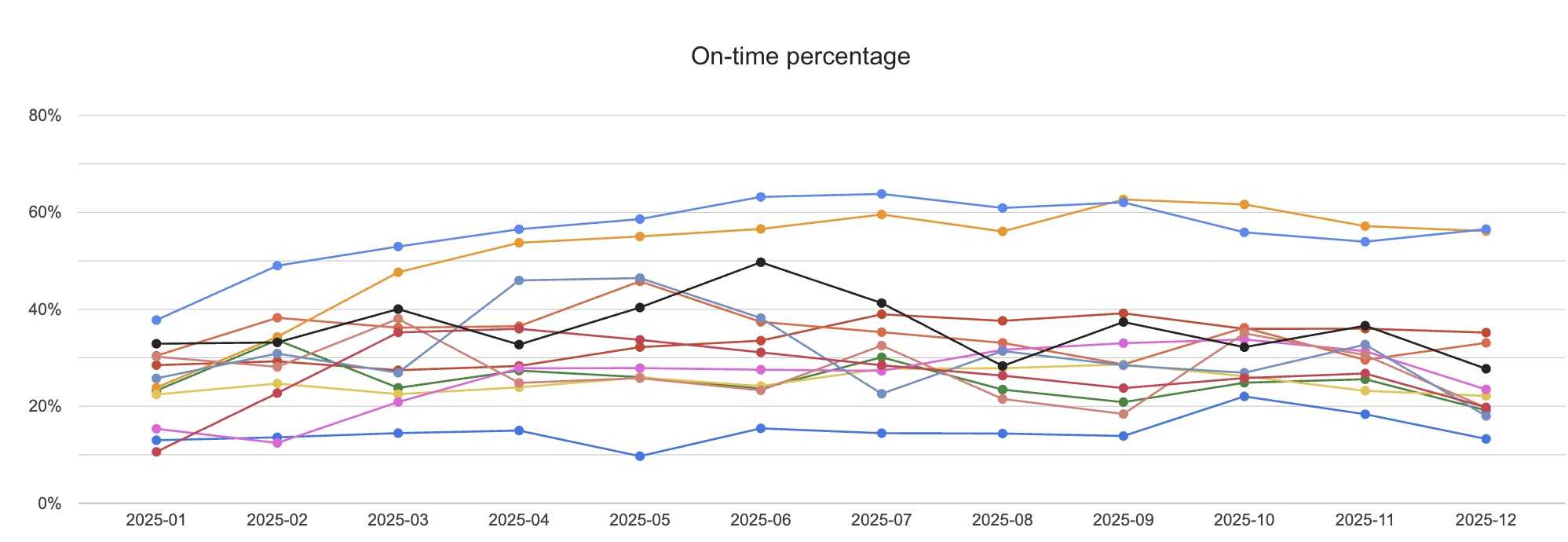
Monthly On-Time Arrivals by Carrier, 2025
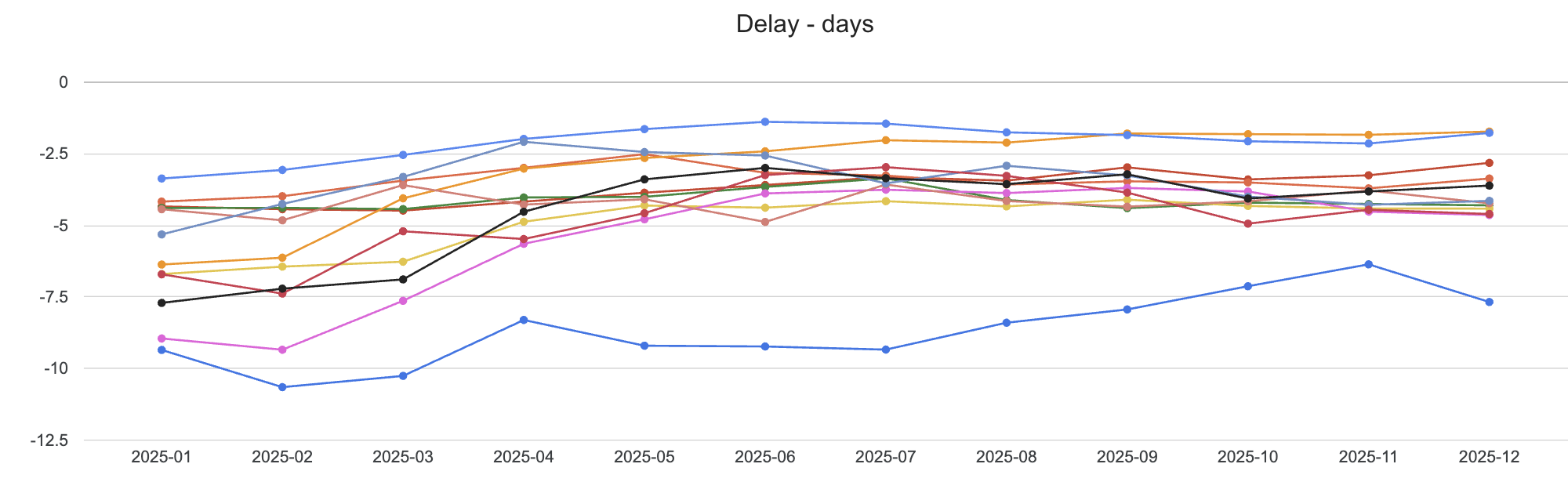
Red Sea Dynamics and Carrier Performance
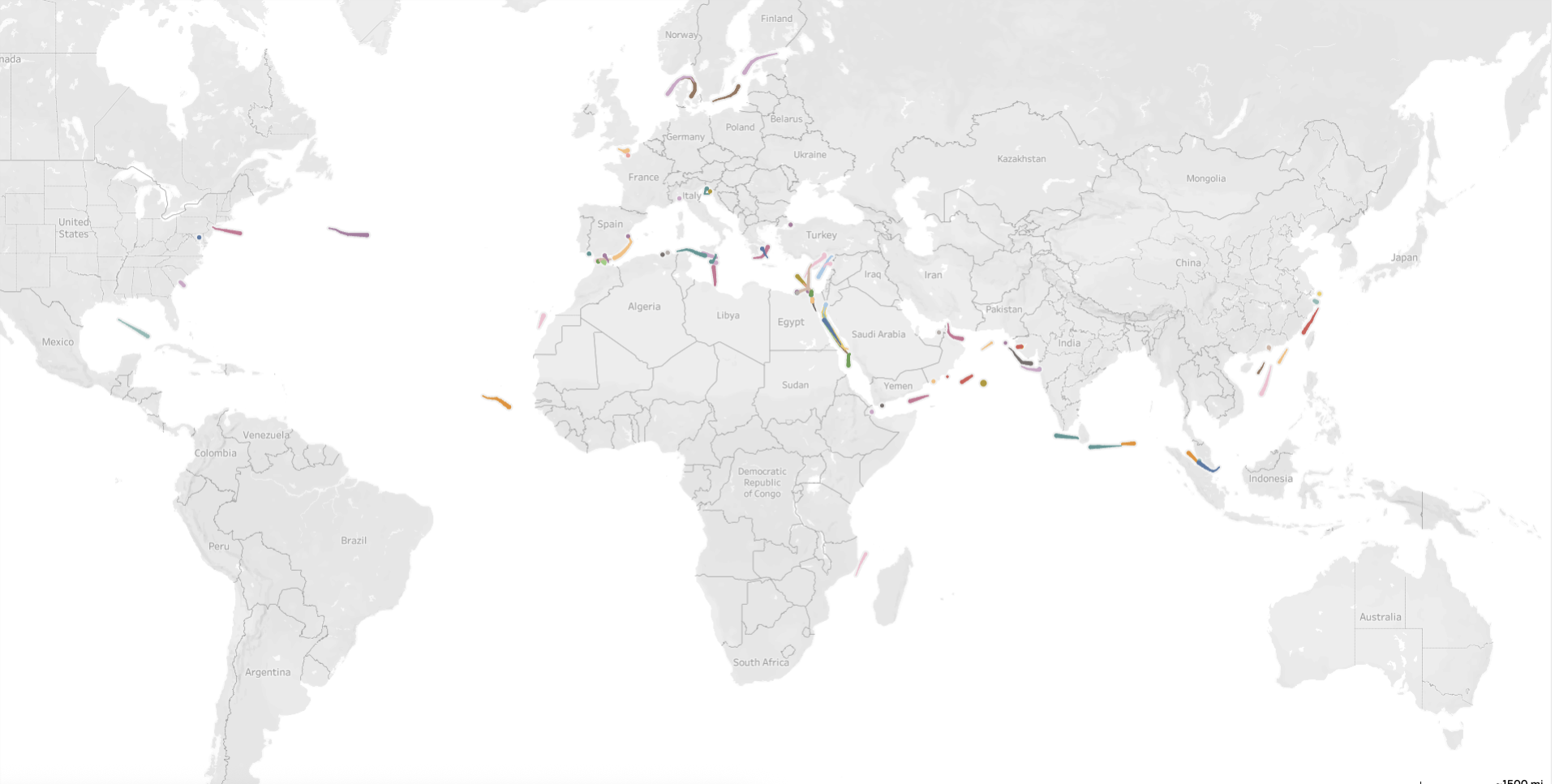
Regarding a return to the Red Sea, the situation is currently too dynamic to try to confidently pinpoint a 'safe’ bet in terms of carrier selection. The geopolitical decisions that control these tides rest in the hands of mercurial leaders and dangerous militias.
Carriers and insurers are continuously adjusting to these developments on a voyage-by-voyage basis. In the case of CMA CGM and their FAL1, FAL3, and MEX strings, this could mean executing unexpected strategies like scaling down several weeks of scheduled voyages through the canal to match overnight developments.
Xeneta Suez Canal Forecasts, February 2026
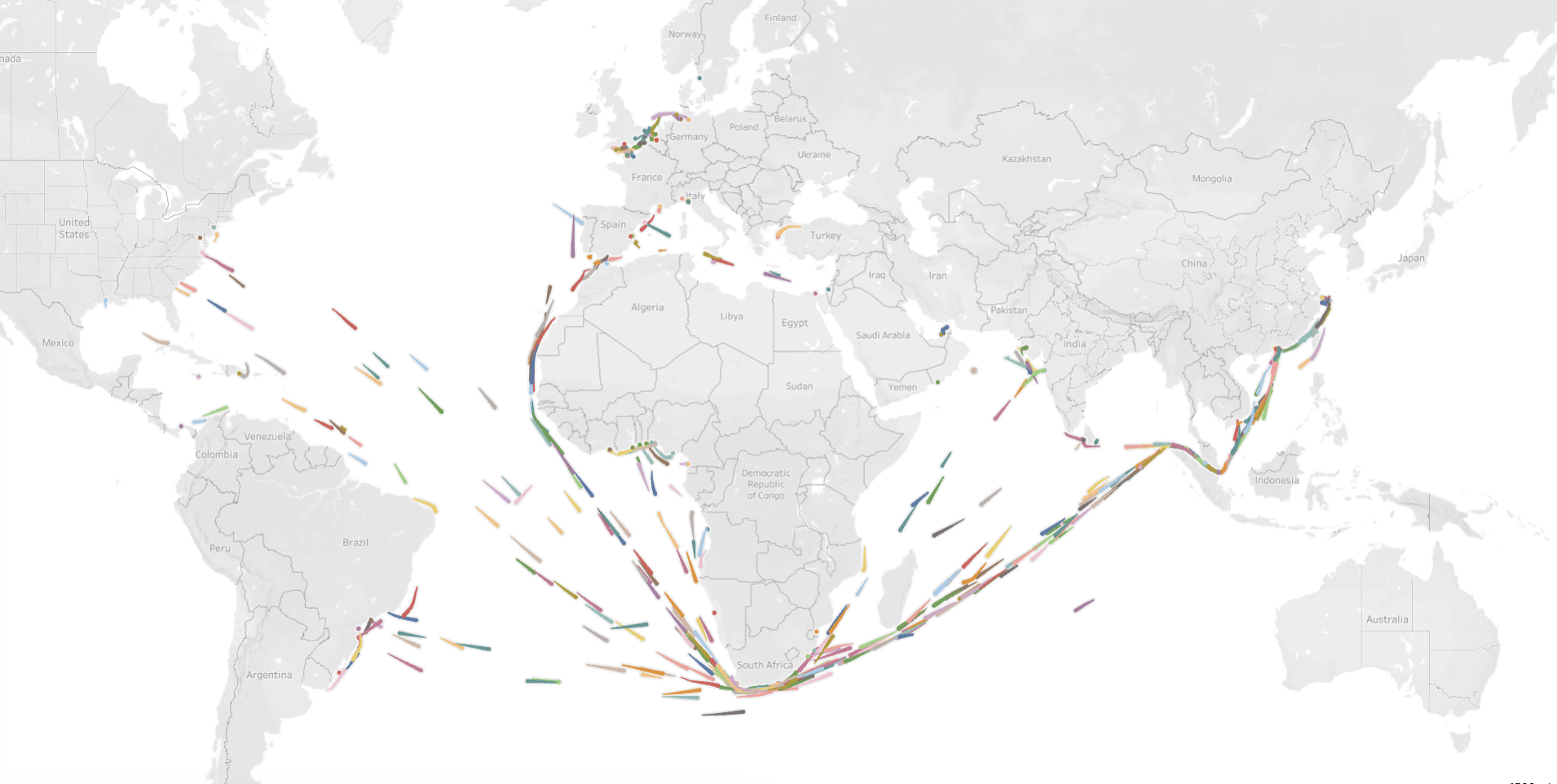
Xeneta Cape of Good Hope Forecasts, February 2026
Shippers are at the very bottom of the decision-making funnel in this equation, highlighting their vulnerability. So, what can they do? Shippers can lean into services where their preferred carriers function as vessel operators to limit their horizon of risk. Then, they can reinforce those best laid plans by identifying failsafe options on their port pairs and maintaining a daily rate of refresh on that intel.
Further down that track, we have the possibility of service specific risk assessment, port congestion scores, and daily updated vessel forecasts to explore with the help of Xeneta's expert analysts.
Mapping operator performance against specific trades can offer a quick scale of confidence for shippers to consider. Due to most strings routing past the Cape of Good Hope, carrier performance on Far East - Europe in 2025 is not an exact 1:1 indicator of how they will handle a dedicated return to the Suez Canal. It is, however, still a solid measure of how carriers held up against relentless reliability challenges on the world’s most troubled trade.
Track the latest Red Sea developments and carrier impacts in our Red Sea News Hub.
Average Carrier Reliability on Far East – Europe, 2025
- Maersk (58% on-time, -1.7 days delayed)
- Hapag-Lloyd (51% on-time, -4.3 days delayed)
- Wan Hai Line (39% on-time, -2.8 days delayed)
- Cosco Shipping Lines (33% on-time, -3.8 days delayed)
- Zim Integrated Shipping Services (25% on-time, -3.5 days delayed)
- Yang Ming Lines (18% on-time, -5.6 days delayed)
- CMA CGM (16% on-time, -4.8 days delayed)
- Mediterranean Shipping Company (16% on-time, -5.9 days delayed)
- Evergreen Line (12% on-time, -6.0 days delayed)
- Ocean Network Express (10% on-time, -11.0 days delayed)
- HMM (5% on-time, -15.2 days delayed)
Maersk (58% on-time) and Hapag-Lloyd (51% on-time) have both been characterized by cautious strategies towards the Red Sea conundrum. Their reliability demonstrates that their operations remain resilient on this trade, making them a preferred choice for shippers keen on predictability.
COSCO (33% on-time) and WHL (39% on-time) perform solidly in the middle range on this scale, with WHL even achieving an additional 8 percentage points against their global results. These appraisals of course fall under the long-established understanding that none of these results are particularly ‘good’ from a historical perspective.
Most of the poorest performers on this trade are already at the bottom of global reliability rankings, with the exception of two operators. CMA CGM (16% on-time) has taken one of the most proactive approaches to the Red Sea among its largest peers, but the results from 2025 suggest these operations don't meet their average service standards.
ZIM (25% on-time) also reveals they faced significant challenges here, dropping from the coveted top three down to fifth place on Far East – Europe. That however, is of little surprise given the nature of the carrier's relationship to the Israel-Palestine crisis and heavy operational limitations.
Monthly On-Time Arrivals by Carrier on Far East - Europe, 2025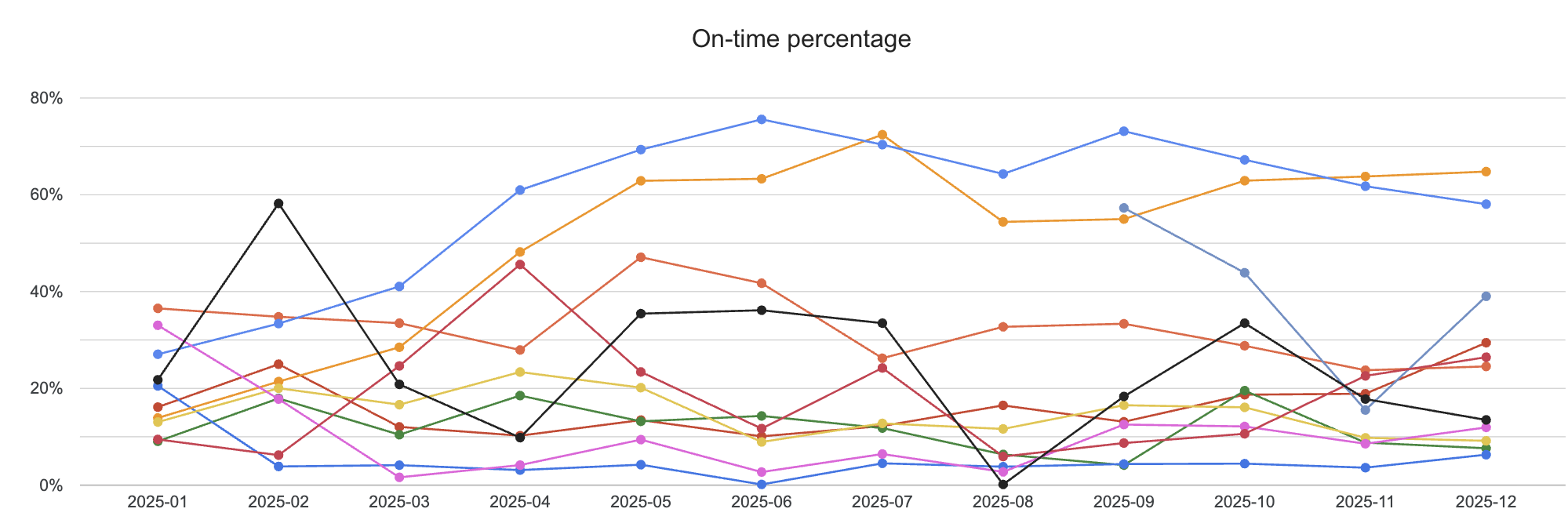
Monthly Delays by Carrier on Far East - Europe, 2025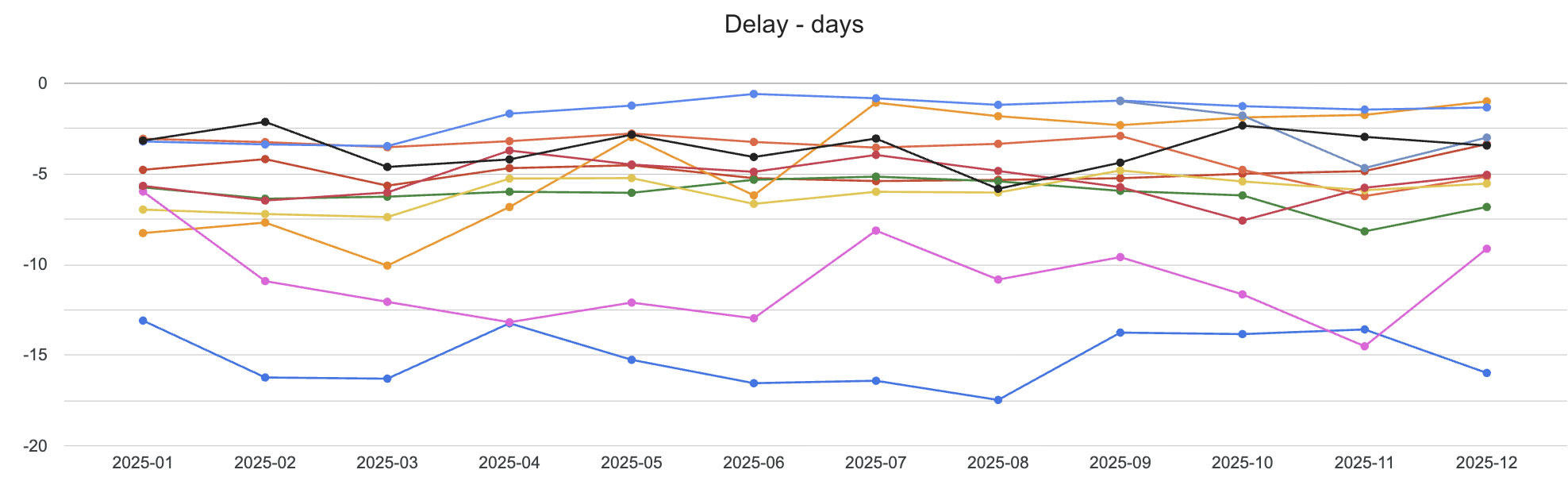
When considering a drop in trade-level reliability for a preferred carrier, shippers are advised to confirm if the same trends hold true on their specific port pairs before switching suppliers.
For parsing out port-to-port outliers or quickly scaling your backup plans, there’s no better tool than our Carrier Scorecard. If you need to tap directly into our global network of enriched carrier data, reach out to the Xeneta team today: contact@xeneta.com
.png?width=387&name=freight-ship-reliability%20(1).png)
.jpg?width=387&name=ocean-freight-shipping-reliability-scorecard--feb-26%20(1).jpg)