



Latest Xeneta ocean container shipping data highlights are provided below quotes from Xeneta Chief Analyst Peter Sand.
Xeneta has also published a dedicated webpage with the latest updates on the Middle East conflict including a live port congestion map.
Xeneta analyst insight
Peter Sand, Xeneta Chief Analyst
"The impact of conflict in the Middle East is making life increasingly complicated for shippers because, while they are firefighting supply chain disruption and elevated spot rates across global trades, they must play their cards carefully when tendering for new long term contracts or risk leaving money on the table."
Spot rates easing but variance between US and Europe
“The supply chains that carriers have built around the Middle East disruption – rerouting via land bridges, alternative ports, and new service networks – are now functioning with enough regularity that spot rates are beginning to reflect a more stable, if still elevated, operating environment.
“Far East to US West Coast rates essentially flat at USD 2 864 per FEU (40ft container) – albeit still more than 52% above pre-crisis levels at the end of February. Into US East Coast, spot rates are still up 46% compared to pre-crisis at USD 3 873 per FEU. These rates have reached a high plateau, sustained by ongoing congestion at Southeast Asian transshipment hubs and the knock-on effects of longer transit times across the network.
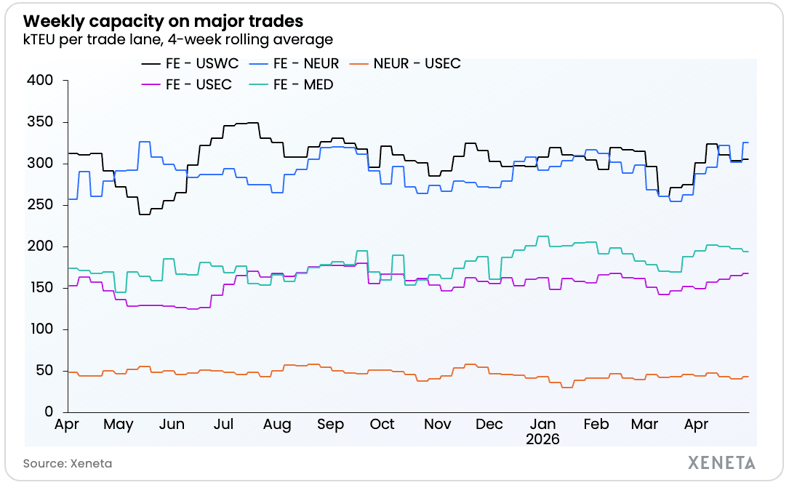
“The European-bound trades are softening to a larger extent. Capacity into North Europe is up 7.6% from a week ago and this combination of carrier adaptation on these corridors and the seasonal softening in second-quarter demand is allowing rates to come off their peaks more meaningfully than on the US-bound trades.
“Far East to North Europe spot rates are down 10% compared to one month ago at USD 2 528 per FEU. Far East to Mediterranean is down 15% in the same period at USD 3 567 per FEU."
Long term market
“The Middle East conflict is creating nervousness and very real operational disruption that is causing spot rates to spike, but you cannot hide from the market fundamentals of supply and demand.
“Xeneta customers tendering in 2026 have reported round one bids below the long term market average in the majority of cases, despite the elevated spot rates across major fronthaul trades. By round three, these shippers are securing even bigger discounts as carriers fight for their volumes for the next 12 months.
“This tells us that the long-term market is being driven by supply and demand fundamentals rather than the crisis-driven sentiment that is propping up the spot market. Carriers open negotiations with ambitious pricing, but shippers played their hand and pushed back effectively. With contracts now being finalised for implementation in May and June, this is a signal that the market expects the current level of disruption to be temporary – even if the spot market has not yet priced that expectation in.”
Data highlights
Market average spot rates – 30 April 2026
-
Far East to US West Coast: USD 2 864 per FEU
-
Far East to US East Coast: USD 3 873 per FEU
-
Far East to North Europe: USD 2 528 per FEU
-
Far East to Mediterranean: USD 3 567 per FEU
-
North Europe to US East Coast: USD 2 188 per FEU
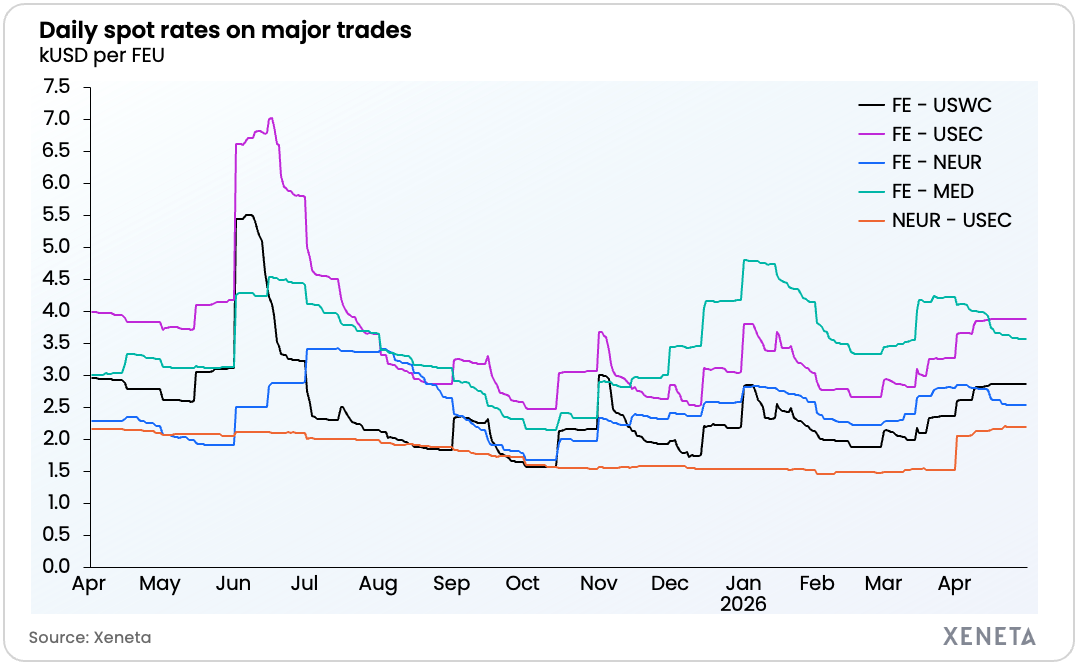
Spot rate changes in the past month – 30 April vs 30 March 2026
-
Far East to US West Coast: +21% (USD 2 368 to USD 2 864 per FEU)
-
Far East to US East Coast: +19% (USD 3 264 to USD 3 873 per FEU)
-
Far East to North Europe: −10% (USD 2 802 to USD 2 528 per FEU)
-
Far East to Mediterranean: −15% (USD 4 221 to USD 3 567 per FEU)
-
North Europe to US East Coast: +45% (USD 1 512 to USD 2 188 per FEU)
Rate signals on heavily impacted trades
As of April 29, average short term rates out of China are up by 24-310% since February 27 on trades most directly impacted by the Middle East conflict. Increases since April 13 are in brackets to show more recent easing.
-
Nhava Sheva: +31% (+44%)
-
Colombo: +21% (+39%)
-
Khor al Fakkan: +316% (+310%)
-
Jeddah: +59% (+76%)
-
Mersin: +11% (+24%)
Offered capacity on major fronthaul trades (4-week rolling average) – w/c 27 April 2026
-
Far East to US West Coast: +0.5% from a week ago
-
Far East to US East Coast: +1.4% from a week ago
-
Far East to North Europe: +7.6% from a week ago
-
Far East to Mediterranean: −1.5% from a week ago
-
North Europe to US East Coast: +7.4% from a week ago
Ends