



Latest Xeneta ocean container shipping data highlights are provided below quotes from Xeneta Chief Analyst Peter Sand.
Xeneta has also published a dedicated webpage with the latest updates on the Middle East conflict including a live port congestion map.
Xeneta analyst insight
Peter Sand, Xeneta Chief Analyst
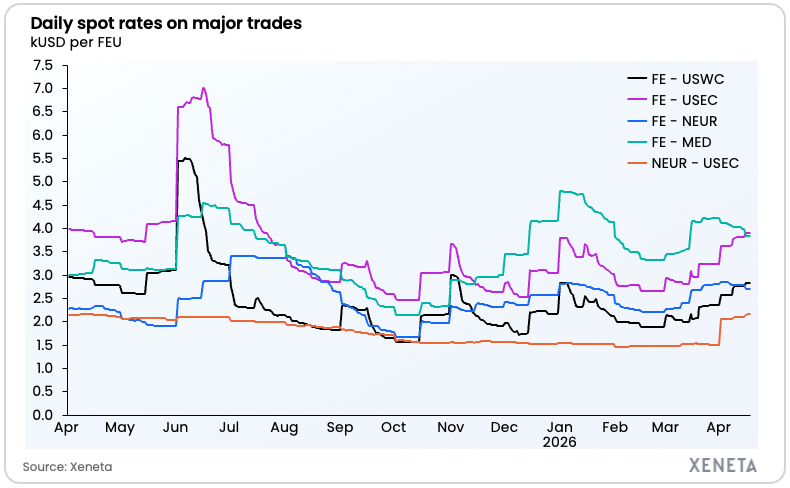
“The ocean freight market is sending very different signals depending where you look across global supply chains. Spot rates on European trades are easing – Far East to North Europe is down around 4% over the past week, Mediterranean down nearly 5%. But on the US-bound trades, rates are still climbing. Far East to US West Coast is up more than 50% since the end of February. That is not a market normalizing from the crisis caused by the Middle East conflict.
“The divergence tells us that the disruption from the Middle East conflict is far from over. Carriers have adapted on the European lanes – new routing patterns are in place and capacity is flowing more predictably. That is bringing some relief to shippers on those corridors. But none of that applies to the Transpacific or Transatlantic, where rates remain elevated and show no sign of retreating.
“Any talk of normalisation needs to account for the fact that the majority of global fronthaul trades are still deep in crisis-level pricing.
“Seasonal dynamics are also playing a role in the European softening – the second quarter is historically the weakest for container demand, which gives rates room to come off their highs. But this should not be mistaken for a structural improvement. The underlying disruption – longer transit times, lower schedule reliability, and the continued closure of the Strait of Hormuz – has not changed. What has changed is that carriers have found workarounds on certain trades.”
Data highlights
Market average spot rates – 17 April 2026
-
Far East to US West Coast: USD 2 833 per FEU
-
Far East to US East Coast: USD 3 894 per FEU
-
Far East to North Europe: USD 2 699 per FEU
-
Far East to Mediterranean: USD 3 842 per FEU
-
North Europe to US East Coast: USD 2 157 per FEU
Spot rate changes since the end of February – 17 April vs 28 February 2026
-
Far East to US West Coast: +51%
-
Far East to US East Coast: +44%
-
East to North Europe: +26%
-
Far East to Mediterranean: +21%
-
North Europe to US East Coast: +43%
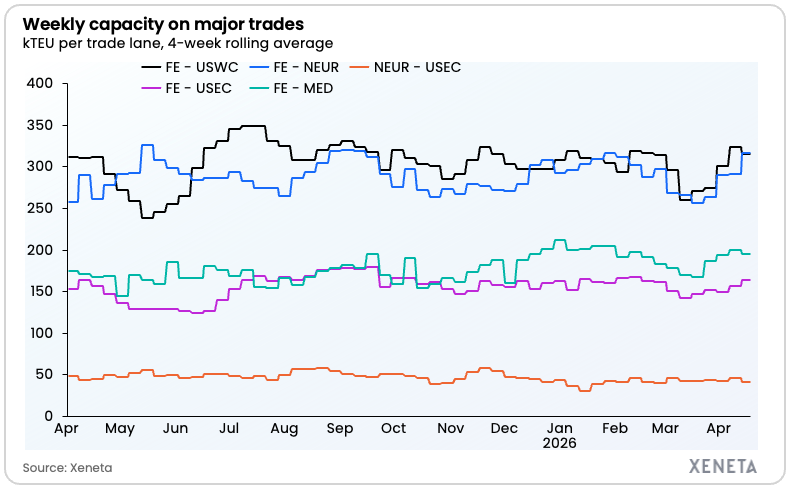
Offered capacity on major fronthaul trades (4-week rolling average) – w/c 13 April 2026
-
Far East to US West Coast: −2.3% from a week ago
-
Far East to US East Coast: +4.4% from a week ago
-
Far East to North Europe: +8.5% from a week ago
-
Far East to Mediterranean: −2.1% from a week ago
-
North Europe to US East Coast: −9.0% from a week ago
Ends