



Latest Xeneta ocean container shipping data highlights are provided below quotes from Xeneta Chief Analyst Peter Sand.
Xeneta has also published a dedicated webpage with the latest updates on the Middle East conflict including a live port congestion map.
Xeneta analyst insight
Peter Sand, Xeneta Chief Analyst
“Conflict in the Middle East forced carriers to build entirely new service networks with little to no warning, including rerouting via land bridges such as Jeddah and alternative ports on the Indian Ocean coastline. On the European ocean container shipping trades, these new routing patterns are now established and carriers have reorganised capacity, meaning freight rates are easing from the spike in the immediate aftermath of conflict.
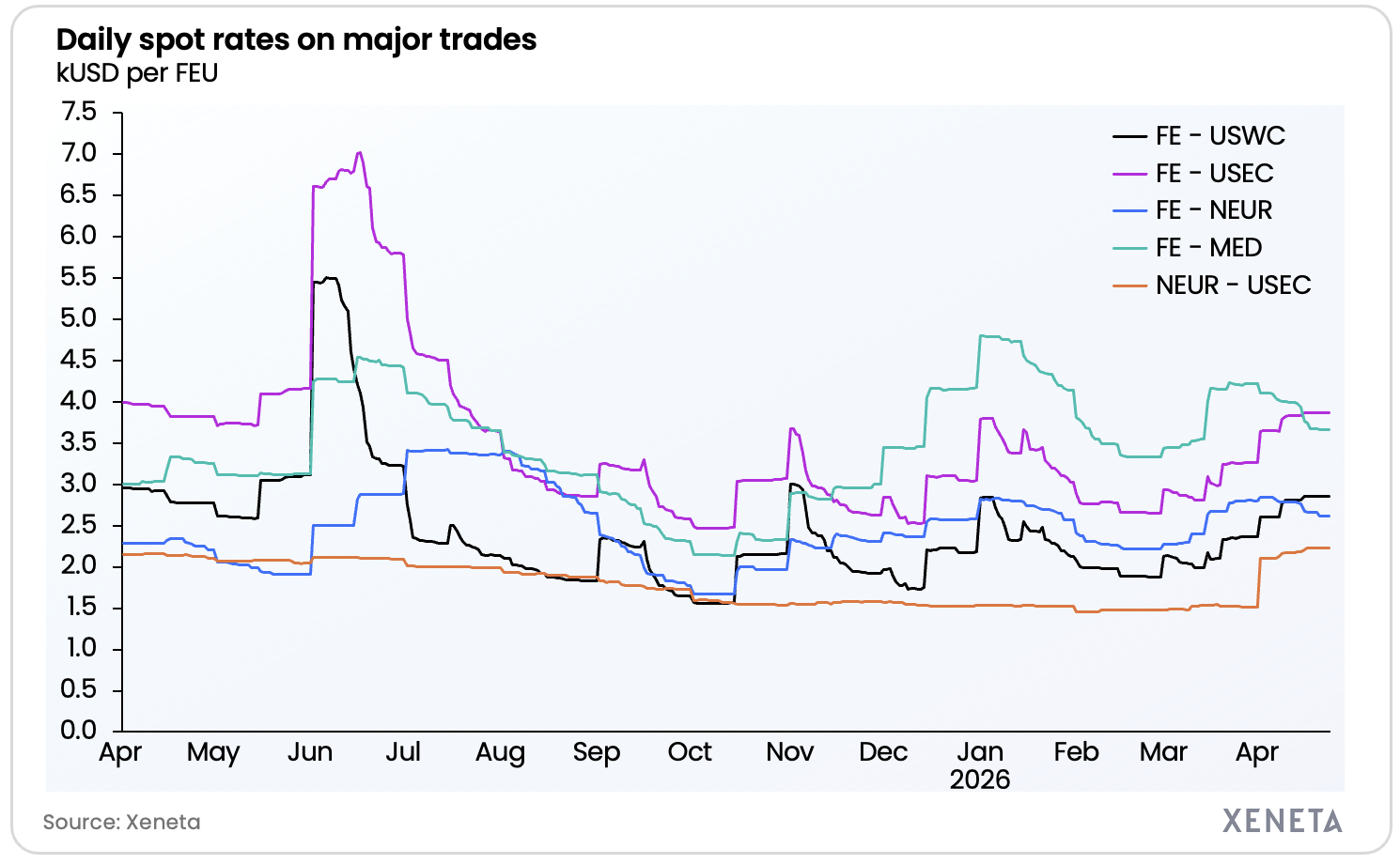
"Compared to one month ago, average spot rates from Far East are down −6% to North Europe and -13% to Mediterranean.
"The softening on the European trades should not be read as a sign that the market is returning to normal. The Strait of Hormuz remains effectively closed to container shipping, the ceasefire is fragile, and, while the alternative routing arrangements that carriers have put in place are stabilizing supply chains, they are still costly workarounds.
“Until there is greater assurance of safe and free passage for ships in the Strait of Hormuz, the underlying drivers of disruption – longer transit times, reduced schedule reliability, congestion at alternative hubs, and elevated surcharges – will continue to hold freight rates above pre-crisis levels.
“On US-bound trades from the Far East, freight rates are still elevated from one month ago as disruption in the Middle East continues to have a cascading effect through Southeast Asian transshipment hubs. Shippers moving cargo to the US via these hubs are paying the price for bottlenecks created thousands of miles away.
“Far East to US West Coast spot rates are up 22% over the past month, while Far East to US East Coast is up 19%. Even the Transatlantic from North Europe to US East Coast – which does not call at Asia transshipment hubs or Middle East ports - has surged 46% compared to one month ago.
“The crisis is still very much present – it has simply migrated from the regional to the global.
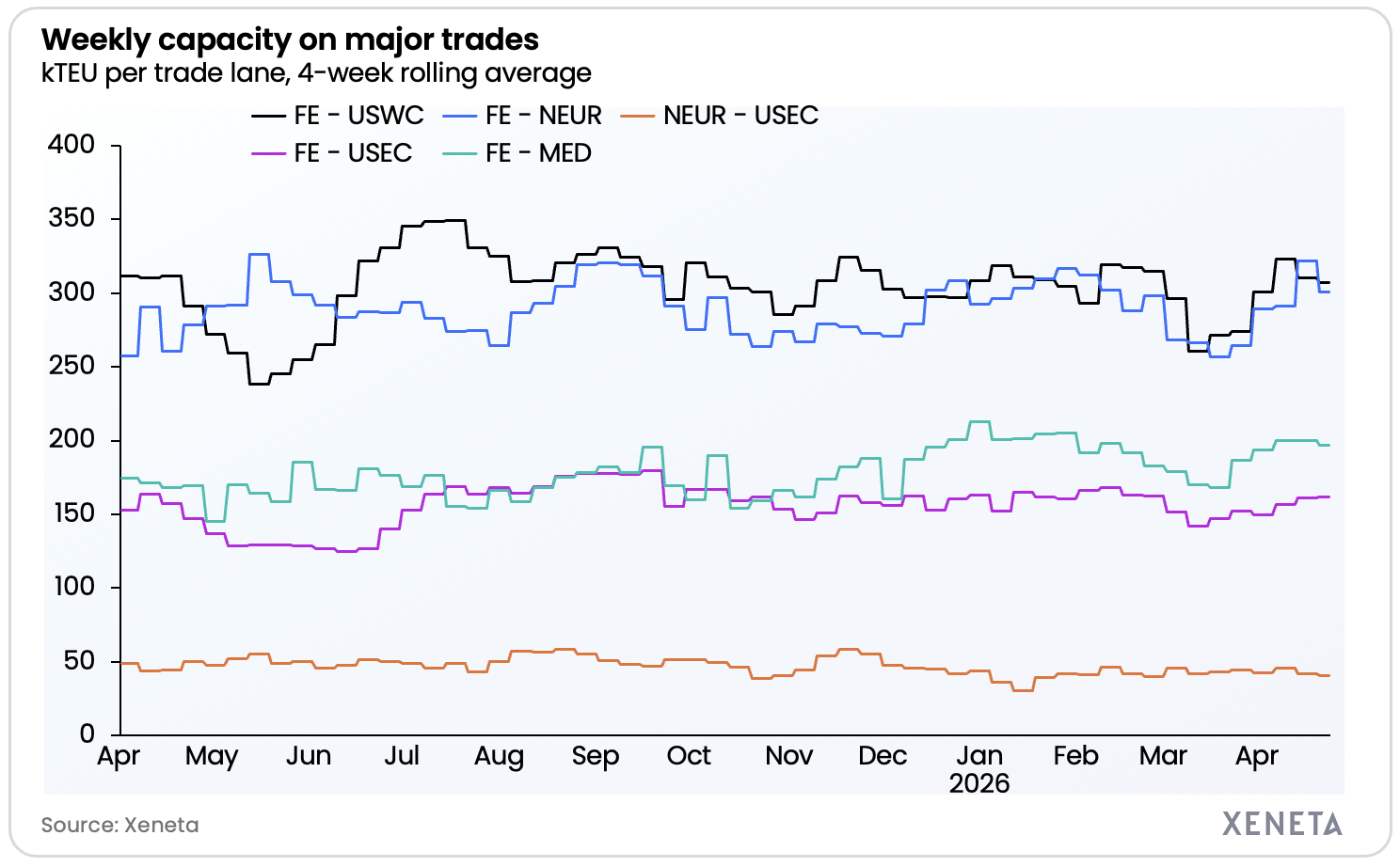
“Carriers are actively managing capacity to prevent rates from falling freely on the European trades while also keeping the US-bound trades tight. Four of the five major fronthaul trades saw capacity decline this week, with Far East to North Europe down 6.6%. That combination of crisis-driven congestion and deliberate supply management is why rates remain elevated across the board, even where the direct impact of the conflict should be limited.”
Data highlights
Market average spot rates – 23 April 2026
- Far East to US West Coast: USD 2 857 per FEU
- Far East to US East Coast: USD 3 871 per FEU
- Far East to North Europe: USD 2 618 per FEU
- Far East to Mediterranean: USD 3 665 per FEU
- North Europe to US East Coast: USD 2 225 per FEU
Spot rate changes over the past month – 23 April vs 23 March 2026
- Far East to US West Coast: +22%
- Far East to US East Coast: +19%
- Far East to North Europe: −6%
- Far East to Mediterranean: −13%
- North Europe to US East Coast: +46%
Offered capacity on major fronthaul trades (4-week rolling average) – w/c 20 April 2026
- Far East to US West Coast: −1.0% from a week ago
- Far East to US East Coast: +0.6% from a week ago
- Far East to North Europe: −6.6% from a week ago
- Far East to Mediterranean: −1.7% from a week ago
- North Europe to US East Coast: −2.3% from a week ago
Ends
Journalists can be added to the distribution list for Xeneta Weekly Market Updates by emailing press@xeneta.com.