

For chemical procurement leaders, trade policy disruption has accelerated to a pace that outstrips the planning cycles most organisations rely on. In early 2025, US chemical imports spiked to over $20 billion in March alone — the highest in more than three years1 — as buyers front-loaded orders ahead of anticipated tariff increases. By April, imports had dropped sharply, leaving teams sitting on bloated inventories and facing softer demand. The stop-start pattern repeated throughout the year, reshaping freight seasonality and making budgeting little more than informed guesswork.
For chemical companies specifically, the stakes are unusually high. Chemical inputs are woven deeply into downstream manufacturing across automotive, agriculture, construction, and consumer goods. When freight costs spike unexpectedly — or when a favoured trade lane suddenly becomes expensive or unreliable — the ripple effect can be wide and rapid.
A New Layer of Risk: The Iran War
The United States and Israel attacked Iran on February 28, triggering a conflict that has driven Brent crude to levels Goldman Sachs expects to average $110 in March and April — a 62% jump from the 2025 annual average.
The scale of disruption is difficult to overstate. IEA executive director Fatih Birol has described the energy shock as more severe than the two consecutive oil crises of 1973 and 1979 combined, with at least 44 energy assets damaged across nine countries (CNN). Markets are reflecting that uncertainty in real time — Brent crude swung 14% in a single session after President Trump announced productive talks with Iran, one of the biggest intraday moves on record. Goldman Sachs warns that if Hormuz flows remain at 5% of normal for ten weeks, prices could surpass the 2008 record high.
Helium: The Hidden Supply Chain Casualty
Beyond oil and freight, the conflict is exposing a vulnerability that rarely appears in boardroom discussions but sits at the heart of advanced manufacturing: helium. Iranian drone and missile strikes targeted Qatar's Ras Laffan Industrial City — the single largest concentration of helium production infrastructure in the world — forcing QatarEnergy to halt all liquefied natural gas (LNG) and associated production on March 2 and declare force majeure on affected contracts. The company's CEO has stated production will not restart until the conflict ends, and that even then, normalisation would require weeks to months.
The Strait's effective closure has taken roughly 27% of global helium supply offline. Analysts estimate a monthly shortfall of 5.2 million cubic metres, with spot prices already surging 70–100%. Alternative supply from US caverns, Russian Amur 2, and German storage can offset only around half of lost volumes, leaving Europe and parts of Asia significantly exposed.
The downstream implications extend well beyond specialty gas buyers. Helium is an essential component of semiconductor manufacturing — used in the chip fabrication process for establishing stable vacuum environments, ensuring precise photomask alignment, and cooling semiconductor materials to reduce thermal stress. Unlike other industrial gases, there is no effective substitute. South Korea, home to Samsung and SK Hynix and producer of roughly two-thirds of global memory chips, sources approximately 65% of its helium from Qatar. The Seoul government has flagged helium as one of 14 semiconductor supply chain materials now under active monitoring.
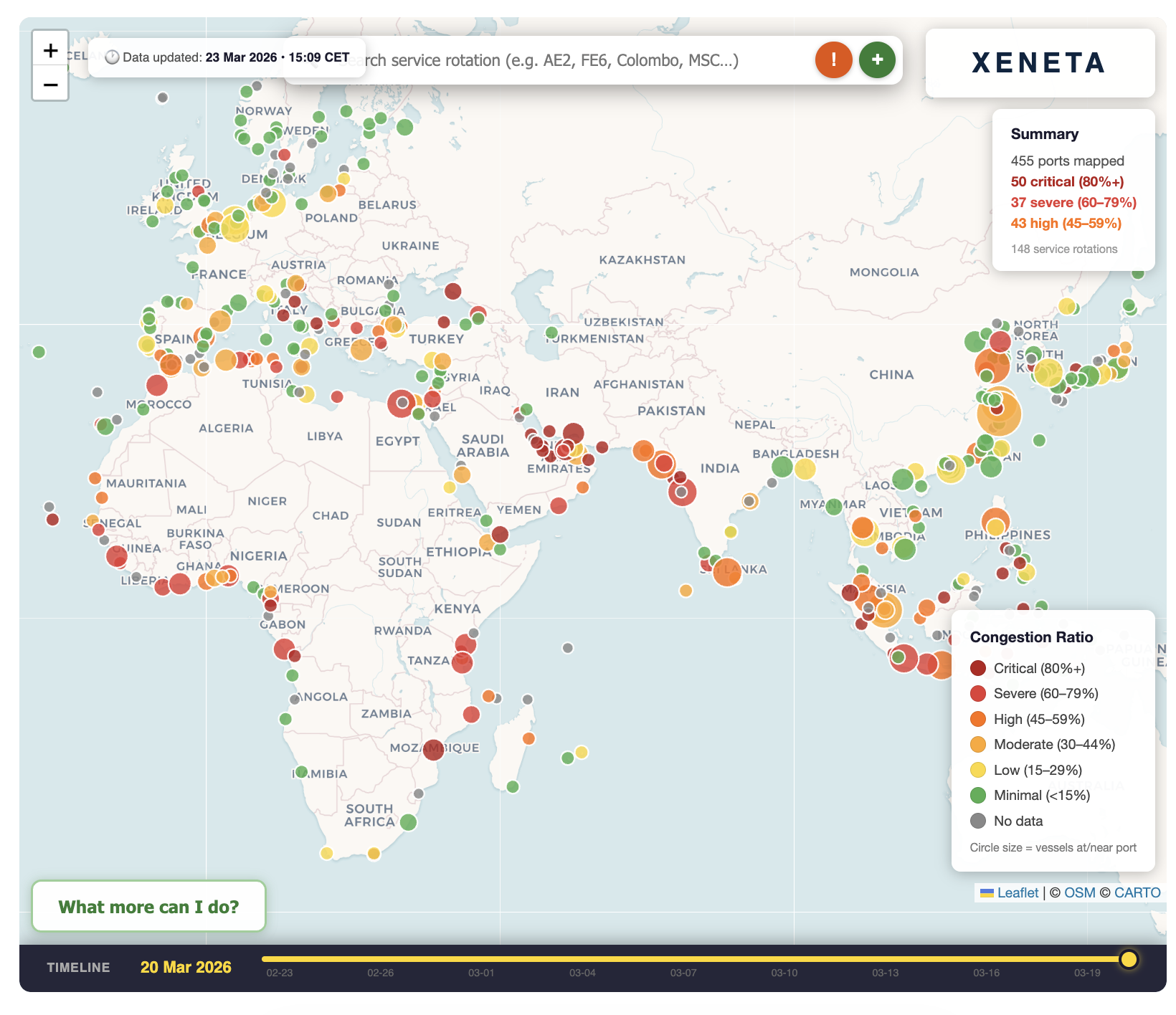
For chemical procurement leaders, the lesson is direct: supply chain risk no longer announces itself through obvious channels. The same is true of dozens of other specialty chemicals and industrial gases whose exposure to geopolitical disruption is only visible once the disruption has already arrived.
Surcharges, Rerouting and the Cost of Disruption
And where the risks are visible, they are not letting up. The Red Sea crisis has now entered its third year, with the majority of container vessels serving Asia-Europe lanes continuing to avoid the Suez Canal in favour of the Cape of Good Hope route. The detour adds up to 14 days to transit times with the longer route has had a lasting price. Xeneta data shows long-term contract rates into North Europe are still 58% above where they stood before the crisis took hold at the end of 2023. Chemical companies with European manufacturing operations sourcing raw materials from Asia have felt this acutely — and many have had to absorb the cost.
"Port congestion delayed critical solvent imports, impacting production timelines. We went through customer delivery pressures, had to manage stock rationing and negotiated expedited logistics to restore operational stability."
Senior Procurement from a Singapore based Chemical Shipper, The 2026 Freight Report
Meanwhile, the tariff landscape has been anything but stable. The Global Economic Policy Uncertainty Index2 reached a record high following the April 2025 reciprocal tariff announcement, leaving procurement teams scrambling to model impacts, reroute supply chains, and renegotiate contracts — often at short notice and at inflated spot rates.
US chemical imports from China dropped nearly 30% year-on-year in the second quarter of 20253 — a structural shift that forced supply chains to be rebuilt around alternative origins in Southeast Asia and India. Each rerouting decision carries freight cost implications. Without real-time rate benchmarking, procurement teams cannot know whether the rates they are accepting are reasonable for the market — or whether carriers are capitalising on urgency.
What Your Peers Are Telling Us
Xeneta's survey of 450 procurement and supply chain leaders — spanning chemicals, pharmaceuticals, retail, manufacturing and beyond — reveals a sector absorbing financial strain that outpaces almost every other industry.
Notably, not a single chemical or pharmaceutical respondent reported zero tangible financial impact from supply chain disruption over the past 12 months. Every organisation in the sector is absorbing cost — the question is whether that cost is managed proactively or discovered after the fact. Now you know, the next question is what you'll do next.
The reactive approach is expensive. Last-minute mode shifts — switching from ocean to air freight, or accepting spot rates far above contracted levels — are often unavoidable when visibility into market conditions is limited. The organisations that get ahead of these decisions are those with access to independent freight rate intelligence that tells them where markets are heading, not just where they have been.
The Freight Market in 2026: Opportunity and Risk
2026 started as a shippers' market. But chemical procurement teams would be right to approach the rest of the year with caution.
Surprise surcharges, heightened tensions in the Middle East, and ongoing uncertainty around Red Sea routing mean that rates, schedules, and budgets are shifting faster than most planning cycles can absorb. And when price volatility feeds directly into freight cost, feedstock cost, and specialty input cost simultaneously, the window between market signal and procurement response gets compressed.
"50% of chemical and pharma organisations have increased contingency budgets due to volatility. Only 10% operate a fully data-driven procurement model. The gap between those two numbers is costing the sector."
The 2026 Freight Report, Xeneta
In a market that moves daily, the cost of delayed action is measurable. Xeneta's platform benchmarks contracted and spot rates at lane level — drawing on data from hundreds of global shippers — so procurement teams know exactly where they stand on a specific port pair, not just a trade corridor average.
That granularity matters when surcharges land unexpectedly or a new contract is on the table. It gives procurement teams the context to have more informed, productive conversations with carriers — understanding what is driving a rate movement, and whether it reflects the broader market.
Volatile markets are also pushing shippers and carriers to work more closely throughout the life of a contract, not just at signing. Xeneta Ocean Schedules supports that ongoing relationship — tracking actual vessel performance against structural carrier schedules, so both sides are working from the same operational reality. Blank sailings, missed port calls, delays: spotted early, before they become emergencies.
The chemical procurement teams pulling ahead aren't overhauling everything at once. One small shift — replacing guesswork with independent rate benchmarking on your key lanes — changes what every conversation with a carrier looks like.
Relationships may open doors; data makes sure you walk through the right ones.
Sources:
1 USITC DataWeb, Imports: For Consumption, includes data through July 2025.
2Deloitte 2026 Chemical Industry Outlook
3ibid