


.jpg?width=1200&name=ocean-freight-shipping-reliability-scorecard--feb-26%20(1).jpg)
March reliability rebound masks disruptions across global networks
March marked the first positive trend in schedule reliability since the start of the year, but these developments should not be taken at face value.
Global on-time performance rose sharply from 27% to 36% of on-time arrivals after 4 consecutive months of deterioration beginning in Q4 2025. While the headline figures point to relief, a closer look at trade-level performance, cancellation rates, and regional dynamics reveals that network elasticity is being pushed to its limits.
Global
Global on-time performance rose to 36% in March, up from 27% in February and 30% in January. Average delays also improved, falling to -4 days, compared to -4.5 days in the previous month.
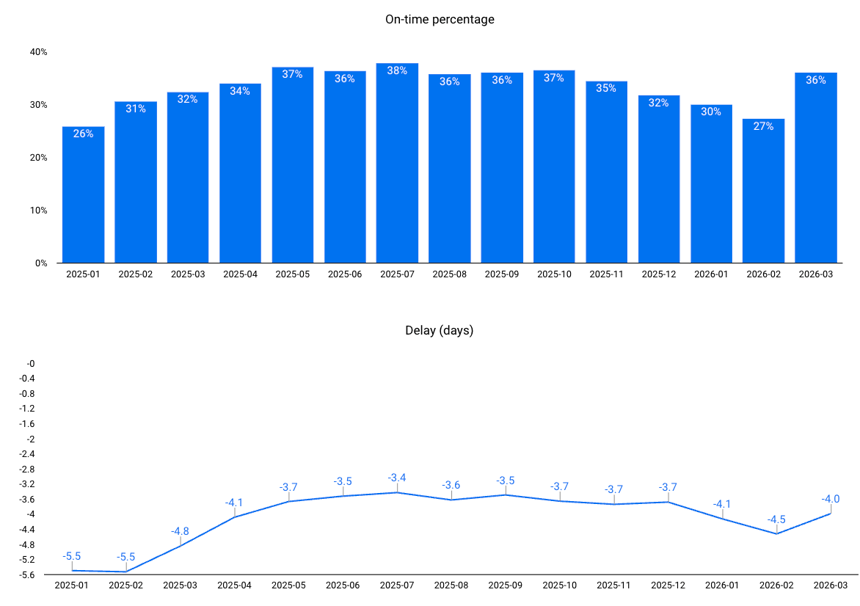
This is a clear break from the downward trend seen since November 2025, and the increasing severity of delays. However, despite shorter delays, performance has not returned to December 2025 levels when late arrivals averaged -3.7 days.
At best, March might be interpreted as a stabilization phase rather than a return to normal operating conditions or a sustained recovery. The symptoms of poor reliability may have eased, but the causes of that underlying friction remain largely unresolved.
Trade
The March rebound is visible across all major east/west trades, but as is often the case, positive developments are unevenly distributed and grounded in nuance.
.png?width=1280&height=872&name=trade%20(1).png)
In the sharpest shift from February outcomes, Asia - North America saw a recovery from 23% of on-time arrivals to 53% in March. Asia – Europe also improved from 19% to 33% of on-time arrivals.
The improvement of transpacific trade reliability stands out this month, and is driven by the easing of weather-related disruptions in the Pacific as well as post-Chinese New Year slowdown. The ports of Los Angeles and Long Beach saw their strongest performance since September 2025, reaching 59% of on-time arrivals.
On Asia – Europe, repeat disruptions from weather-related congestion and temporary operating suspensions at select European ports have largely eased. However, this trade remains structurally constrained by longer routing around the Cape of Good Hope and persistent network inefficiencies, including chronic delays on several alliance strings.
The Middle East, which is often in the poorest performance group and has ranked at the very bottom since January 2026, saw modest improvement from 18% to 24% of on-time arrivals from February to March. Delays also decreased in severity by a full 24-hours to an average -5 days of delay.
While these improvements are notable, they should not be read as evidence of a smooth system reset in response to the war in the Persian Gulf.
Service and voyage-level adjustments have distorted performance metrics. Many services initially responded to the closure of the Hormuz Strait by omitting Persian Gulf port calls and calling at alternative relay ports in the surrounding region earlier in their rotations. These necessities translate into shorter delays on paper, but not smooth operations on the ground.
Many vessels also conducted inducement calls to nearby ports during the first wave of displacement – these calls create a blind spot in the measurement of reliability against established schedules.
The results for March on Asia – Middle East strings are further complicated by the operational strategies implemented later in the month. Reduced carrier participation, fewer port calls, and rotations being readjusted to focus on the Indian Subcontinent or Mediterranean ports all signal superficial improvement.
A significant portion of the 250,000 TEU of weekly tonnage normally bound for ports like Jebel Ali or Abu Dhabi has already been redistributed to intra-Asia and Asia – Europe cargo flows, changing the allocation of reliability outcomes.
If operational complexity can yield false positives for a region in crisis, what type of information helps ground perspectives in reality?
Across Asia–North America and Asia–Europe combined, lost sailings in March 2026 accounted for 17% of planned sailings, aligned with March 2025. However, the composition of those cancellations reveals a deeper trend. Blank sailings rose to 20% of planned sailings, up from 13% a year earlier, indicating a higher reliance on deliberate capacity withdrawals as opposed to ad-hoc operational disruption from delays and omissions.
In the Middle East, lost sailings accounted for 20% of planned sailings, lower than the 23% recorded in March 2025. On the other hand, blank sailings rose sharply to 23% against 16% in 2025, again suggesting a transition toward proactive capacity withdrawals.
This reinforces the framework that improvements in reliability are being supported by increased voyage cancellations, rather than a significant recovery in underlying network performance.
Alliances
The March rebound has compressed performance differences between alliances, but it has not fundamentally reshaped the competitive landscape.
Top 5 alliances by on-time performance (March 2026)
- Gemini Cooperation — 63% / -1.5 days
- Ocean Alliance — 40% / -3.7 days
- Non-alliance carriers — 34% / -3.9 days
- MSC (standalone) — 23% / -4.3 days
- Premier Alliance — 20% / -6.0 days
Gemini Cooperation continues to lead with 63% of vessels arriving on time and an average delay of -1.5 days, maintaining a comfortable lead over its peers. However, performance remains well below the 76% of on-time arrivals in December 2025, indicating that even the most stable network has not been immune to recent disruptions.
.png?width=1192&height=430&name=alliances-otponly-new%20(1).png)
Ocean Alliance recorded the most significant rebound, achieving up to 40% on-time arrivals and nearly doubling its February level. Premier Alliance also improved by 11 percentage points up from 9% but remains at the bottom of the rankings with just 20% of vessels arriving on time and the most severe delays of –6 days late.
MSC's standalone network saw the least change, with a modest 3 percentage points of improvement in March up to 23%, while non-alliance carriers recovered to 34% on-time.
Carriers
The market in March was also characterized by a tighter competition at a carrier level, with both COSCO and CMA CGM creeping closer to Gemini Cooperation partners Maersk and Hapag-Lloyd in the Top 2. However, improvements in on-time performance are not always matched by equivalent reductions in delay severity. Note that despite improved on-time percentages, all competitors outpace average arrival delays for Hapag-Lloyd and Maersk by a full day or more.
Top 5 global carriers by on-time performance (March 2026)
- Hapag-Lloyd — 52% / -2.6 days
- Maersk — 50% / -2.6 days
- COSCO — 40% / -3.5 days
- CMA CGM — 40% / -3.6 days
- ZIM — 36% / -4.2 days
Hapag-Lloyd and Maersk remain the benchmark, both operating above 50% on-time performance and with the lowest delay severity among major carriers of –2.6 days. That said, both vessel operators improved more modestly against their peers in March, with Maersk gaining 5 percentage points and Hapag-Lloyd 3 against their on-time performance in February.
Not so far behind them, COSCO and CMA CGM posted strong recoveries in March, up by 18 and 9 percentage points respectively to 40% on-time, while ZIM rounds out the top five following a month-on-month improvement of 6 percentage points and 36% of arrivals on-time.
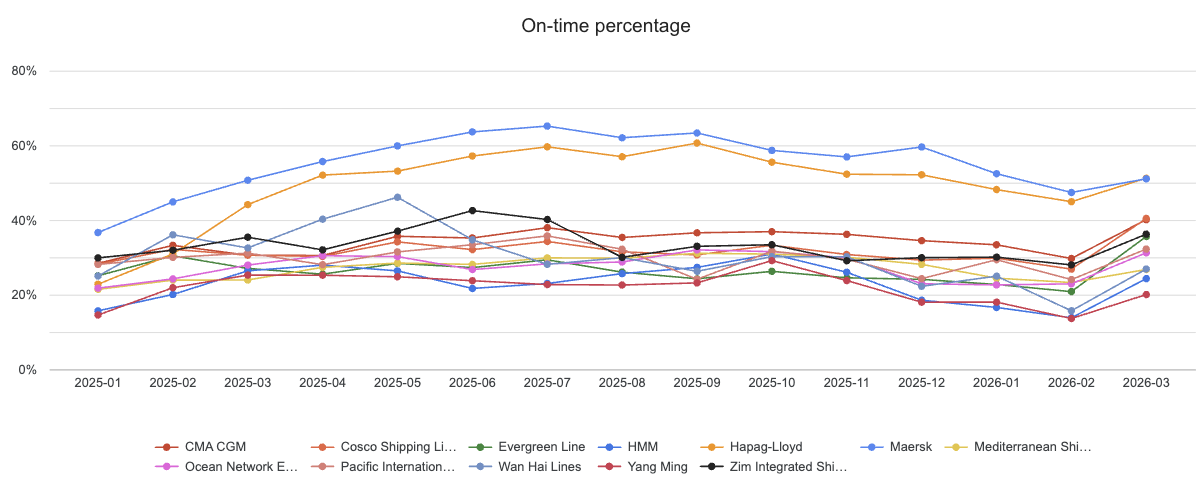
On the surface, the most significant gains were seen among carriers that had fallen the furthest in February. This recovery has compressed the spread between top and mid-tier performers, but structural differences in network management remain a key differentiator.
As for network strategies that yielded notable improvements in reliability; MSC and Evergreen stand out in terms of reduced activity on the Middle East trade in March. MSC reduced weekly port calls by 28% to an average of 49 per week, and Evergreen Line decreased calls by 24% down to 24 per week.
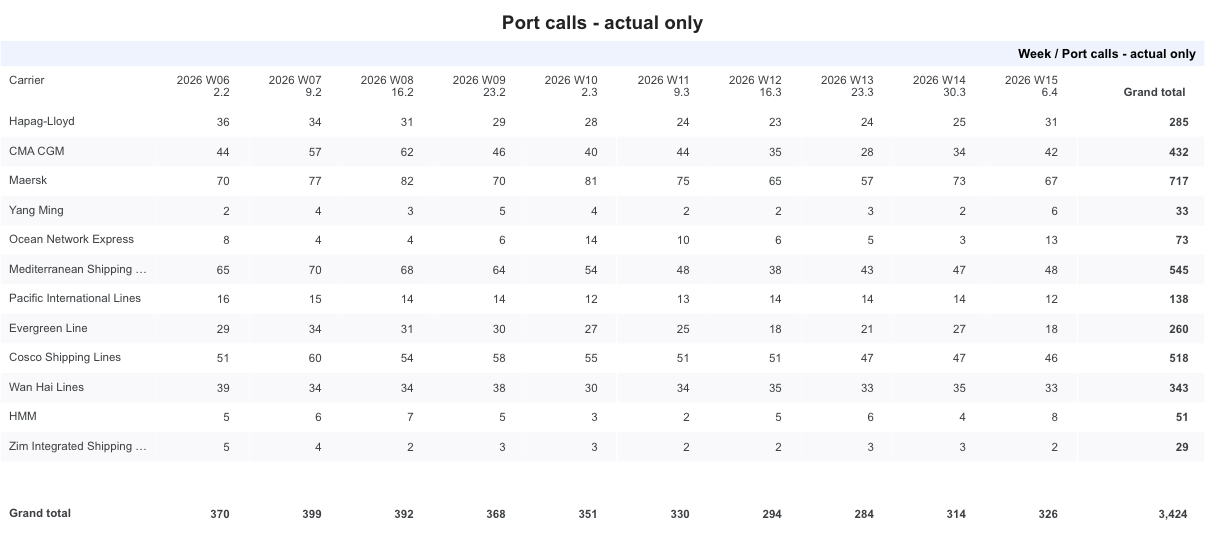
On the other end of the spectrum, Hapag-Lloyd and Maersk may have appeared to lag in their recovery, but their partnership on the Gemini Cooperation has a well-established operating philosophy of avoiding blanked sailings. In the past three months, Gemini services accounted for just 2% of blank sailings across all deep-sea trades and less than 4% of global lost TEU. By comparison, COSCO and CMA CGM's partnership on Ocean Alliance represents 10% of blank sailings globally since the start of 2026, and 18% of the lost capacity.
What's next?
March offers some relief after a weak start to the year, but the underlying conditions for a sustained recovery remain absent. The key risk is not simply ongoing geopolitical disruption, but a continued reliance on short-term network adjustments that maintain performance at a surface level.
Elevated cancellation rates, regional instability, and uneven shock absorption across trades all point to a market that remains sensitive to further disruption.
For shippers, this reinforces the need to evaluate reliability at a service level across multiple metrics, rather than relying on carrier or alliance averages alone. As network strategies continue to shift, so too does the reliability of the services behind them.
April is already testing the limits of predictability in decision-making, with ongoing disruption and evolving carrier responses continuing to erode confidence during tenders.
Xeneta's Carrier Comparison Scorecard provides a clean view of supplier performance at a service level, helping shippers understand how these dynamics impact their supply chains. For a deeper assessment of how evolving network strategies inform routing decisions, Xeneta's Advisory team works with shippers to translate market signals into more resilient procurement strategies.
.png?width=387&name=freight-ship-reliability%20(1).png)