


Oslo - Norway, 8 April 2026
The US-Iran ceasefire will likely bring some immediate relief to air freight, but a full return to pre-conflict capacity and rates on trades transiting Middle East hubs is still one to two months away, according to Xeneta analysts.
Airspace restrictions across the Gulf in the aftermath of US-Iran conflict forced airlines to ground aircraft and cut capacity on key freight corridors, pushing rates sharply higher on routes transiting Middle East hubs - particularly Southeast Asia to Europe and South Asia to Europe.
Niall van de Wouw, Xeneta Chief Airfreight Officer, said: “This has been a supply issue from the start. The moment airlines start increasing flights through Middle East airspace, it will put less pressure on the existing capacity and create a downward pressure on rates.
“Bringing air capacity back to these corridors should provide welcome relief for shippers, many of whom are facing continuing severe disruption in ocean supply chains which will take far longer to recover from this conflict."
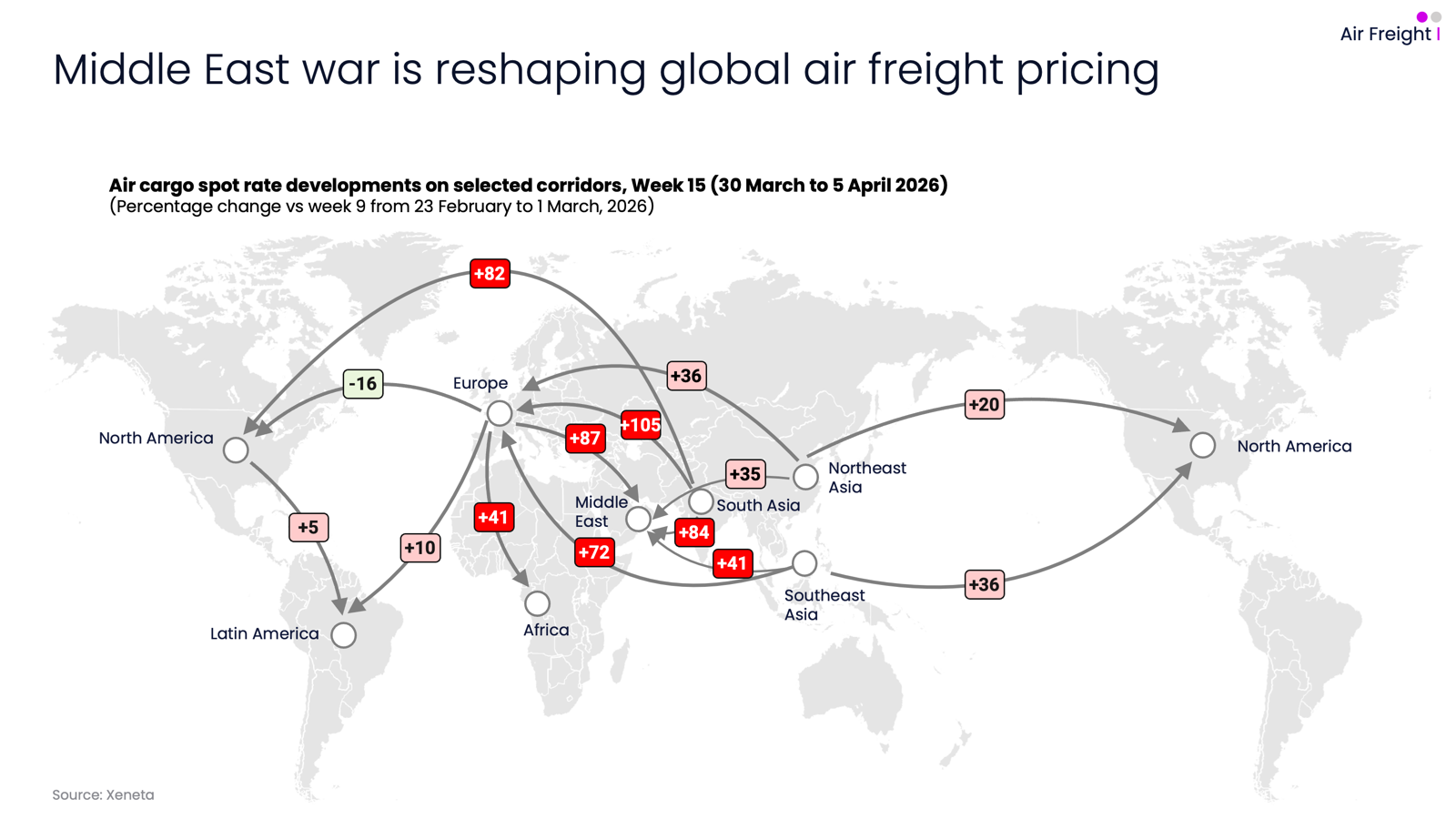
In the week ending 5 April, Xeneta data shows air cargo spot rates up +105% on the South Asia to Europe corridor. Spot rates are also up +87% from Europe to Middle East, +84% from South Asia to Middle East, +82% from South Asia to North America and +72% from Southeast Asia to Europe.
Falling jet fuel prices will add further downward pressure, however, van de Wouw cautions rates will not fall as fast as they rose and that a full recovery to pre-conflict service levels is likely to take one to two months.
He said: “Even when it is deemed safe to fly, setting up the infrastructure again takes time. Customers need to find you again and trust you again. Insurance companies may still advise against transiting these Middle East hubs despite the ceasefire.
“Carriers will be in no rush to lower rates given the ceasefire is only temporary and the geopolitical situation remains uncertain. Shippers will also not rush into major routing decisions on the basis of a fragile two-week ceasefire, especially given Iran’s re-closure of the Hormuz Strait a matter of hours after the agreement was announced. Regardless, a two-week timeline is too short to justify restructuring freight plans - so I do not expect spot rates to go down as fast as they went up.”
Van de Wouw identifies passenger confidence as a key variable in recovery of airfreight in Middle East corridors.
He said: “Gulf carriers such as Emirates and Qatar Airways operate some of the world's most important air freight networks, but those networks depend on passenger revenue. If tourist confidence in Middle East destinations takes time to recover — even after the ceasefire — airlines may operate routes at below-sustainable passenger load factors and could cut network capacity as a result.
“Will airlines operate those routes or cut their networks based on demand? This is a key variable for the short-term recovery for air freight."
Ends