



.jpg?width=1200&name=ocean-freight-shipping-reliability-scorecard--feb-26%20(1).jpg)
Welcome to Xeneta's February 2026 Schedule Reliability Scorecard (SRS). Last month we looked back at the global on-time performance for January and asked 'Is this decline a temporary blip, or a trend?'
Our data reveals that the decline of on-time percentage is now a distinct trend, and we are entering a period of systemic disruptions with massive ripple effects.
Global
Global on-time performance fell to 27% in February, the lowest level since January 2025 when we saw 26% of vessels arrive on-time. The key difference is that Q1 2025 was characterized by massive alliance shifts that necessitated sweeping delays, blank sailings, and omissions across several trades.
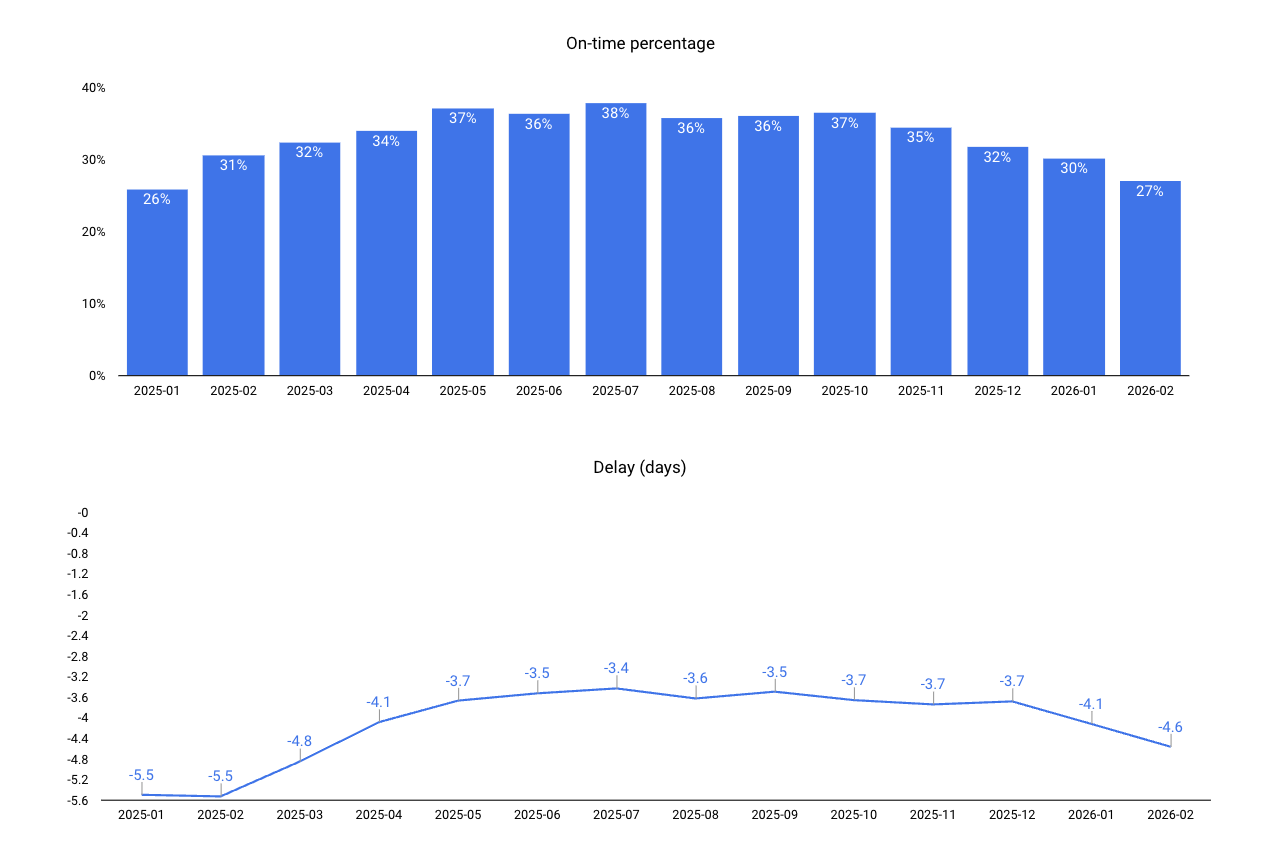
What we are facing now is the impact of sustained pressure across E/W trades and repeat disruptions in key regional hubs. The subtle dip down to 35% in November was just the beginning of a slow but sustained decline.
Average global delays have echoed the trend, increasing by another 12 hours from January's 4.1-day average. When disruptions are causing more than a higher number of late arrivals, but also increasingly severe delays, this often indicates the early stages of a more prolonged period of reduced reliability.
Trade
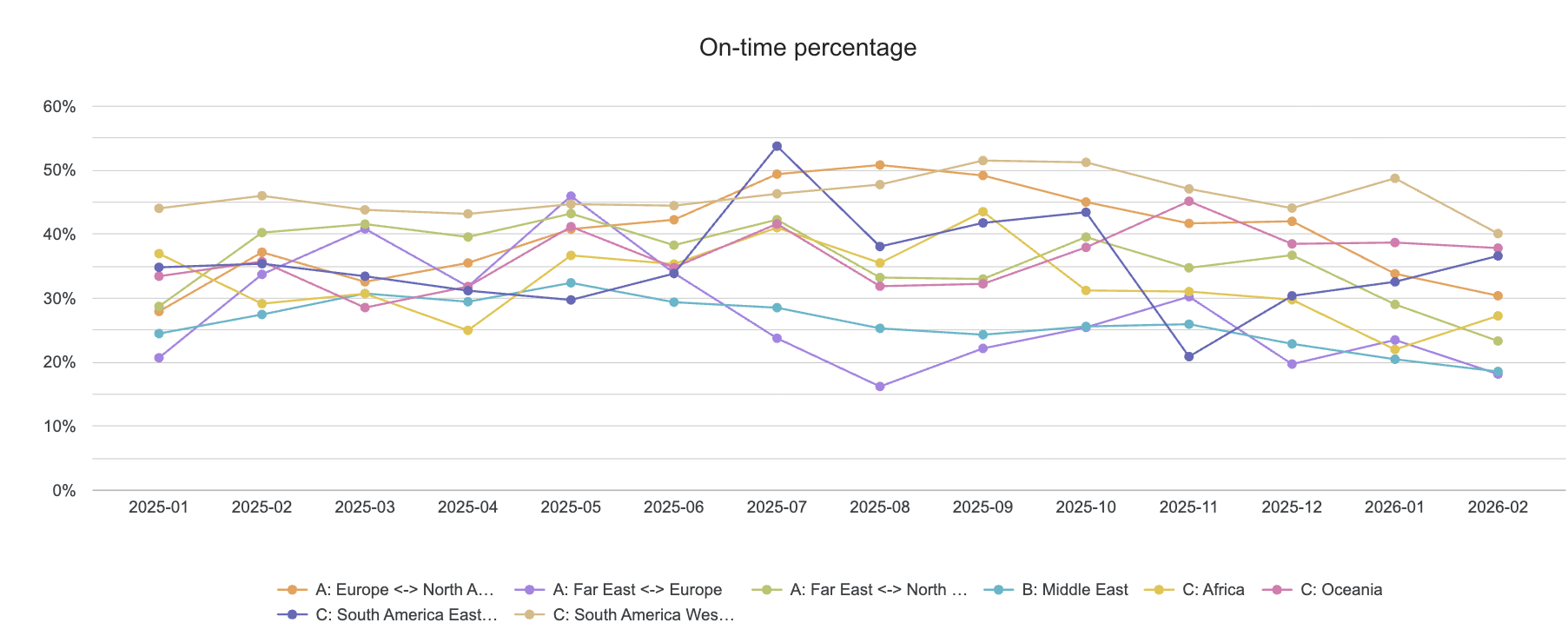
The decline of on-time arrivals for all but Africa and Oceania trades over the past month further reinforces signals that recent developments are more than seasonal challenges.
A look at our hierarchy reveals there are no clear outliers to be found in this landscape, only evidence of least worst impact:
Trade Lanes — Best to Worst (OTP / Avg Delay)
- South America West Coast — 40% / -2.5 days
- Oceania — 38% / -3.3 days
- South America East Coast — 38% / -3.7 days
- Europe ↔ North America — 29% / -3.0 days
- Africa — 27% / -5.4 days
- Far East ↔ North America — 23% / -3.6 days
- Far East ↔ Europe — 19% / -4.9 days
- Middle East — 18% / -6.6 days
Far East – Europe, still suffering from the strain of transit times around the Cape of Good Hope, saw a decline of 5.9 percentage points down to 18% — its lowest point since August 2025. This considerable deterioration was matched by the Middle East trade, down by 3.4 percentage points to 18% as well.
While their baselines are higher, Far East – North America and West Coast South America had the worst slump of all, falling by 5.9 and 8.4 percentage points against January, down to 23% and 40% respectively.
It's not uncommon to see schedule reliability decline during the onset of the Chinese New Year, but we usually see conditions improve modestly by the end of February. The lateness of this year's lunar new year are only partly to blame for the lingering delays, with key Chinese hubs including Yantian and Ningbo seeing sustained weekly congestion between 35-60% throughout the month.
North Pacific storm patterns compounded these preexisting delays and caused many vessels to slow steam across the Pacific, increasing berthing delays in Long Beach and Los Angeles from -1.9 to -2.9 days late in February.
Seasonal disruptions aside, the overall trend for the transpacific trade still suggests consistent decline over the past 3 months. With volumes picking back up into the West Coast gateway post-CNY, there is a heightened risk of accumulated delays posing challenges in March.
Alliances
The alliance hierarchy as we know it remains intact, but the gap between Gemini Cooperation and its peers continues to be gradually compressed.
Alliances — Best to Worst (OTP / Avg Delay)
- Gemini Cooperation — 60% / -1.5 days
- Non-Alliance — 25% / -4.5 days
- Ocean Alliance — 20% / -4.7 days
- MSC (standalone) — 19% / -4.9 days
- Premier Alliance — 9% / -6.6 days
Gemini just saw its largest ever single month drop in reliability, from 69% to 60% on time in February. This was accompanied by an increase in severity for those delayed arrivals, with delays nearly doubling from -0.8 days late to -1.5 days late on average.
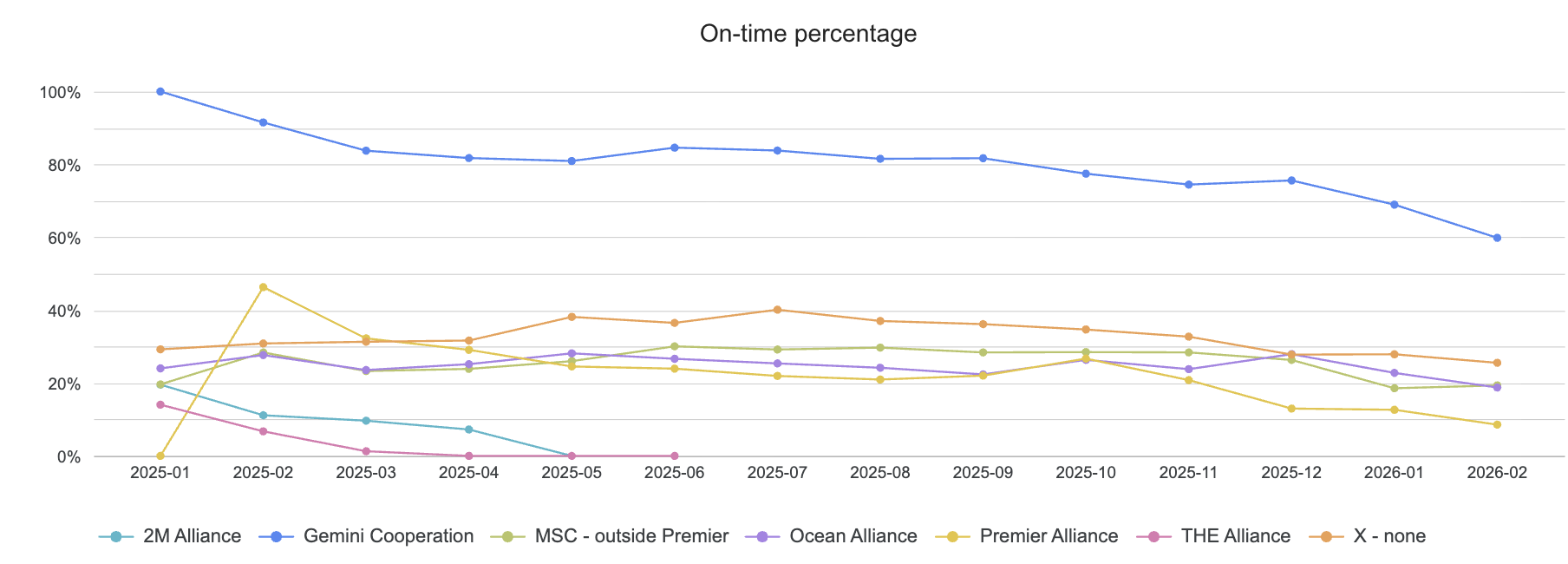
Alliances already operating at weakened performance like Premier are also plunging to new lows, revealing the challenges of early 2026 are not unique signs of the Gemini Cooperation's deterioration.
Premier Alliance closed February at just 9% of on-time arrivals, the lowest reliability ever seen in any alliance since 2022 — excluding the final days of their predecessors THE Alliance and 2M in Q1 2025.
What's next?
The events unfolding in the Persian Gulf right now are already eroding the less-than-ideal schedule stability of the surrounding region, well beyond a couple weeks' worth of localized delays and omissions.
Ports like Nhava Sheva are seeing average delays of -3 days and have already experienced on-time percentage collapsing from 50% to 33% in the span of a week. While a few Gulf-bound services are showing more moderate delays than might be expected, these effects are short lived and caused by the omissions of calls to Abu Dhabi and Jebel Ali, effectively shortening the proforma rotations.
While we can expect the impacts to be most pronounced in the Middle East trade, the knock-on effects of port congestion, ad-hoc calls, and delayed arrivals have rippled through neighboring countries and impacted adjacent trades like Asia – Europe and Asia – East Coast South America.
Shippers in corridors with exposure to Africa, Europe, and the Middle East are now facing increased uncertainty around last-minute cargo diversions and evolving surcharge structures.
In the Persian Gulf and beyond, it’s becoming critical for shippers to evaluate service performance on across their port pairs on an ongoing basis. Check out Xeneta's new Ocean Schedules to get started today.
.png?width=387&name=freight-ship-reliability%20(1).png)