


Shippers have become remarkably good at managing disruption.
Pandemics. Port congestion. Red Sea diversions. Capacity crunches. Strikes. Blank sailings.
After years of near-constant volatility, most procurement teams now have a crisis playbook.
But there’s a problem:
That playbook is built on patterns.
And today’s market is becoming increasingly unpredictable precisely because those patterns are breaking down.
The ongoing conflict in the Middle East is a perfect example. Rates are reacting differently. Carrier behavior is evolving faster. Capacity shifts are harder to interpret. And historical benchmarks — including last year’s contract rates — are becoming less reliable indicators of what happens next.
That creates a dangerous environment for shippers entering long-term contract negotiations.
Because while disruption itself is familiar, the market response to disruption no longer is.
And the cost of getting it wrong is high: locking into inflated rates, exposing supply chains to service instability, or missing opportunities to secure competitive long-term agreements while the market shifts underneath them.
The shippers navigating this environment most effectively are not relying on historical comparisons alone.
They’re relying on real-time market intelligence.
In this blog, we’ll explore why traditional tendering strategies become riskier during periods of disruption — and how data-driven procurement teams can make smarter long-term contracting decisions even when the market refuses to behave predictably.
Six Types of Crisis
Look back at the last 25 years of shipping disruption and the crises that have shaped the industry fall into six categories: geopolitical shocks, natural disasters, labour action, economic crises, infrastructure failures, and cyber attacks.
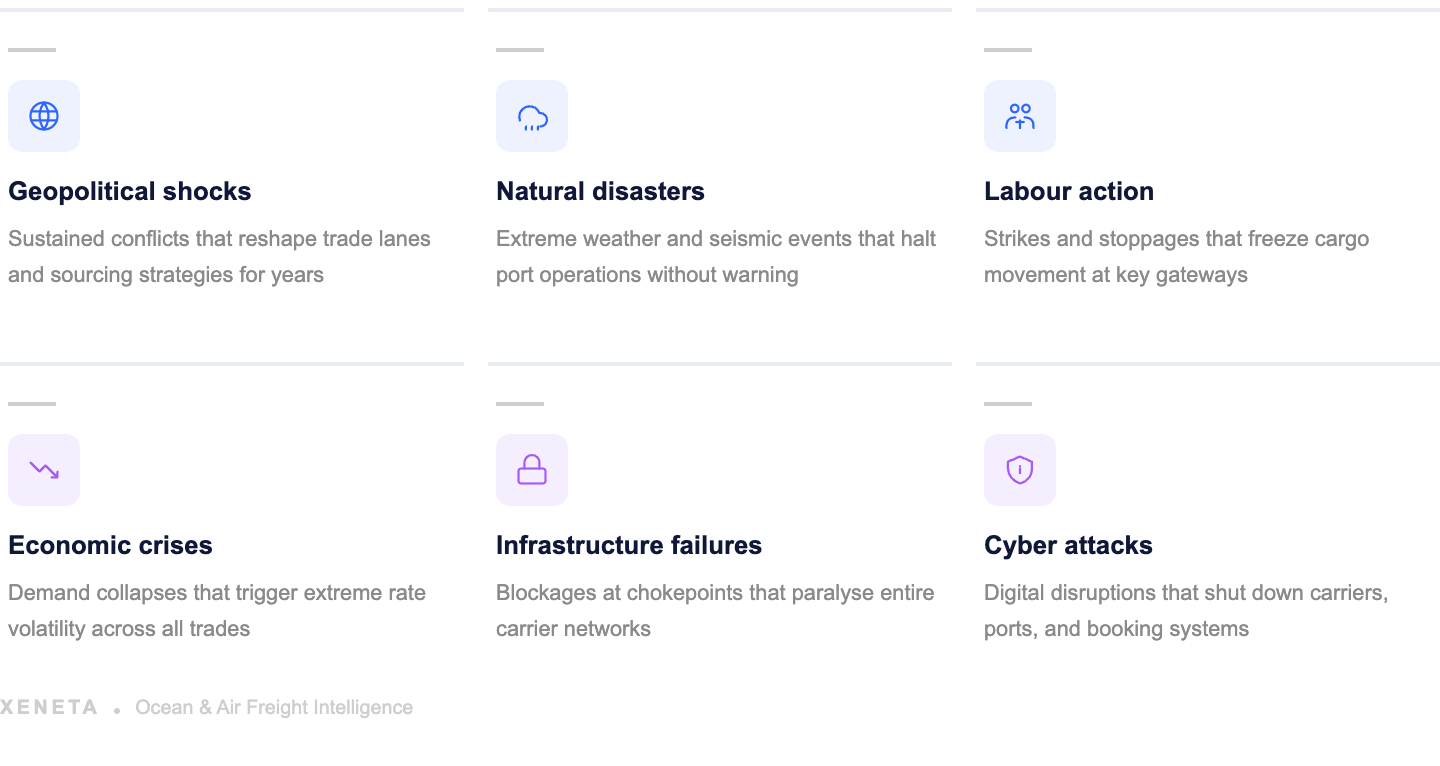
These crises differ in their geographic reach, duration, the trades they affect most directly, and the speed at which they ripple across supply chains.
Geopolitical crises, such as the conflict in the Middle East, are sustained events that reshape trade lanes, restructure carrier networks and alter sourcing strategies for years, not months.
The Middle East Crisis – spot rate shock and market sentiment
Conflict in the Middle East has forced carriers to build entirely new service networks with little to no warning, including rerouting via land bridges such as Jeddah and alternative ports on the Indian Ocean coastline.
This has caused ripple effects beyond the immediate vicinity of conflict. For example, average spot rates from China to North Europe have eased in the past month as the supply chain workarounds stabilize, but remain up 16% compared to pre-conflict on 27 February. Even on the Transpacific trade from China to US West Coast, average spot rates have plateaued at +54% compared to pre-conflict.
On the European ocean container shipping trades, these new routing patterns are now established and carriers have reorganised capacity, meaning ocean container spot rates are easing from the spike in the immediate aftermath of conflict. Compared to one month ago, average spot rates from the Far East are down 6% to North Europe and 13% to Mediterranean.
This is what a long-term geopolitical crisis looks like: a regional shock that restructures global trade flows and leaves no trade lane untouched.
If shippers don’t have comprehensive, realtime market intelligence and data, they could look at the current disruption and elevated spot rates and fear their hand has been weakened during negotiations… this is where a single source of market truth becomes critical.
Tendering during a crisis
Shippers must set data-backed targets from the first round of a tender. Carriers will always open high, especially during a period of high-profile geopolitical disruption, but a shipper with access to real market data can call their bluff and know when to push back.
Despite the elevated spot rates and sentiment of fear in the market, the underlying fundamentals of supply and demand still suggest a softening of the long term contract market across global trades. This has been the view since Xeneta published the 2026 Ocean Outlook back in October last year.
Looking at data received from Xeneta customers, they have used this intelligence to play their hand effectively during what could have been a difficult tendering season.
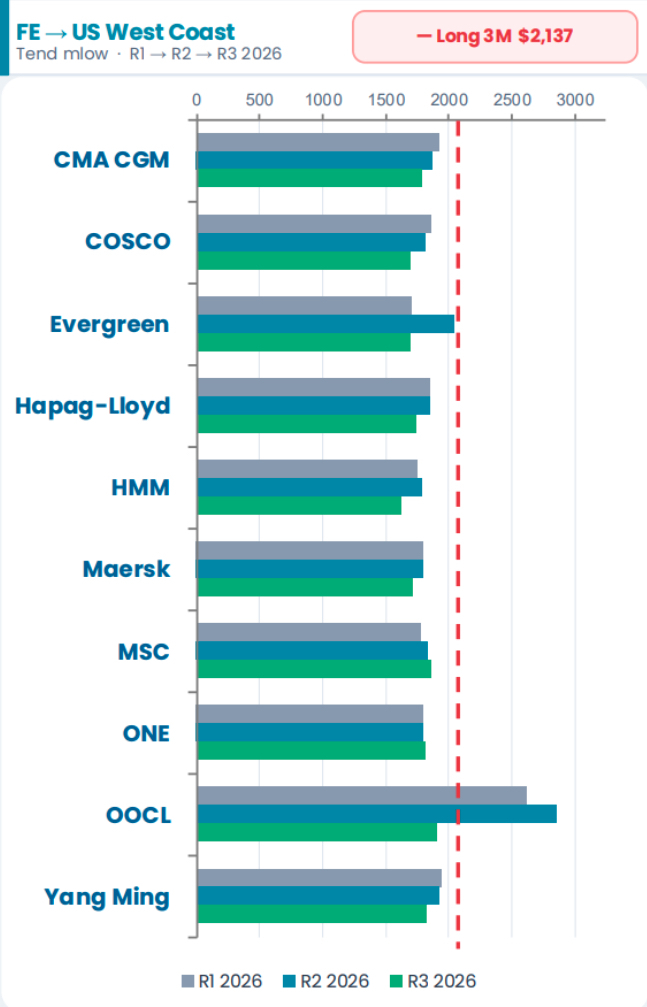
The chart below shows almost all first round bids reported by Xeneta customers tendering on trades from Far East to US West Coast were already below the long-term market average (USD 2,137 per FEU). Despite the disruption, congestion, elevated spot rates and sentiment driven by the ongoing Middle East conflict, the smart shippers use data and intelligence to know not to accept current long-term market levels as a ceiling.
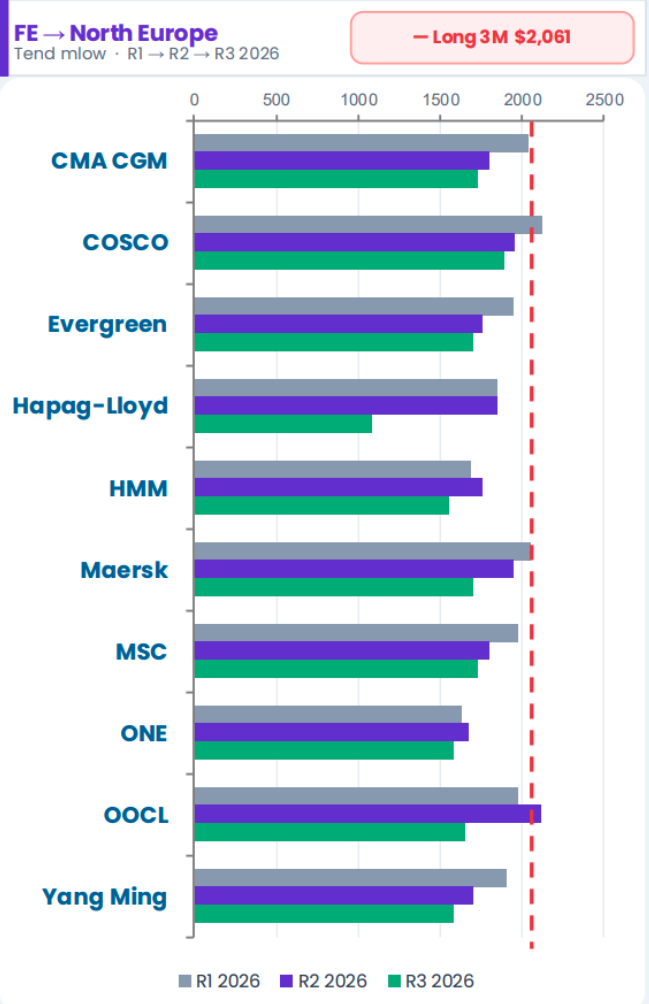
Even from Far East to North Europe — a trade more directly affected by the ongoing Red Sea closure — the majority of Round One bids were below the long term market average of USD 2061 per FEU.
These shippers then used data and intelligence to secure further discounts across Round Two and Round Three.
This tells us that the long-term market is being driven by supply and demand fundamentals rather than the crisis-driven sentiment that is propping up the spot market. With contracts now being finalised for implementation in May and June, this is a signal that the market expects the current level of disruption to be temporary – even if the spot market has not yet priced that expectation in.
Why This Matters
Understanding the type of crisis you are in and the longer term implications, changes what each function in your organisation should be doing right now.
For procurement teams managing the Middle East conflict, the question is whether the rates you negotiated — or are currently negotiating — are going to last the contract term and remain competitive. For example, the impact of geopolitical incidents tend to outlast annual tender cycles, but how this feeds into rates over the longer term can vary significantly from crisis to crisis.
For finance and CFO-level stakeholders, the most important question is not what rates are today. It is how much of the current elevated cost base is structural versus temporary, and whether budget assumptions made before the crisis still hold. When a freight cost surge appears in the P&L due a geopolitical incident , the question that follows in the boardroom is: why did we not see this coming, and what are we doing about it?
Is this is a short term pain to be managed or a longer term financial risk?
Carriers respond differently during crises
Tendering during a crisis is not just about cost. Carriers will adopt different approaches which must be factored into supply chain resilience strategies.
Carriers ultimately make their own risk assessments in the wake of a supply chain crisis — prioritising the safety of crew, cargo, and vessel. We saw it clearly earlier this year as carriers adopted different strategies on Red Sea and Hormuz transit, with some attempting passage and others rerouting entirely.
The challenge for shippers is that these decisions can quickly impact schedule reliability, transit times, and overall service quality — often before the full market impact becomes visible.
That makes ongoing carrier performance visibility critical during periods of disruption.
.png?width=1056&height=844&name=Frame%2013793%20(1).png)
With the Carrier Scorecard (example above), shippers can identify declining performance early, before service deterioration materially impacts their supply chain. For procurement teams running quarterly tenders or frequent allocation reviews, this kind of visibility creates an opportunity to act proactively — rather than waiting until issues become operationally critical.
Five Small Shifts for Shippers Navigating a Disrupted Market
The organisations that navigate crises most effectively are not necessarily the ones with the largest procurement teams or carrier networks.
They are the ones that can separate temporary noise from structural change faster than the market around them.
That requires more than experience alone. It requires data, visibility, and the ability to challenge assumptions in real time.
Here are five shifts procurement and supply chain teams should consider during periods of disruption:
1. Classify the crisis before responding to it
Is this geopolitical, structural, and multi-year, or is it an acute infrastructure shock with a defined recovery curve? The answer could determine whether you renegotiate contracts or adjust routing. Acting with a short-term playbook on a long-term crisis can be an expensive mistake.
2. Watch long and short term markets across all trades — not just your own
The Middle East crisis raised spot rates 46% on the Transatlantic, a trade lane with no direct exposure to the conflict. Shippers who only monitor the lanes they actively use or do not consider the relationship between spot and long term markets will be caught out. Disruption cascades, so the signal is almost always visible in adjacent markets first.
3. Separate surcharges from base freight rates
Emergency Bunker Surcharges, war risk premiums, and port congestion surcharges are not base freight costs. Keeping them itemised and time-limited gives you the leverage to remove them when conditions change. Accepting all-inclusive rates during a crisis embeds temporary cost into permanent contract structures.
4. Use carrier performance data, not carrier promises
During a crisis, carriers vary significantly in how they manage reliability, cancellation rates, and capacity. Data on cancellation rates, actual versus announced transit times, and carrier scorecard performance tells you who is delivering and who is not.
5. Build the case for market intelligence before the next disruption arrives
In every major disruption, the organisations that respond most effectively are the ones that already have access to real-time, lane-level freight rate data and carrier performance benchmarks across long and short term markets. The cost of information asymmetry in shipping is not a rounding error. It shows up in COGS, in budget variances, and in missed savings that compound over years.
The cost of information asymmetry in shipping is not marginal. It appears in inflated contract rates, unstable budgets, missed procurement savings, and supply chain decisions made too late.
Because in volatile markets, the biggest risk is rarely disruption itself.
It is making long-term decisions with short-term visibility.