

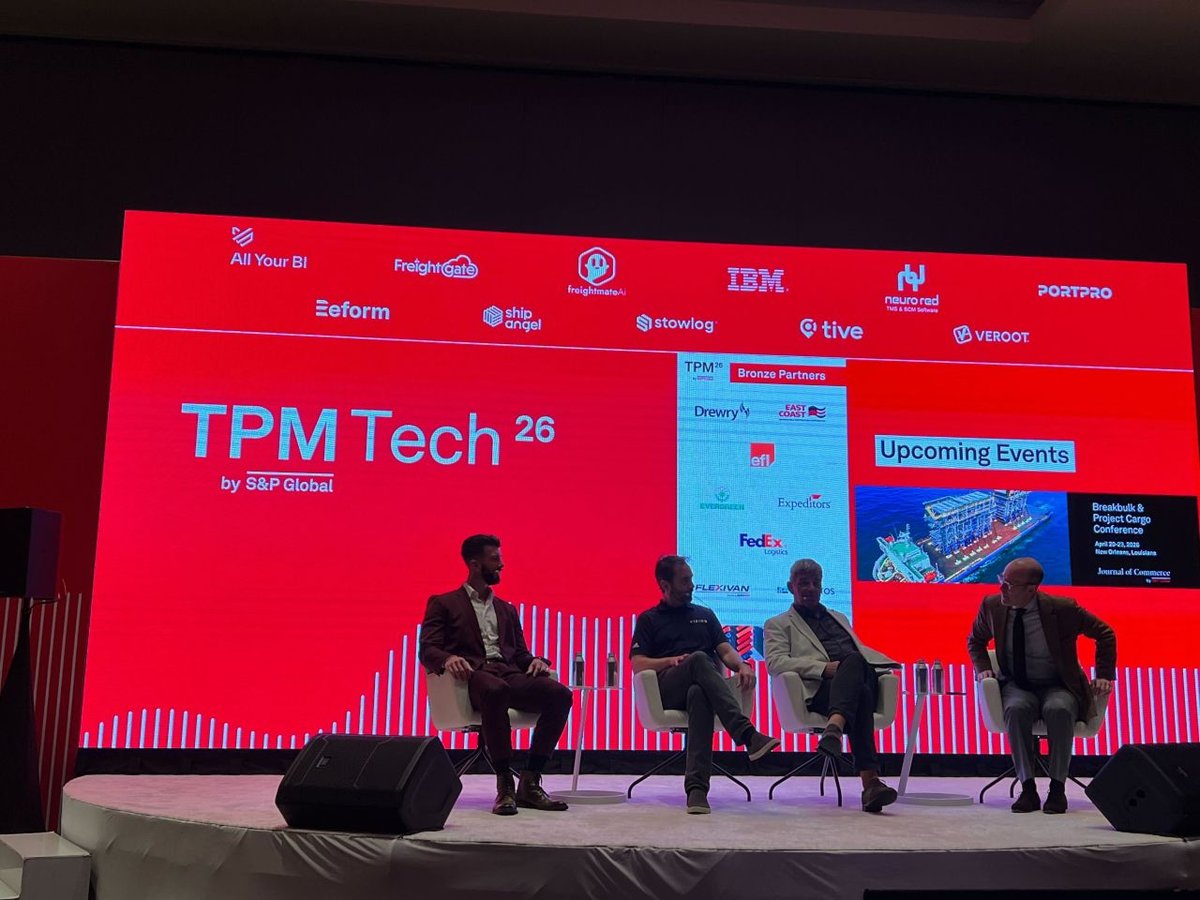
TPM opened just as many shippers thought the market was finally settling down.
After a turbulent start to the year shaped by tariffs, container freight rates had started to soften and attention had shifted back to tender season. Shippers had spent weeks, and in many cases months, negotiating annual agreements in a cooler market. Then, the day before TPM, escalation of conflict in the Middle East through the joint US and Israel military operation against Iran changed the picture again.
That shift was immediate. Facts were still emerging as the conference began, and so was the industry’s understanding of what it would mean for supply chains. What should have been a week focused on annual tenders quickly became a forum for discussing disruption, exposure, and how quickly contract assumptions can be overtaken by events.
Carriers were not rushing to sign new ocean container freight agreements. Trans-Pacific contract negotiations, generally the focus of TPM, were suspended in several cases. Asia-Europe contracts, many of which had only recently been agreed, were already being amended with surcharges or rate revisions.
That was one of the clearest messages from TPM. This was not routine market volatility. Rates and transit times move up and down all the time. What the industry is dealing with now is a series of shocks that arrive with little warning and reset the market before contracts have time to catch up.
The challenge is not only the shock itself. It is what happens when the market resets and shippers still do not have a clear view of their exposure.
That is when the market becomes harder to navigate than it needs to be. Carriers and shippers end up having commercial discussions without the same view of reality. Procurement teams negotiate multi-million-dollar contracts using outdated Excel files. Carriers still sometimes provide rates based on instinct and gut feel rather than transparent market signals. When conditions change this quickly, that gap becomes expensive.
The operational announcements we saw during TPM made that very real.
MSC was among the first to issue an End of Voyage Declaration. Cargo inbound to affected ports in the Middle East would be discharged at the first safe nearby port and made available for customer pick-up. A mandatory $800 surcharge would apply to all affected cargo, with no exceptions. Handling, storage, and ancillary charges would be at the cargo owner’s expense. And if cargo needed to be diverted to another location, a new booking would have to be arranged. For shippers, that means extra cost and more complexity almost immediately.
At the same time, the Strait of Hormuz was effectively closed to container shipping. Xeneta data shows 204 container vessels affected in and around the Persian Gulf as of Monday 9 March, including vessels steaming, waiting, and in port.
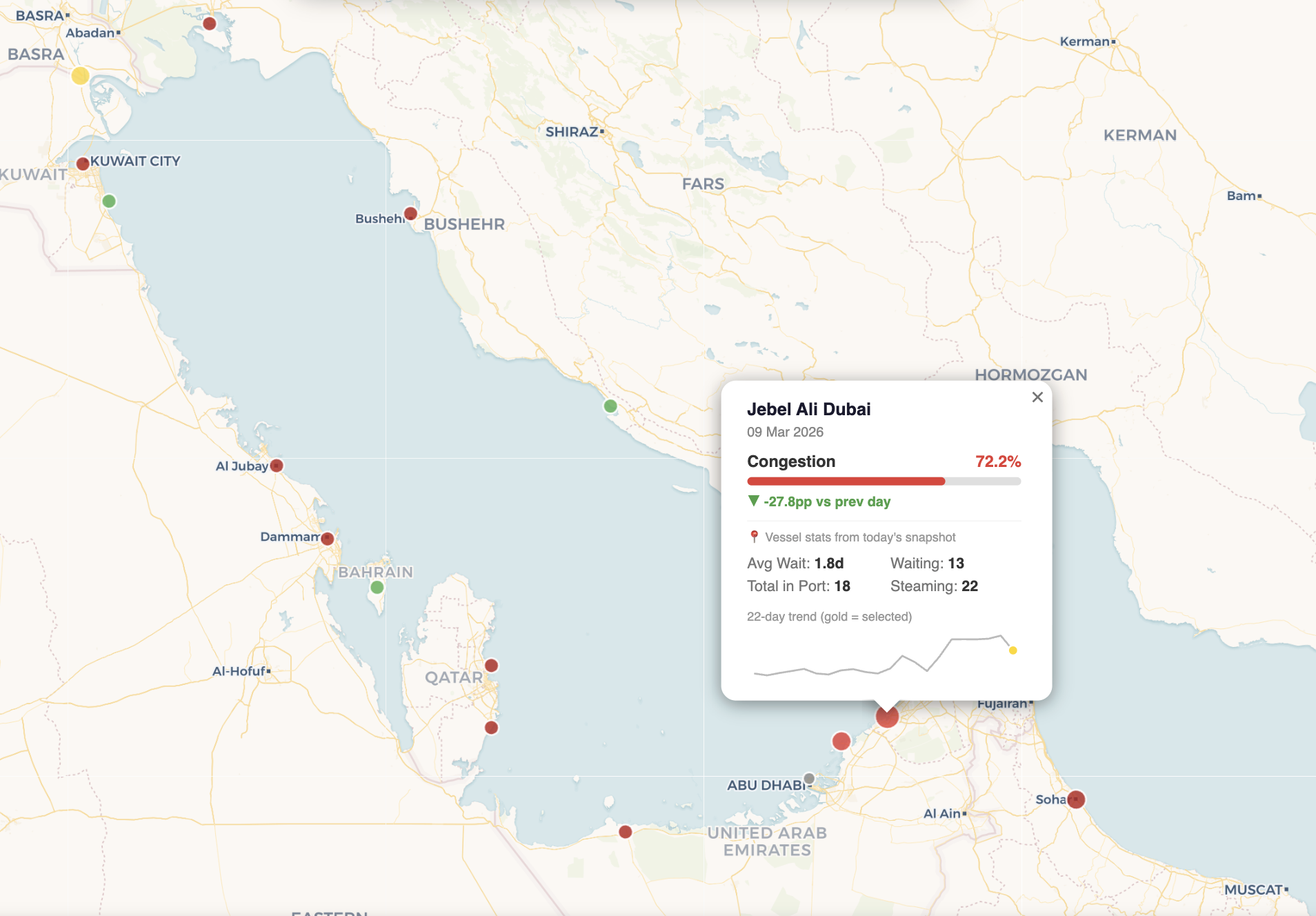
That is a major operational shock, especially for shippers moving cargo through the Middle East to the US East Coast, including pharma and retail flows. The impact is not only about the number of vessels involved. It is also about uncertainty around routing, timing, surcharges, and how quickly those pressures feed into contract discussions.
Commercial responses followed just as quickly.
MSC announced Emergency War Surcharges of $500 per TEU for dry cargo and $1,000 per TEU for reefer cargo on certain trades from the Indian subcontinent and Gulf nations into Africa and the Indian Ocean islands. It also announced a War Risk Surcharge for cargo moving from the Arab Peninsula to Africa, ranging from $2,000 for 20-foot dry containers to $4,000 for reefers. Maersk announced an Emergency Contingency Surcharge for cargo to and from the Middle East at $1,800 for 20-foot containers, $3,000 for 40-foot and 45-foot containers, and $3,800 for reefers and special equipment. Hapag-Lloyd, so far, has announced a $1,000 per container GRI on cargo from the Indian subcontinent and Middle East to the US.
This is where transparency matters. Shippers need to know which costs are linked to real operational disruption, which are temporary, and which risk becoming part of a broader rate reset.
Bunker is a good example.
For many BCOs at TPM, one of the biggest concerns was not only base ocean rates, but where bunker prices would go next. That concern looks well founded. Bunker prices surged over the weekend as the latest escalation in the Middle East fed directly into oil and marine fuel markets.
When fuel moves that quickly, shippers need to know exactly what bunker surcharge their cargo is exposed to and whether that surcharge is linked to a transparent index. They also need to compare this year’s contract rates with last year’s in a way that isolates fuel from the rest of the increase. Otherwise, it becomes much harder to tell whether higher costs are being driven by bunker or whether something else is being added on top.
That matters even more in a softer demand environment.
Very few BCOs at TPM said they expect their MQC to be higher than last year. More are forecasting lower demand, pointing to weaker economic indicators, elevated warehouse stocks, and softer end-market demand. That creates a difficult tension. On one side, disruption is pushing cost pressure higher. On the other, underlying demand is not strong enough to support the idea that every increase should simply be accepted without scrutiny.
That is where better contract design starts to matter.
Scenario planning still matters, of course, but nobody can predict every shock. Nobody can model COVID perfectly in advance. Nobody can forecast the Red Sea crisis, new tariffs, or conflict in the Middle East with precision. The best procurement teams are not trying to guess every future event. They are building resilience into their contracts so they are less exposed when the unexpected happens.
That is why index-linked contracts continue to stand out. If contract mechanisms move with the market, conversations become more grounded and less reactive. And for finance leaders worried about cost stability, the upcoming launch of container freight futures on Euronext based on Xeneta data points to another way the market is maturing.
There was also an important reminder at TPM that cost is not only about buying the cheapest rate.
Service level matters just as much. On imports from China to the US West Coast, the spread in transit time offered by carriers is around 13 days, while the rate gap is only about 10%. For many organizations, paying slightly more for faster transit, stronger reliability, and fewer delays is not overpaying. It is a better commercial decision.
The same pressure is now showing up in air freight too. Major transshipment hubs such as Doha and Dubai have been affected, and Xeneta’s latest analysis shows airspace closures linked to the conflict removed 16% to 18% of global air cargo capacity with almost no warning. That is expected to push rates higher and reduce flexibility for shippers moving cargo on Asia-Europe lanes in particular.
So yes, TPM reinforced that shocks are now arriving faster than supply chains can comfortably absorb them. But it also made something else clear. The companies that will handle them best are not the ones chasing the lowest number on a spreadsheet. They are the ones using better data, building more flexible contracts, and making decisions with a clear view of both cost and service.
In this market, that is not a nice-to-have. It is how resilience gets built.
How to monitor the market and assess risk with Xeneta
Disruption is hard to predict, but it is easier to manage when you can see changes early. Xeneta’s market monitoring and risk management capabilities are built to help teams spot cost spikes, capacity tightening, and supplier issues sooner, so they can respond quicker and act with confidence.