



If you work in logistics operations, this probably sounds familiar:
A sailing gets blanked.
Your container rolls.
Inventory plans shift.
Customer service calls start stacking up.
And you're expected to explain to leadership what happened — and how you’re fixing it.
Somewhere in the middle of it all, you think:
“Why does it feel like we’re always reacting?”
For many logistics teams, day-to-day operations have become a cycle of disruption, escalation, and recovery. It’s not a performance issue. It’s not even a planning issue.
It’s a visibility gap.
And that gap is expensive.
Every time a blank sailing catches you off guard, you risk:
- Higher rebooking costs
- Spot market exposure
- Service failures
- Strained carrier relationships
- Internal escalations that damage credibility
When you only see disruption after it hits execution, you’re not managing risk, you’re absorbing it.
With renewed geopolitical tensions in the Middle East, vessels diverting from the Red Sea, and carriers adjusting networks again, that volatility is no longer theoretical — it’s playing out in real time.
And has been for a while...
The Cost of Just “Following the Flow”
Did you know that statistically, you are more likely to divorce than change your bank provider?
That’s inertia.
And that same inertia shows up in logistics more often than we like to admit.
Teams stick with familiar carriers.
They route the same way quarter after quarter.
They rely on historical performance.
They assume stability will return.
It feels efficient. It feels low risk. It feels “tried and tested.”
And yet, we see time and time again that overexposure to underperforming carriers results in
- Missed opportunities to reallocate volume
- Overpaying when rates soften
- Underestimating tightening cycles
- Increased dependency on the spot market
Disruption is manageable when you see it building, which is why logistics teams need clearer signals about what’s forming in the market.
The Cost of Operating with Blind Spots
There are only a few certainties in life: death, taxes, and high volatility in ocean freight markets.
(Who knows, Trump tariffs might make the list one day too!)
All this volatility means capacity doesn’t sit still for long. One month there’s space on your key trade lane, the next carriers are quietly pulling sailings. Alliances reshuffle networks. A regional disruption suddenly changes routing patterns. Schedules get adjusted — sometimes with very little notice.
None of that is new.
Disruption is part of the job. Your job.
What really causes problems isn’t that these shifts happen. It’s realizing they were happening after they’ve already impacted your bookings.
When operations teams don’t see capacity tightening early, blank sailings turn into:
- Rolled cargo and missed connections
- Expensive spot bookings
- Last-minute rerouting
- Warehouse congestion
- Expedite fees
- Customer compensation costs
If a single container rolls and requires rebooking at $1,000–$2,000 higher rates, that’s painful. Multiply that across dozens of containers during peak season, and you’re looking at six- or seven-figure impact on freight budgets.
Schedule reliability across major trade lanes has fluctuated significantly over the past few years, often sitting well below pre-2020 levels. Even small drops in reliability create cascading effects: port congestion, missed rail connections, inland bottlenecks.
And yet, many operations teams are still relying on:
- Historical carrier performance
- Static routing guides
- Monthly reporting
- Information that surfaces after disruption has already happened
Whether intentionally or not, limiting your team’s visibility into market movements creates blind spots in your operation — and the most frustrating part is that you may continue following the same 'tried and tested' processes, genuinely believing everything is performing as effectively as possible.
Right up until the market shifts — and exposes the gaps.
While you can’t control volatility, there are small shifts you can make to control how early you see it.
Blank Sailings: The Early Signal Most Teams Miss
When carriers divert vessels or redeploy ships due to geopolitical risk, blank sailings often follow as networks rebalance and capacity is repositioned.
Which means they don’t happen randomly. They are usually tied to demand shifts, alliance reshuffles, or strategic capacity adjustments.
The issue isn't necessarily that they happen – although they can cause undue stress. Instead, it's often the timing of them that causes the biggest headache.
By the time a blank sailing impacts your booking, the market has often been signaling tightening capacity for weeks.
If you don’t have visibility into:
- Offered vs. withdrawn capacity
- Capacity trends on your key trade lanes
- Changes in alliance behavior
- Port congestion patterns
you only see the disruption when it hits execution. And at that point, your options are limited.
Earlier awareness allows teams to:
- Secure space before capacity tightens
- Adjust routing proactively
- Shift volume between carriers
- Communicate realistic timelines internally
- Protect service levels before customers feel the impact
The difference between proactive and reactive logistics often comes down to one thing: how early you can see change forming.
As Peter Sundara (孙德) Swamickannu of Visy said on The Freight Debate Podcast:
“Procurement is not only activated during a crisis. If you do that, it's not a strategy — it's damage control.”
The same applies to logistics operations.
If you’re only adjusting once a blank sailing hits your booking list, you’re not managing volatility.
You’re absorbing it.
Using Carrier Scorecards to Reduce Operational Risk
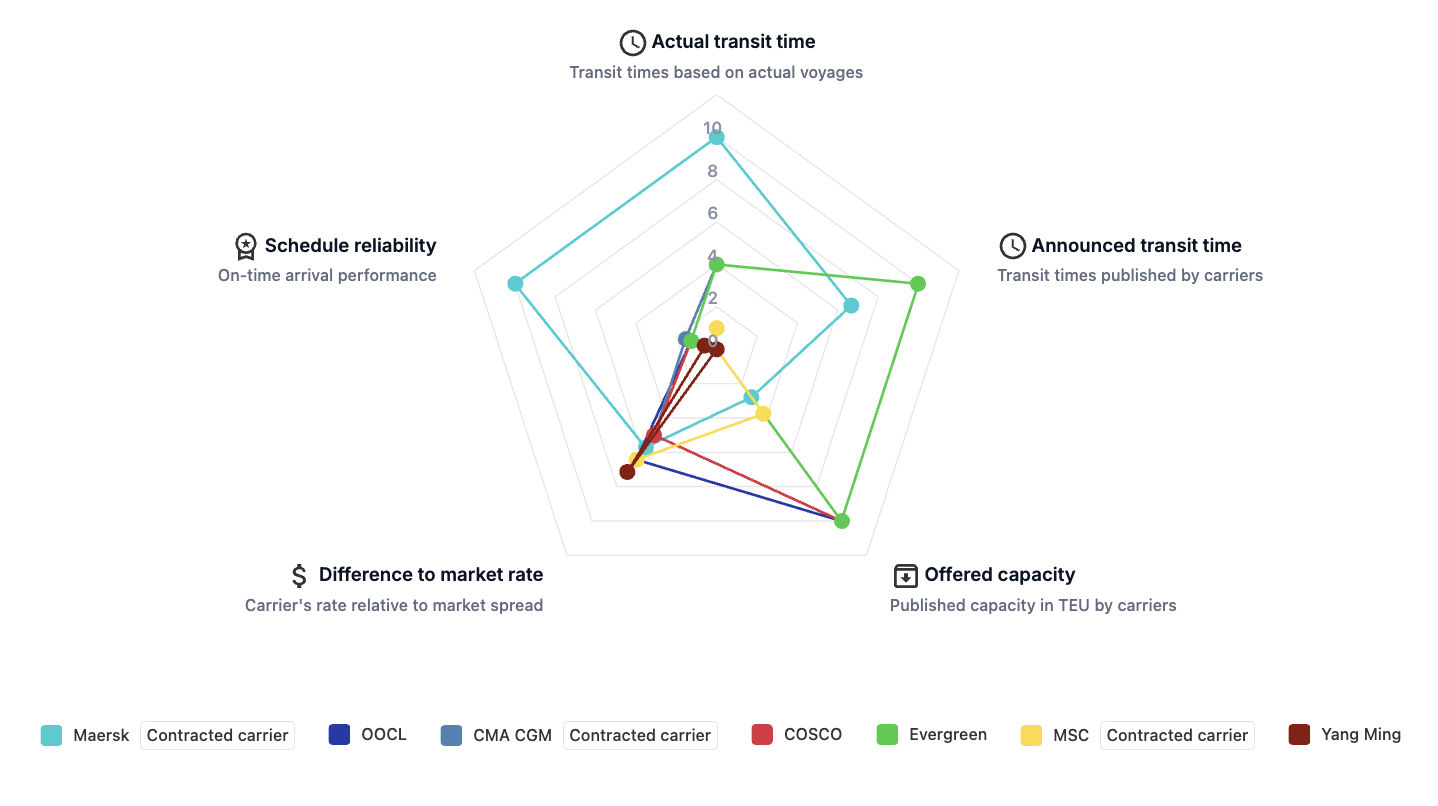
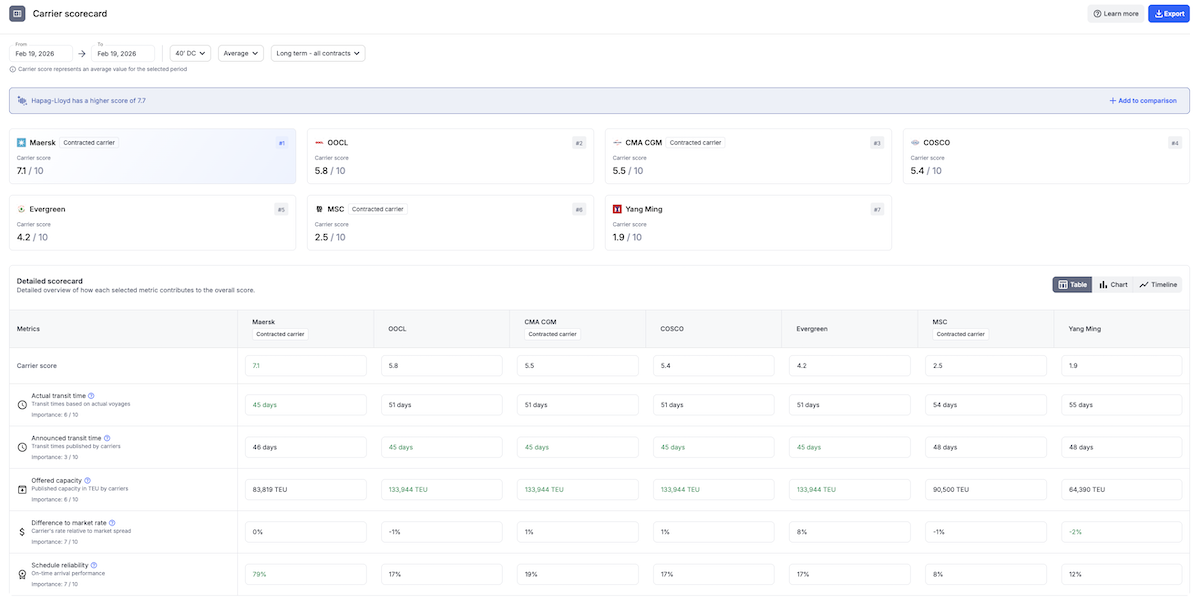
Carrier performance can vary widely by lane, season, and alliance structure.
Relying on a global average performance metric doesn’t reflect your operational reality.
Adopting the Xeneta Carrier Scorecard approach allows logistics teams to:
- Compare schedule reliability by trade lane
- Benchmark contracted rates against market averages
- Evaluate carrier consistency over time
- Identify risk exposure before peak pressure builds
- Justify volume shifts with data
This means, instead of reacting to missed sailings or cost spikes, teams can:
- Adjust carrier allocation early
- Diversify exposure where reliability drops
- Prepare internal stakeholders with supporting data
- Reduce last-minute decision-making
This doesn’t eliminate disruption, but it does reduce operational risk.
From Reactive to Informed
Day-to-day logistics doesn’t have to feel like constant firefighting.
With real-time market intelligence, capacity signals, and schedule reliability insights, logistics teams can:
- Anticipate blank sailings
- Adjust routing faster
- Reduce costly escalations
- Improve internal communication
- Protect service levels
Xeneta supports logistics professionals with transparent, lane-level data that helps teams see market shifts forming — not just reacting once they land.
If you want to understand how Carrier Scorecards and real-time intelligence can support earlier decisions and fewer escalations, join the webinar for a deeper look and live demo.
Watch here:
Because in today’s market, while disruption is unavoidable, being the last to know is not.