


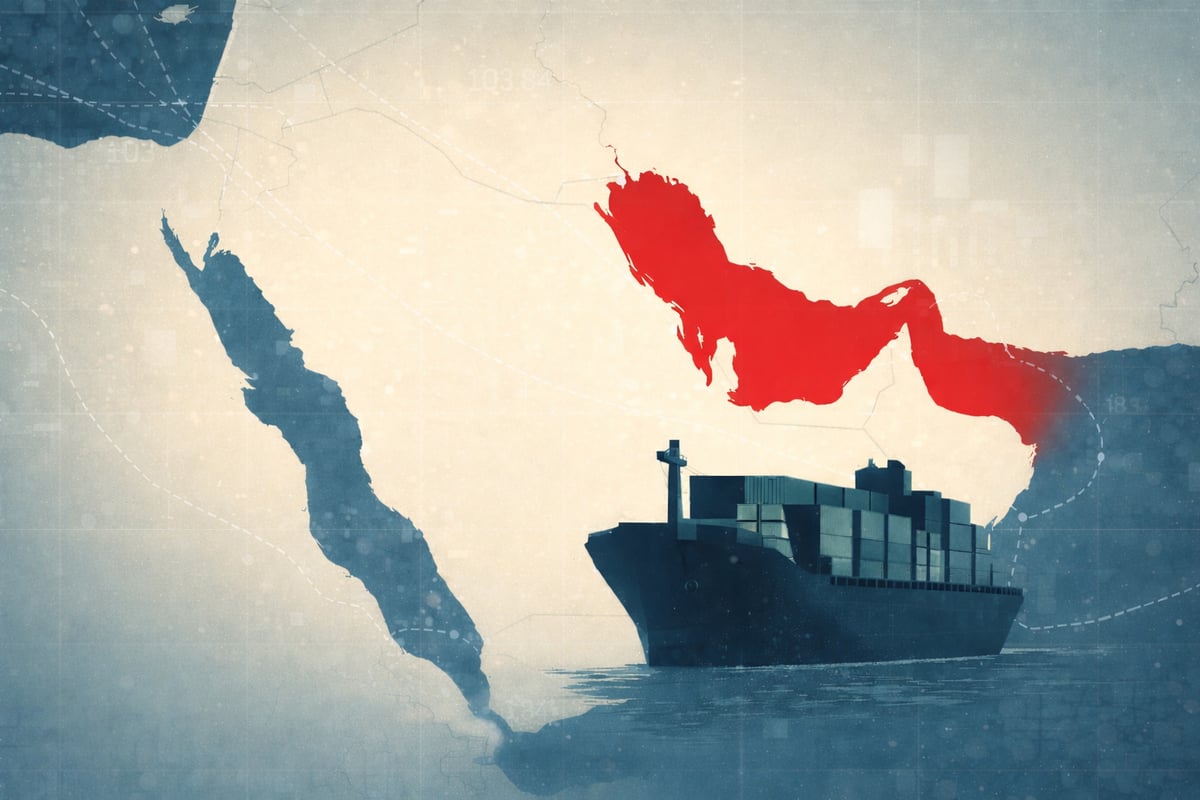
Since the escalation of conflict in the Middle East on 28 February, the critical Strait of Hormuz has been effectively closed to major container shipping.
For shippers, the result is stranded cargo, congested ports, schedules in disarray and costly surcharges.
Whether your responsibility during a black swan event is keeping cargo moving, managing strategic supply chain risk or explaining freight budget variance to the board, this crisis demands attention across an organization.
This blog update explains what Xeneta data is showing right now, how the crisis is likely to evolve and what you can do to manage these risks.
Note: Xeneta has produced a live map of congestion at ports on risk watchlist services impacted by the Middle East conflict.
Three waves of disrupted cargo
The vessels impacted by the Middle East conflict can be categorized in three waves:
The first wave:
Vessels already in or near the Persian Gulf when the conflict started and have been forced to discharge at the nearest safe port, such as Khor Fakkan, Sohar, Karachi, Mundra, Nhava Sheva.
For these shippers with displaced cargo, the challenges now include customs clearance at unplanned ports, arranging inland transport from unfamiliar locations and competing for berths at facilities overwhelmed by unexpected volumes.
The second wave:
Vessels that departed Asia before suspensions were announced. This cargo is splitting between transshipment hubs such as Singapore and Colombo, as well as ports closer to the region such as Mundra. Smaller feeders are still transiting the strait, but for larger container ships it is effectively closed.
The third wave:
The third wave of cargo is the bookings being made now. Mid-long term schedules are already changing, whether that is existing strings previously calling at ports in the Gulf now utilizing neighboring ports to the south and east of the Strait of Hormuz or being diverted on longer (but more reliable) sailings into the Mediterranean via Cape of Good Hope.
Port Congestion: Where the pressure Is building
The chaos caused by an effective closure of the Strait of Hormuz means ports at the gateway to the Gulf are in a critical state due to the rapid increase in containers being offloaded. Khor Fakkan has been locked at 100% congestion for over 10 days. Sohar has climbed from 67% on 28 February to 70%, with average delays of +13.2 days at the peak in Week 11 - a nine-fold increase over pre-crisis levels.
Congestion is also building along the Indian subcontinent. Karachi has risen from 14% to 63% over 12 days. Mundra is up 33 percentage points, while Nhava Sheva is running well above its normal range.
At major transshipment hubs further away from the epicenter of conflict in the Middle East, signals regarding congestion are diverging. Singapore has eased from 48% to 28%, Colombo has eased to 31% since a peak of 50% on March 12, while Tanjung Pelepas and Port Klang are trending upward.
Congestion at these major transshipment ports means services calling at both Gulf and Indian ports on the same rotation may now face compounding delays at multiple points along the string.
Adding schedule data to congestion paints a fuller picture
Congestion data tells you how many vessels are waiting. Schedule performance data tells you how severely your bookings are being disrupted, which is critical for logistics teams trying to keep cargo moving predictably.
Across three key ports, Xeneta data shows sharp schedule performance deterioration in Week 11 (the first full week after the conflict began), with delays potentially easing in Weeks 12–13.
|
Port |
Wk 9 (pre-crisis) |
Wk 11 (peak) |
Wk 13 (latest) |
Vessels 7 days+ late (Wk 11) |
|
Mundra |
+3.5 days |
+5.9 days |
+2.9 days |
29% |
|
Nhava Sheva |
+2.8 days |
+3.9 days |
+3.2 days |
16% |
|
Khor Fakkan |
+2.5 days |
+7.9 days |
+2.2 days |
100% |
|
Karachi |
+4.3 days |
+7.4 days |
+4.2 days |
69% |
At Mundra, on-time arrivals dropped from 44% to 31%, with more than one in three vessels arriving a week or more behind schedule. Nhava Sheva’s on-time rate collapsed from 50% to 33%. The Week 12–13 moderation is welcome but likely reflects carriers shortening rotations by omitting Gulf calls, rather than genuine improvement in underlying conditions.
How carriers are responding - the Xeneta risk watchlist
Carriers are restructuring services far faster than they did during the Red Sea crisis, showing lessons are learned by all parties during black swan events.
Xeneta has 18 services on its risk watchlist - mostly Far East–Middle East routes but also Asia–Europe services, such as Premier Alliance’s FE5, which calls Jebel Ali and Abu Dhabi.
The carrier response includes three key approaches:
1) Outright suspensions: Examples include Gemini’s FM1 and ME11
2) Nearby relays: This means ad hoc per-voyage inducements at neighboring ports, such as Mundra and Khor Fakkan, while omitting Gulf calls. MSC is already omitting Abu Dhabi on its Carioca service and feedering via Hambantota instead.
3) Alternative routing via the Mediterranean: Both MSC with its Phoenix and CMA CGM with its updated Phoenicia service, also known as Ocean Alliance’s MED5, are promoting Asia–Eastern Mediterranean services that access Gulf markets overland through Turkey or Jeddah via the Suez Canal, bypassing both the Strait of Hormuz and the Houthi threat zone.
Shippers now face a choice between these two imperfect options. Do they opt for shorter routing via neighboring ports where there is severe congestion, higher surcharges ($2,000–$4,000/TEU in emergency war risk charges alone) and less schedule certainty?
Do they choose longer routing via the Mediterranean and Cape of Good Hope, where there is more predictability but extended transit times and higher base rates?
For procurement teams, this means benchmarking every surcharge against market data.
For finance, it means freight budget assumptions made even weeks ago may already need revising.
Non-Gulf services are also impacted
Of the 48 services on the Asia-Europe trade, 18 call at least one of the 14 countries within the immediate vicinity of conflict. That amounts to 239,000 TEU of weekly capacity passing through key Middle East ports.
A handful of ports are now absorbing diverted Gulf cargo that cannot transit the Strait of Hormuz. The exposure also extends to any Asia-Europe or Far East-South America service that calls India, Sri Lanka, East Africa, or other neighboring ports being used as relay hubs. If your service touches any of these ports, your schedule is exposed.
For example, the Damietta Express on a Gemini Asia–Northern Europe loop was scheduled to call at Salalah then proceed to Singapore. Instead, it spent over a week in limbo, never made it into Salalah and ultimately diverted to Nhava Sheva to discharge cargo. That kind of ad hoc rerouting cascades through every subsequent port call on the string, affecting every shipper with cargo on that vessel or waiting for it downstream.
What shippers should do now
-
Establish repeatable monitoring routines — congestion maps, schedule updates, service watchlists. Consistency beats ad hoc information gathering in a fast-moving crisis.
-
Track schedules daily, not weekly. Use tools like Xeneta’s Ocean Schedules platform for voyage-level visibility. Assumptions made on Monday can be obsolete by Wednesday.
-
Map your service exposure across the full network, not just Gulf-bound services. Any rotation touching Singapore, Indian ports or East African hubs is potentially affected. Build scenario plans for sustained disruption.
-
Ask carriers for line-item breakdowns on every emergency surcharge and benchmark what you are being quoted against market data. Don’t just accept surcharges and time-limit them (e.g. 30 or 60 days) so they are re-negotiable. You need to demand surcharge transparency.
-
Build buffer into lead times. With 30% of vessels arriving 7+ days late at Mundra and 69% at Karachi during peak disruption, pre-crisis transit assumptions are unreliable.
-
Build budget scenarios and prepare insight on freight spend variance. Base rate increases, emergency surcharges and extended transit times mean cost assumptions from even weeks ago may need updating.
How Leading Shippers Are Responding to Middle East Disruption
Market conditions are shifting fast. Watch Xeneta’s webinar, How Leading Shippers Are Responding to Middle East Disruption, for a practical look at what the freight rate and service reliability data is showing and what shippers can do now to protect budgets and service levels. When conditions change fast, decisions need to keep up. Register to hear how teams are monitoring volatility, assessing impact, and responding with greater confidence.
.png?width=387&name=freight-ship-reliability%20(1).png)