
.jpg)


Latest Xeneta ocean container shipping data highlights are provided below quotes from Xeneta Chief Analyst Peter Sand.
Xeneta has also published a dedicated webpage with the latest updates on the Middle East conflict including a live port congestion map.
Xeneta analyst insight
Peter Sand, Xeneta Chief Analyst:
“The impact of conflict in the Middle East on ocean container shipping is a rapidly evolving situation and uncertainty remains massive.
“We are seeing exactly what we anticipated when the conflict escalated – port congestion, deteriorating schedule reliability, longer transit times and surcharges being pushed out across the board.
“Shippers are exploring every available solution to keep supply chains moving without calling at Gulf ports, whether through land bridges, rerouting or alternative networks now being offered by carriers and freight forwarders.
“Around 800 000 containers per month used to travel into the region affected by this crisis. Those goods still need to reach customers and the industry is finding different ways to make that happen.”
Nhava Sheva example:
“Nhava Sheva in India has emerged as one of the more attractive stopovers for frustrated cargoes. Shippers would rather have their cargo dwelling in Nhava Sheva than stuck in the port of origin.
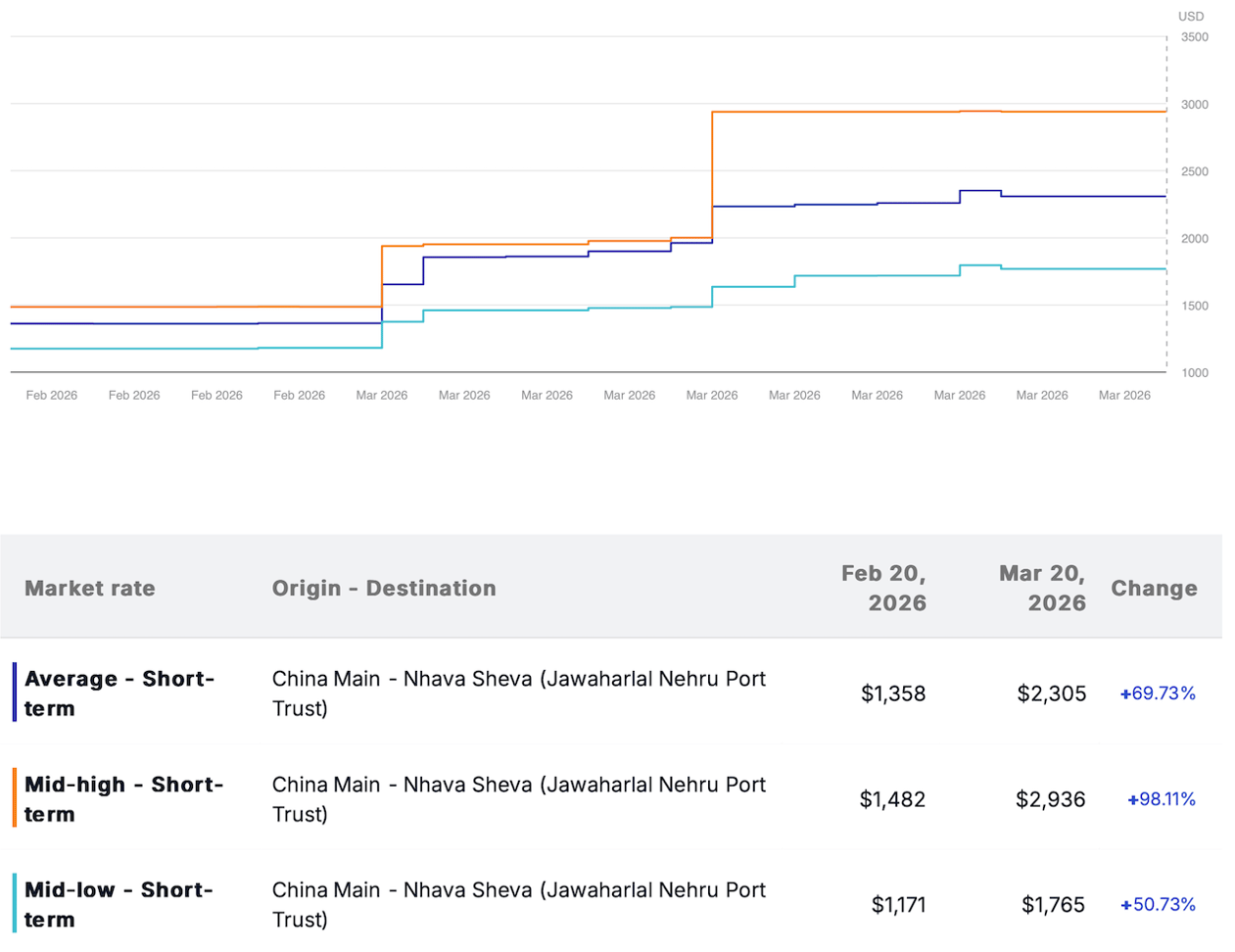
“The trade from China to Nhava Sheva is a textbook example of the ripple effects caused by a crisis like this. The market average spot rate has surged almost 70% over the past month, from USD 1 358 per FEU (40ft container) to USD 2 305 per FEU. But the real story is in the spread, with the market mid-high spot rate nearly doubling, up 98% to USD 2 936 per FEU. The market mid-low spot rate has increased by a lesser 51% to USD 1 765 per FEU.
“The widening spread between the lower and higher end of the spot market tells you there is a fight for capacity, with shippers who desperately need their cargo to move willing to pay top dollar to do so.”
Wider impact:
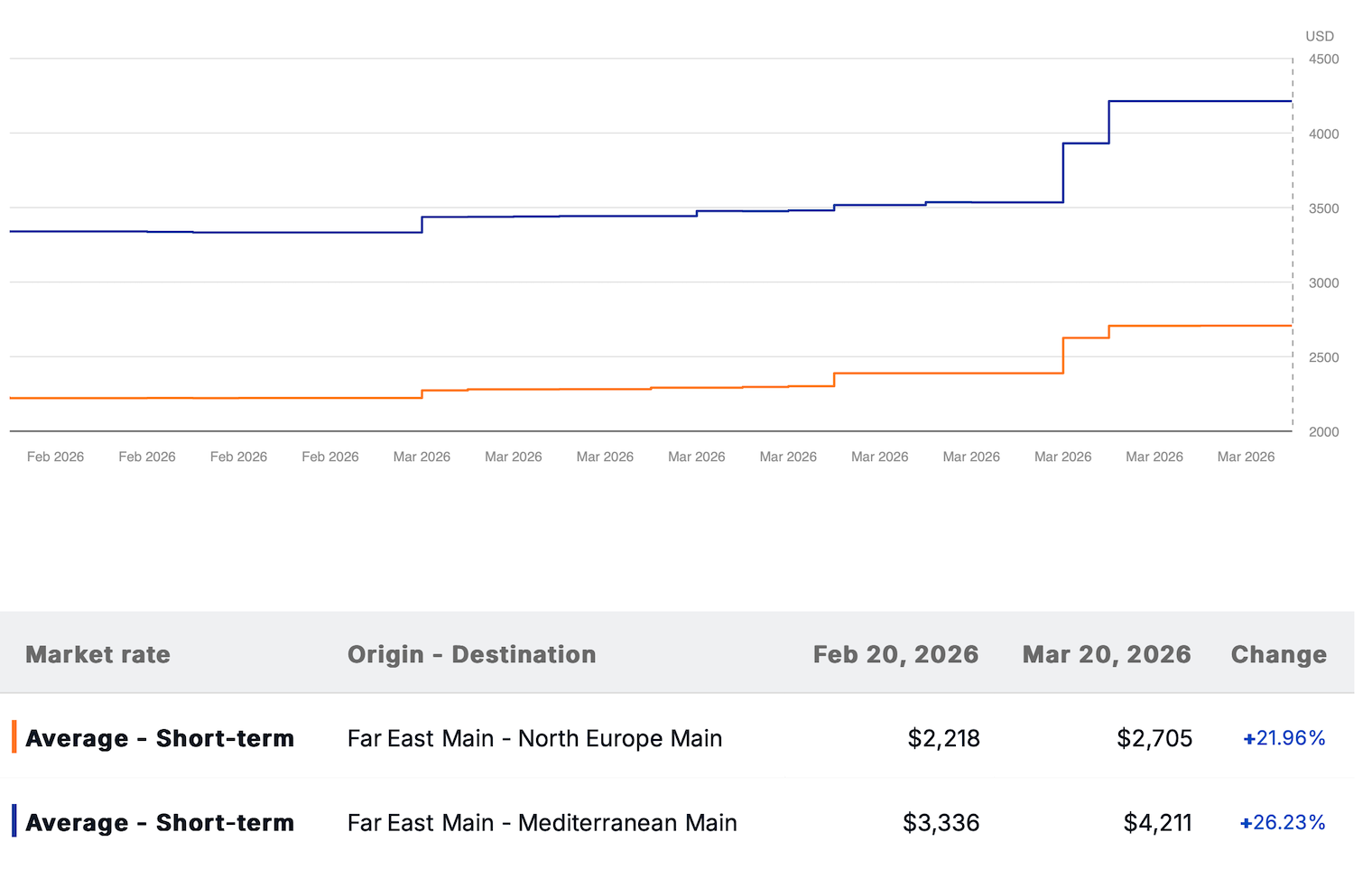
“The escalation in conflict has also brought back a de facto closure of the Red Sea for major container shipping. The trade lane most directly impacted by the complete closure of the Red Sea – Far East to Mediterranean – is seeing sharp spot rate increases, up 26% over the past month to USD 4 211 per FEU. Far East to North Europe has jumped 22% to USD 2 705 per FEU.”
Port congestion:
“Port congestion continues to spread across ocean supply chains, reaching beyond the epicenter of conflict in the Middle East, particularly at major Asia transshipment hubs. This has clear implications for shippers using services calling at these transshipment hubs, even if their cargo would never touch a Middle East port.
“Congestion at Port Klang in Malaysia is at 50% and has remained elevated throughout the crisis. Tanjung Pelepas stands at 37%, Singapore has climbed back to 36% after a brief improvement, and Colombo is at 46%.
“These port congestion numbers are volatile and shifting daily as carriers, freight forwarders and shippers all work to protect their interests during yet another supply chain crisis. Monitoring congestion and schedules once a week is simply not enough during a crisis of this nature.”
Data highlights
China to Nhava Sheva – spot rate spread on 20 March 2026
-
Market average: USD 2 305 per FEU (+69.7% from one month ago)
-
Market mid-high: USD 2 936 per FEU (+98.1% from one month ago)
-
Market mid-low: USD 1 765 per FEU (+50.7% from one month ago)
Transshipment port congestion examples
-
Port Klang (Malaysia): 50% – elevated throughout the crisis
-
Colombo (Sri Lanka): 45.5% – down from 55.6% three days ago, remains high
-
Tanjung Pelepas (Malaysia): 36.8% – volatile, down from 41.2% the previous day
-
Singapore: 36% – rising again since 16 March, up from 20.3% four days ago
Major fronthaul average spot rates
-
Far East to US West Coast: USD 2 118 per FEU (+12% from one month ago)
-
Far East to US East Coast: USD 3 008 per FEU (+13% from one month ago)
-
Far East to North Europe: USD 2 705 per FEU (+22% from one month ago)
-
Far East to Mediterranean: USD 4 211 per FEU (+26% from one month ago)
-
North Europe to US East Coast: USD 1 482 per FEU (+0.1% from one month ago)
Offered capacity on major fronthaul trades (4-week rolling average) – w/c 16 March 2026
-
Far East to US West Coast: +4.5% from a week ago
-
Far East to US East Coast: +5.9% from a week ago
-
Far East to North Europe: +0.1% from a week ago
-
Far East to Mediterranean: -2.2% from a week ago
-
North Europe to US East Coast: +11.4% from a week ago
Ends
Journalists can be added to the distribution list for Xeneta Weekly Market Updates by emailing press@xeneta.com.
Xeneta’s Media Contacts
Philip Hennessey
Director of External Communications, Xeneta
+44 7830 021808
press@xeneta.com