.png)


.jpg)

Latest Xeneta ocean container shipping data highlights are provided below quotes from Xeneta Chief Analyst Peter Sand.
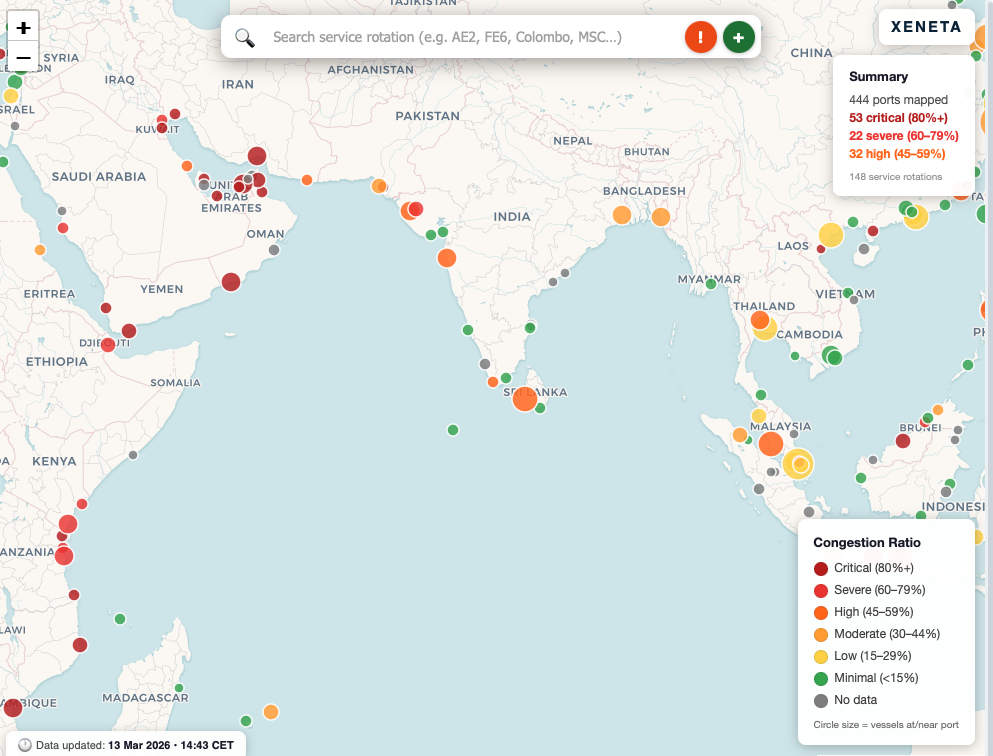
Xeneta has also published a live map detailing congestion across ports directly impacted by the Middle East conflict. The map, pictured below, is found using this link and can be used to support editorial with credit to Xeneta as the source.
Xeneta analyst insight
Peter Sand, Xeneta Chief Analyst
“The ongoing conflict in the Middle East continues to send shockwaves through ocean supply chains.
“Carriers have cancelled services into the Arabian Gulf, but supply chains do not stop. Some shippers simply cannot pull the plug – they need their cargo to keep moving. Alternative ports like Nhava Sheva in India are being used as temporary storage and transshipment points, bringing cargo closer to the Gulf.
“Congestion is building and is toxic for supply chains as carriers and shippers try to identify the least worst option for their cargo.
“Port congestion at Nhava Sheva has risen sharply from 15% pre-Middle East crisis to 55% and climbing. We are also now seeing rising congestion at major Southeast Asian hubs such as Port Klang and Tanjung Pelepas in Malaysia, exactly as Xeneta forecasted when this conflict escalated.
“Ripple effects are now seen in spot rates on major fronthaul trades, particularly Far East to North Europe and Far East to Mediterranean. The Transpacific remains a weak market where even disruptions from the Middle East conflict are not yet lifting rates, but for European trades the direction is one-way and upward.
“The spread in the market is widening as uncertainty grows. While market average spot rates tell one story, we are seeing some shippers signing rates of USD 4 000–5 000 per FEU from China into North Europe and the Mediterranean – that’s roughly 50% above the current market average. This shows just how important it is for some shippers to secure space on board ships.
“Carriers will come up with solutions to maintain the services during a black swan – but it will come at a cost for shippers. In a matter of days, CMA CGM has set up a service unloading goods at Khor Fakkan, located just before the Strait of Hormuz, for onward transportation by train or truck into the region.
“This latest black swan event highlights the importance of long term supply chain resilience strategies. Shippers need to deploy resources not just for firefighting today’s disruptions, but also for the medium and long term. Index-linked contracts offer a way to bridge the gap – they provide assurance that the rate being paid reflects the market, while at the same time allowing shippers to focus on service levels rather than haggling over the next surcharge being thrown at them.”
Data highlights
Nhava Sheva – impact of Middle East conflict example
-
Market average spot rate
-
28 February (pre-conflict escalation): USD 1 350 per FEU (40ft container)
-
12 March: USD 2070 per FEU (+54% compared to pre-conflict)
-
-
Market average spot rate expected to increase further in the next week.
-
Port congestion
-
28 February: 15%
-
12 March: 55%
-
Market average spot rates on major fronthaul trades – 12 March 2026
-
Far East to US West Coast: USD 2,062 per FEU (40ft container)
-
Far East to US East Coast: USD 2,846 per FEU
-
Far East to North Europe: USD 2,336 per FEU
-
Far East to Mediterranean: USD 3,536 per FEU
-
North Europe to US East Coast: USD 1,469 per FEU
Offered capacity on major fronthaul trades (4-week rolling average) – w/c 9 March 2026
-
Far East to US West Coast: -12.2% from a week agoFar East to US East Coast: -8.1% from a week ago
-
Far East to North Europe: -5.2% from a week ago
-
Far East to Mediterranean: -1.9% from a week ago
-
North Europe to US East Coast: +1.7% from a week ago
Ends
Journalists can be added to the distribution list for Xeneta Weekly Market Updates by emailing press@xeneta.com.
Xeneta’s Media Contacts
Philip Hennessey
Director of External Communications, Xeneta
+44 7830 021808
press@xeneta.com