



In the lead up to our Year in Review of schedule reliability, where we will highlight supporting measures like congestion and cancellation rates, we take one final look back at month-over-month trends.
Global
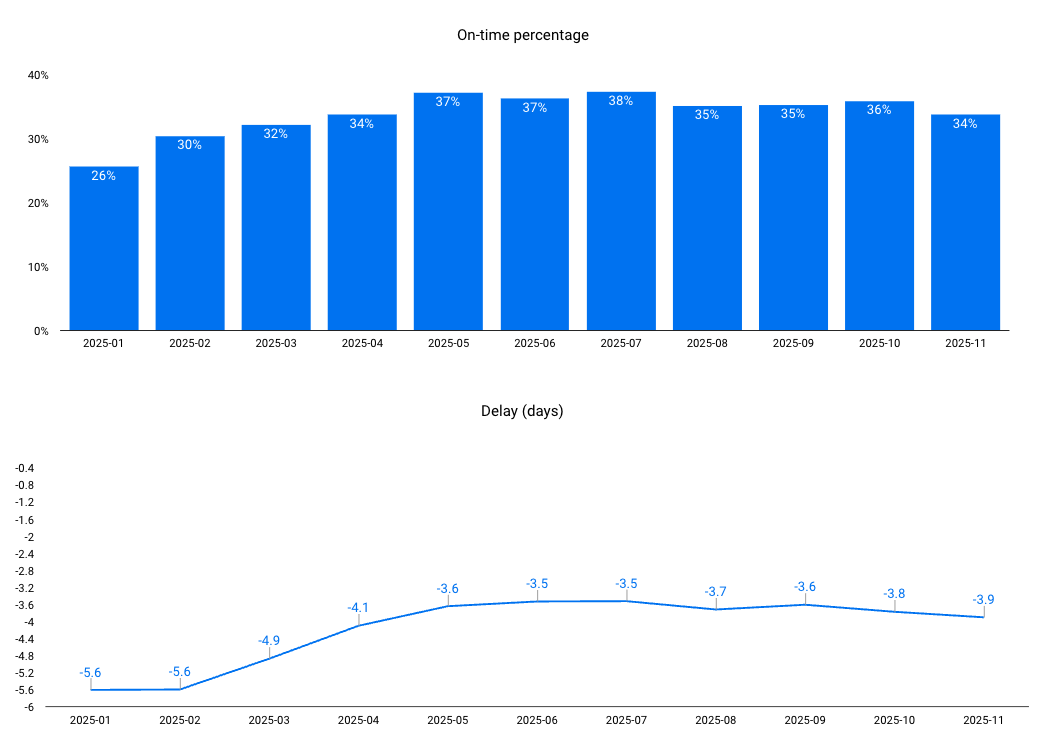
November's global schedule reliability saw average on-time percentage dip slightly down to 34%, over from 36% in October. This was coupled with a corresponding increase from –3.9 days of delay against –3.8 days. While it’s not necessarily foreboding, November is the first ‘low’ deviation from the sideways trend observed in the last 7 months. In the wake of the complex alliance turnovers that defined Q1 and Q2, on-time arrivals have ranged between 35-38% since May.
Monthly global reliability
There is no major variable currently expected to yield a dramatically positive or negative effect on global reliability in the close of the year. While there is plenty of excitement around the dedicated trickle of increased Suez Canal transits, any positive impacts on reliability are still far from measurable.
This is due to two considerations; the first being that voyages must be executed at scale and frequency to have a clear impact on Far East – Europe, and thus global reliability. Right now, we have just 4 new Suez Canal proforma schedule inclusions lined up. CMA CGM’s MEX, INDAMEX, FAL1, and FAL3 services round out the roster, with all but the Mediterranean – North America INDAMEX being classic Far East – Europe strings. The more discreet aspect is that the imminent voyages are classified as inducement (aka unplanned) calls and cannot be measured against fixed service schedules. Even with new service versions like version 19 of the FAL3 having already commenced, roundtrip times mean that the next officially scheduled eastbound voyages through the Suez Canal won’t be upon us until January.
Trades
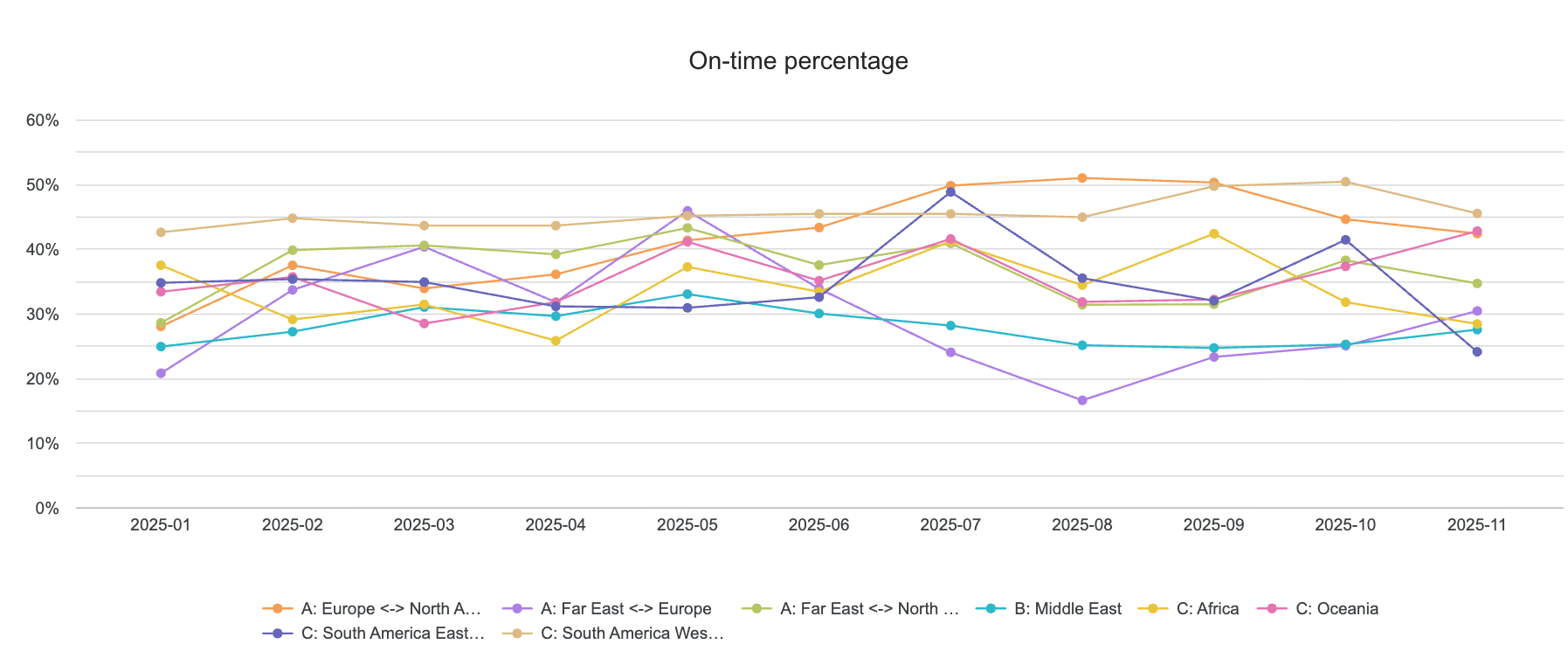
As for trade level performance; Far East – Europe has managed to climb back to 31% of on-time arrivals in the past 4 months, with an additional 24% increase against October. This brought the trade just above Middle East and South America East Coast, which closed November at 27% and 23% respectively. South America East Coast was notably high in October with 40% OTP and has now fallen to the bottom of the pecking order, following a pattern of pronounced highs and lows over the past 6 months.
Monthly trade reliability
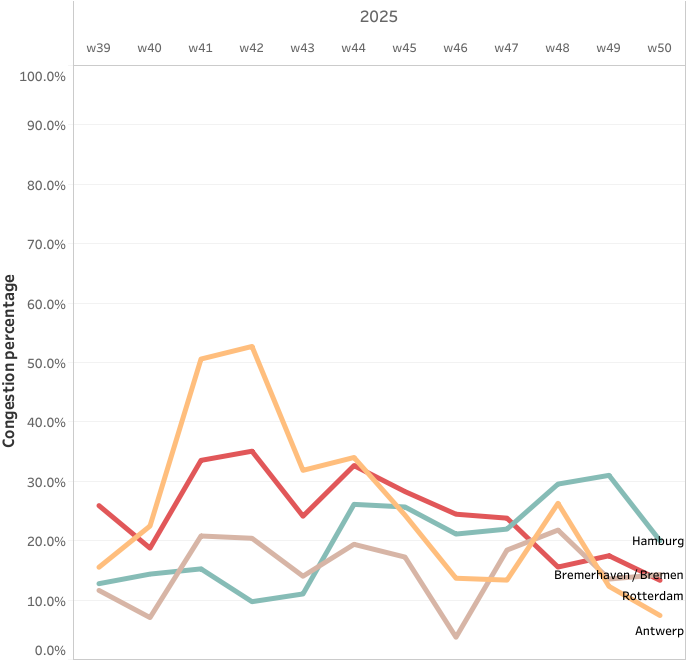
The slight lift in Far East – Europe's November reliability may be due in part to more tightly controlled congestion in Northern European ports over the past 6 weeks. Key ports Antwerp, Rotterdam, and Hamburg have sustained average congestion levels below 35% during this period. The reliability impact of recurrent work stoppages across Northern Europe compounded against extended transit times and larger vessel sizes is a subject we’ll explore in more detail in our January edition.
Weekly average congestion
In another positive development, South America West Coast continued the lead in trade reliability with 45% but was followed closely by Oceania with 43% of on-time arrivals. Oceania has been on a quiet resurgence since August when averages dipped down to 32% and even edged past Europe – North America, which closed at 42% in November.
Alliances
Alliance performances in November continued the micro-trend seen in our previous report wherein top performer Gemini faced decline while historically low performing MSC saw a modest uptick.
Monthly alliance reliability
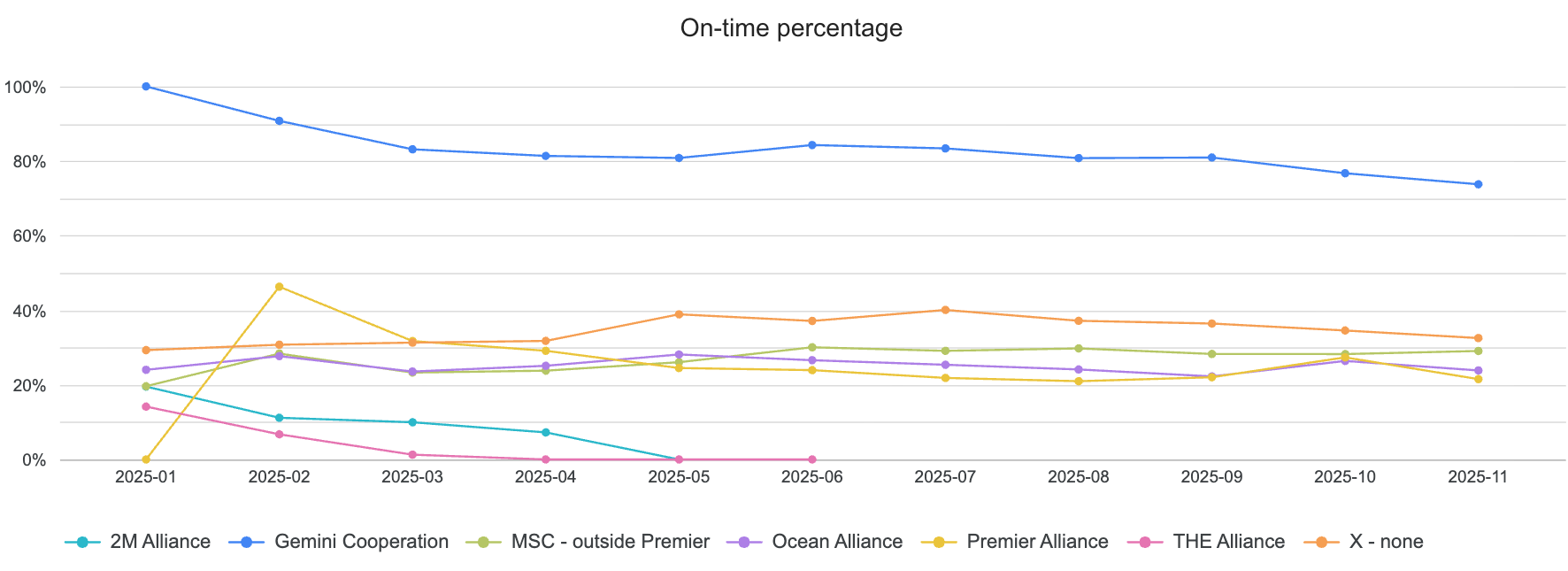
Gemini closed November at 74% against 77% in October, and non-alliance services also saw a two-percentage point decline from 35% to 33% in that span. However, this downturn does not mark a new trend, as both have seen consistent degradation since the start of Q2. Gemini has lost nearly 11% of reliability since July, while non-alliance services have lost a more pronounced 21% of their on-time arrivals.
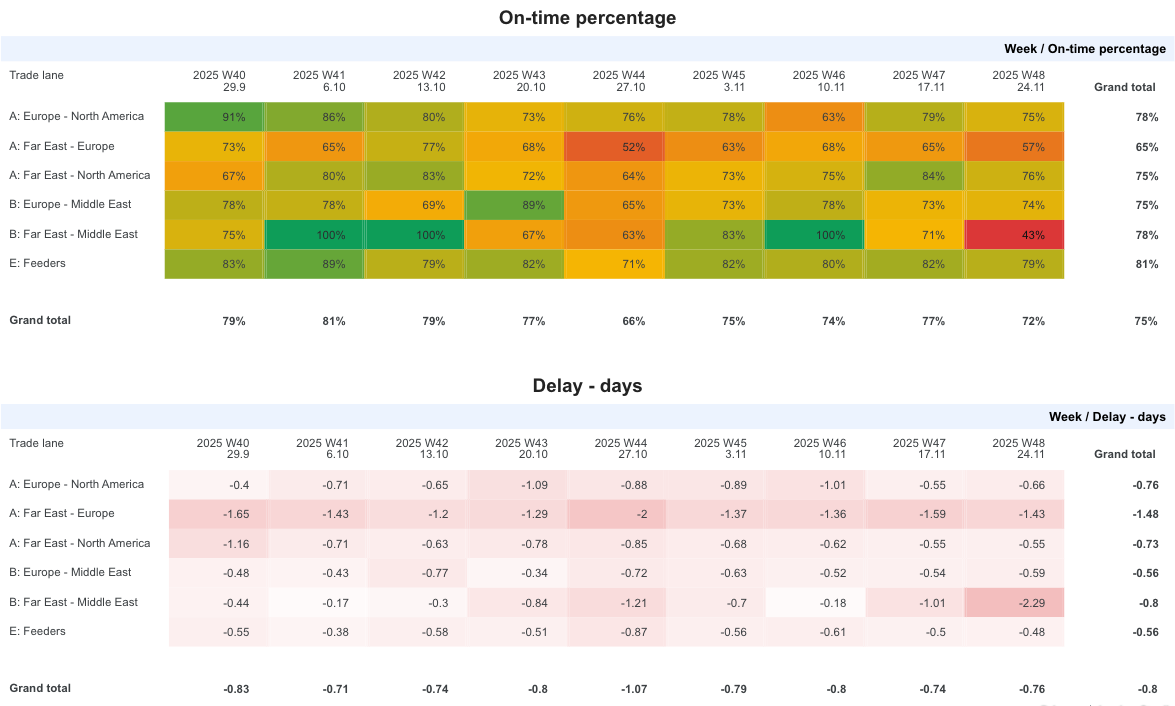
Under the hood, Gemini Cooperation struggled most on the Far East – Middle East trade this past month, with week 48 averaging out at 43% on what is generally a stable lane for the alliance. A major factor here is that the Gemini averages just 7 weekly port calls on a single service on this trade, the Far East Middle East Loop. With such a small sample size of weekly voyages, it means that when minor disruptions do occur, they create a more drastic deviation in aggregate reliability results. That said, the trade that continues to have the biggest influence on driving down Gemini’s average monthly performance is Far East – Europe, with 63% of on-time arrivals in November.
Weekly Gemini reliability
MSC inched up to 29% in November, while all others slipped by two to three-percentage points. Premier Alliance hosted 18% less on-time arrivals this past month and sadly lost the same amount of positive steam it had gained from September through October. While MSC’s steady range of 28-30% over the past 6 months is a sign of resilience, it's still a far cry from their biggest competitor. Despite the Gemini partnership being subject to negative outliers and the expected erosion that comes with maturity, all other performances remain well below their operational consistency.
Want to learn more?
Please join us again in January to see how your carriers are measuring up against the global rankings, and which operational challenges to look out for on your port pairs. In the meantime, if you’re a shipper that’s looking to put a fair price on peace of mind, check out Xeneta’s Carrier Scorecard. Powered by eeSea datasets and Xeneta intelligence, this tool brings you the ability to easily pinpoint which carriers stand out from the crowd. With tender season closing in, now is the perfect time to steer reliability signals to your advantage.