
%20(1).png?width=1200&name=ocean-freight%20(1)%20(1).png)
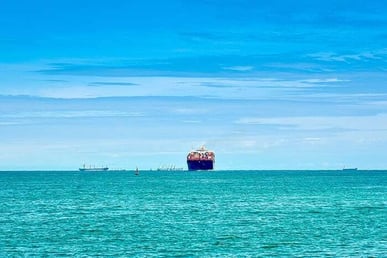
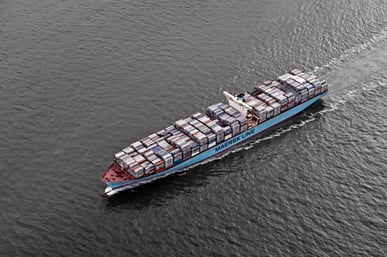
It’s official, Maersk is about to complete their second East – West passage through the Red Sea with MAERSK DENVER. The 6200 TEU vessel is currently deployed on the Middle East – North America MECL1 service connecting India to the US East Coast and Gulf ports. The vessel went dark three days ago on January 10, echoing the cautious cloaking pattern of MAERSK SEBAROK and other vessels belonging to CMA CGM that have recently completed ad-hoc passages through the Red Sea. MAERSK SEBAROK transited the Suez Canal on December 23, and is scheduled to arrive in New York City, her first North American discharge port, today.
MAERSK DENVER currently remains dark, but Maersk confirmed her successful passage through the Bab-al-Mandeb strait yesterday afternoon. The vessel is forecasted by our team to arrive on January 16th.
What does this mean for Maersk? If the carrier completes two successful passages within a 3-week window, it’s highly likely they’ll increase the frequency of these trials in the immediate period ahead. This could take shape in using eastbound and westbound passages on the MECL1, additional vessels on this string, one-way transits on other services, or a combination of all three. Barring any sudden changes in Israel-Houthi relations, we can safely expect to see at least one more Maersk vessel making a westbound passage within the next week or two.
Then there’s the bigger picture, what does this mean for other carriers? Including updates to CMA’s INDAMEX service – Maersk's use of two MECL1 vessels now brings us to two North America strings utilizing the Red Sea passage, albeit just one that is officially committed. With the addition of CMA’s partnership with OCEAN alliance on the MEX / MED2 we have a tally of two North America services, a Far East – Europe service, ONE’s recently announced slot chartering activity on the Red Sea China service operated by GFS, and statements from Yang Ming Line’s general manager suggesting that Premier Alliance is warming up to some imminent trials of their own.
Taking the above into account, and the message that Maersk's’ growing confidence sends to their peers, the sporadic trickle of passages may very soon become a modest stream if ceasefire conditions continue to be met. As for what types of strings to watch, we could broadly speculate that a service like Premier Alliance’s round-the-world EC2 would be a good candidate for trials. Given its structure, the service already has just one eastbound passage past the Cape of Good-Hope and could conveniently cut down round trip time between Asia and North America with a lower-risk partial commitment on the backhaul.
Depending on the rate and scope of advancement across carrier networks, what unfolds could be a double-edged sword for shippers. While they may benefit from a downward slide of rates due to an abundance of capacity, the risks to reliability and on-time shipments is a potential shock to be wary of.
Reach out to contact@xeneta.com if you want to learn more about using our services to learn how these new transits will impact your supply chain, and what you can do about it.