


Freight procurement teams used to tolerate a lot of chaos.
Rates scattered across inboxes. Supplier updates arriving in conflicting formats. Spreadsheets that ballooned with every new quarter. And a shared understanding across the team that if something broke, someone would fix it manually because there was no other choice.
But as volatility increased, the previous way of managing rates quietly stopped working. Not because teams lost discipline, but because the market changed faster than the systems built to support it.
This is the backdrop behind the rise of the freight rate management system, a tool that is becoming essential for shippers, forwarders, and supply chain teams that need order in an environment that constantly shifts under their feet.
If you have ever wondered what a freight rate management system really is, and why it suddenly matters, this guide breaks it down.
So What Is a Freight Rate Management System?
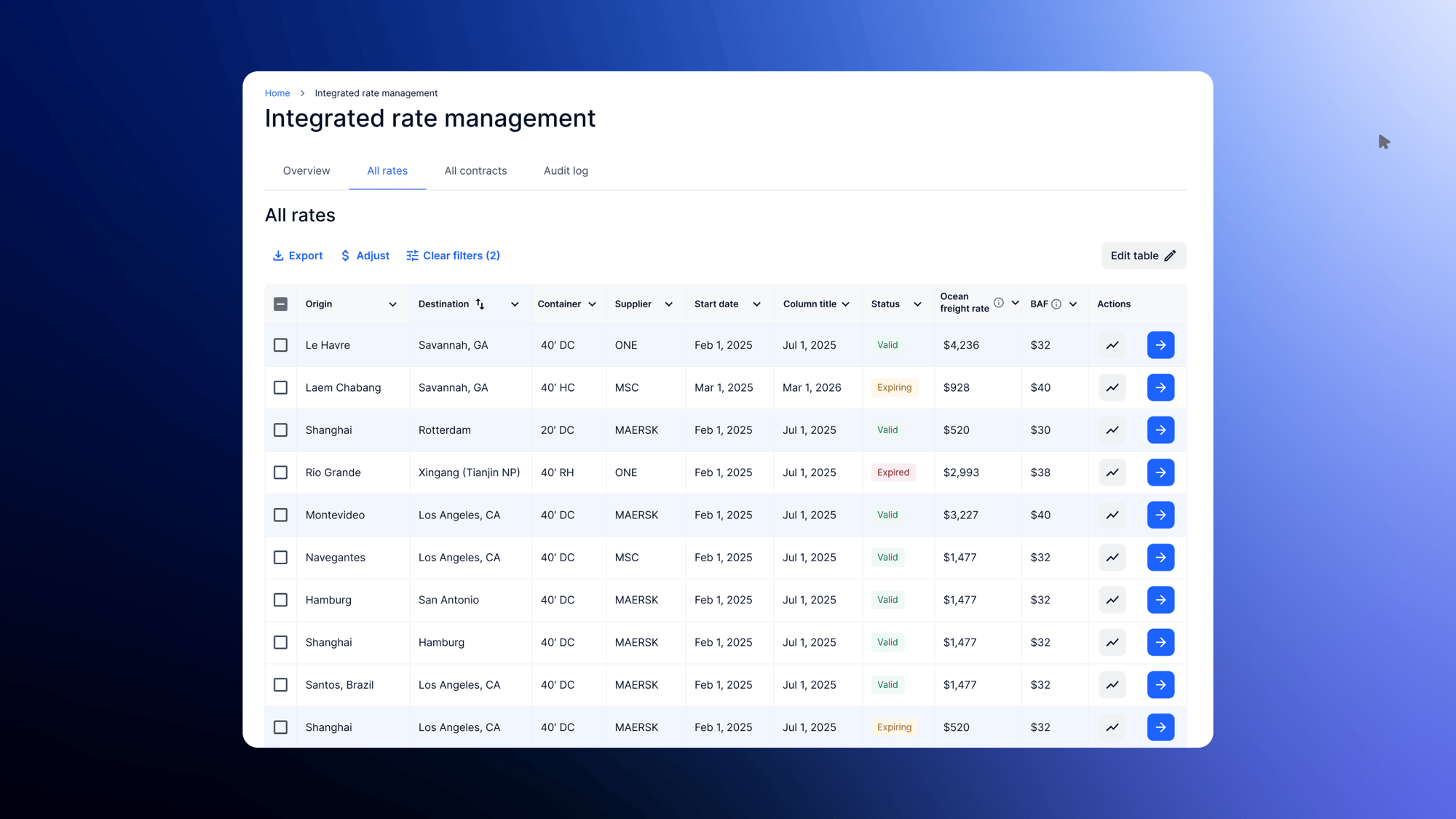
A freight rate management system is a centralized platform that stores, updates, tracks, and standardizes all of a company’s freight rates, surcharges, and contract terms across ocean, air, and inland transportation.
It replaces the fragmented, manual processes that most teams still rely on.
Instead of:
• files named “final_v9_CORRECTED(2).xlsx”
• inconsistent formats from suppliers
• days spent validating rates
• formulas breaking quietly in the background
• different regions operating on different versions
A freight rate management system creates one structured, auditable, always updated source of truth.
The real power is not the storage. It is the standardization. When rates, surcharges, rules, and components are structured consistently, the entire procurement process becomes faster, cleaner, and far less risky.
Why Freight Rate Management Suddenly Matters
Not long ago, freight procurement could function with slower cycles. You updated rates quarterly. You managed exceptions manually. You adjusted spreadsheets when needed.
The market was not calm, but it also was not rewriting itself every few months.
Then volatility arrived. Not as a short spike, but as a permanent feature of global trade.
Rates move quickly. Capacity shifts without warning. New alliances reshape reliability.
Surcharges appear, disappear, and reappear. Geopolitical events alter lanes overnight.
Freight became far more fluid than anything spreadsheets were designed to support. This is why freight rate management evolved from admin work into a core discipline almost overnight. Manual processes cannot keep up with the speed, scale, or complexity of today’s market.
When rate management is manual, volatility exposes every weakness. When it is standardized, volatility becomes manageable.
What a Freight Rate Management System Actually Does
Let’s remove the buzzwords and talk about real functionality.
A strong freight rate management system includes:
Centralized Rate Storage
All contract rates, spot quotes, and surcharges live in one place.
Not spread across email, shared drives, or regional folders.
Standardized Supplier Inputs
Suppliers submit their updates in a consistent structure so you do not spend hours reformatting.
Real-Time Benchmark Comparisons
Teams can instantly see where their contract sits in the market.
Invoice Validation
Component-level visibility makes it possible to catch discrepancies early.
Audit Trails
Every update has a record.
Every change is traceable.
No more “who updated this?”
Access for Global Teams
Everyone sees the same data, in the same format, at the same time. None of this is glamorous. All of it is essential.
Who Uses a Freight Rate Management System?
Procurement teams
To secure competitive contracts and evaluate supplier bids with confidence.
Logistics and operations teams
To validate rates, manage surcharges, and align cost expectations.
Finance
To audit charges accurately and consistently despite foreign currencies, and improve cost forecasting.
Sales teams
To generate quotes without risking margin leakage.
Executives
To understand cost exposure and build strategies based on reliable data.
When rate data is standardized, all these functions can finally speak the same language.
What Problems Does a Freight Rate Management System Solve?
Time Loss
Manual rate updates that once consumed days now take hours.
Spreadsheet Errors
Incorrect formulas, overwritten cells, or version confusion often lead to expensive mistakes.
Lack of Market Context
Teams make better decisions when contracts sit side by side with real market benchmarks.
Slow Internal Alignment
Without a system, stakeholders get different answers depending on who they ask.
Invoice Disputes and Reconciliation Issues
Clear rate components make validation straightforward.
Siloed Regional Processes
Standardization removes the dependency on tribal knowledge.
Why Spreadsheets No Longer Work
There was a time when spreadsheets were enough. That time has passed.
Spreadsheets:
• break easily
• hide errors
• do not scale
• make audits painful
• rely on individual memory
• collapse under complex surcharges
• cannot keep up with weekly market movement
• encourage inconsistent workflows across regions
Spreadsheets were built for calculations, not freight procurement. A freight rate management system is built for both.
How Freight Rate Management Supports Modern Procurement Strategies
As more shippers adopt hybrid procurement models that blend fixed pricing, spot exposure, index-linked contracts, and shorter tender cycles, rate management becomes the foundation beneath all of it.
Clean, standardized rate data supports:
• better timing decisions
• faster tenders
• stronger negotiations
• clearer insight into cost exposure
• fewer disputes
• more accurate budgets
• more resilience during disruption
The strength of procurement outcomes directly reflects the strength of rate management.
How to Choose a Freight Rate Management System
Look for systems that offer:
• unified rate data across modes
• clean auditability
• simple supplier upload workflows
• strong validation logic
• integrated benchmarks
• fast bulk updates
• access controls for global teams
• straightforward exports for finance and sales
• minimal reliance on fragile formulas
A good system should feel calm and predictable. If it feels complicated, it will not become part of your long-term workflow.
Bottom Line: Standardized Rate Management Is Becoming the Industry Norm
Teams that standardize their rate management processes will:
• reduce chaos
• gain clarity
• cut manual workload
• speed up alignment
• strengthen procurement decisions
• avoid costly surprises during volatility
Teams that do not will remain stuck in a cycle defined by rework, firefighting, and uncertainty.
The market has moved on. Rate management needs to move with it.
Upload Once. Update Everywhere.
See how global shippers are simplifying updates, gaining clarity, and building standardized processes that scale with Integrated Rate Management by Xeneta today.
-1.gif?width=960&height=540&name=RMS%20(1)-1.gif)