

On 28 February 2026, a military escalation in the Middle East triggered the closure of the Strait of Hormuz and a suspension of Suez Canal transits. Within days, the five largest container carriers — MSC, Maersk, CMA CGM, ONE, and Hapag-Lloyd — had all announced emergency fuel surcharges. Hapag-Lloyd applied a war risk surcharge of $1,500 per TEU on cargo to and from Gulf-linked corridors. Vessels planned for Suez transit were diverted around the Cape of Good Hope, adding ten to fourteen days per voyage and pushing fuel costs up roughly 40%. Asia to US West Coast spot rates climbed approximately 40% from their late February levels. Transatlantic rates moved 50% in a single week in April.
For freight procurement teams managing contracted rates in spreadsheets, this sequence of events created an immediate and practical problem. Every surcharge announcement was a rate management event. Every rerouting decision changed the cost basis on affected lanes. Every new war risk levy required someone to open a file, update a formula, check the version, and redistribute the result. In a period where the surcharge environment was changing faster than a quarterly update cycle could accommodate, the administrative gap between current market reality and the data teams were actually working from widened with each passing week.
This is the freight rate management crisis. Not a future risk. A present condition, documented in the rate tables of the carriers shippers work with every day.
The environment has changed. The tools have not.
For most of the past decade, spreadsheet-based rate management was survivable. The quarterly rhythm worked well enough. Suppliers returned rate sheets, teams extracted and validated the data, files were updated and shared. The process was slow and error-prone, but in a market defined by relative stability it was manageable.
That stability is gone. The Hormuz crisis is the most acute example, but it is not the only one. The Red Sea disruption, which added emergency rerouting surcharges from 2024 into 2025, had already demonstrated that unplanned surcharge events could arrive and compound faster than manual processes were designed to handle. US tariff policy in early 2026 introduced a shift from country-specific tariffs to a broad global surcharge, forcing procurement teams to reassess contracted rates across thousands of lanes simultaneously. UNCTAD issued a formal warning in March 2026 of heightened risks to energy supply and vulnerable economies as a direct result of the Hormuz disruption — a signal that the instability driving surcharge complexity was not resolving quickly.
In this environment, carriers have adjusted their own operating rhythms accordingly. Some are now issuing rate updates weekly rather than on the bi-weekly or monthly cycles that previously defined the market. For a procurement team working from a spreadsheet updated four times a year, that shift is not a scheduling inconvenience. It is a structural mismatch between the pace at which the market moves and the pace at which manual processes can respond.
The cost is calculable.
The administrative burden of spreadsheet-based rate management is rarely measured explicitly. It accumulates across team capacity as part of the quarterly cycle, treated as a fixed cost of doing business rather than a variable that can be reduced.
When it is measured, the numbers are significant. A shipper managing rates across 40 lanes with four carriers requires approximately three hours per carrier rate sheet for a standard post-tender upload. Across four carriers, that is 12 hours per tender cycle. Add the kind of surcharge events that defined Q1 and Q2 2026 — emergency fuel levies, war risk charges, rerouting adjustments — and the unplanned update burden compounds quickly. For shippers managing larger networks, 250 hours of annual rate administration is a conservative estimate.
That time is not spent benchmarking contracted rates against the market. It is not spent preparing for negotiations or evaluating carrier performance. It is spent keeping data accurate enough to use. In a year when carriers are revising surcharges weekly and new charges are appearing with forty-eight hours notice, the cost of that manual cycle is not abstract. It shows up in the quality of decisions made on rate data that may already be several surcharge events out of date.
Beyond the time cost, the downstream consequences are significant. When rate data is not current, procurement cannot benchmark accurately, because the comparison is built on a flawed foundation. Logistics operations may execute bookings against rates that no longer reflect contractual terms. Finance cannot validate invoices with confidence. The risk of each of these consequences compounds with every surcharge event that goes unrecorded.
The standardisation problem cuts both ways.
Spreadsheet fragmentation is not limited in its consequences to the shipper's own operations. Carriers and freight forwarders receive rate sheets in dozens of different formats from dozens of different counterparties. Translating those inputs into their own systems before they can price a tender is a significant administrative burden on their side of the relationship as well. It slows response times and introduces the risk of misinterpretation at the point where accuracy matters most.
When shippers operate from standardised, structured rate data, that friction reduces for both parties. Tenders move faster. The risk of errors in translation decreases. And the commercial relationship can focus on the substance of the negotiation rather than the mechanics of reconciling incompatible files.
Rate management as a competitive variable.
The shippers who have moved beyond spreadsheets have not done so because the technology was new. They have done so because events like the Hormuz closure made the cost of staying on spreadsheets impossible to absorb.
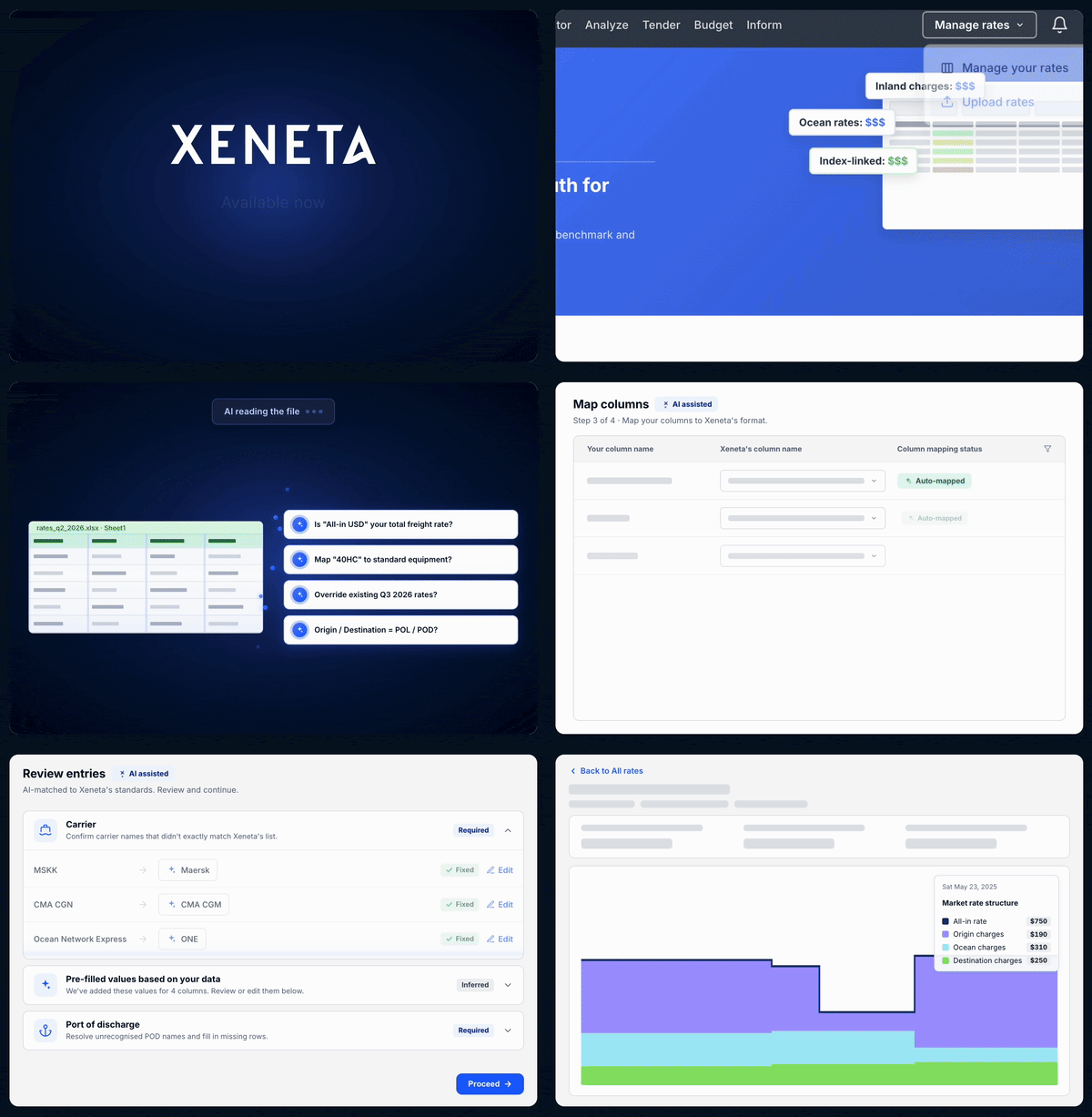
What replaces the spreadsheet is not a different kind of spreadsheet. It is a structured rate management environment where contracted rates are uploaded, standardised and validated automatically. Where surcharge adjustments — including the kind of stacked, multi-carrier levies that defined Q1 2026 — are applied across all relevant lanes in seconds, with a full audit trail attached. Where procurement, logistics and finance work from a single, current source of truth. And where rate data connects directly to market benchmarks, so the time between a disruption event and an accurate assessment of its cost impact reduces from days to minutes.
When Hapag-Lloyd announced its war risk surcharge on 2 March 2026, the shippers who could respond that day were not working from last quarter's spreadsheet.
It's over for the spreadsheet.
Xeneta's Integrated Rate Management transforms freight rate chaos into one source of truth. Upload your rate sheets, apply surcharge updates in seconds, and benchmark your contracted rates against the market — all in one place, now available in platform.
If your team is still managing rates manually, the market is not waiting for you to catch up.