

Freight procurement has always required discipline. In the market conditions that have defined 2025 and 2026, it requires something more: an infrastructure capable of keeping pace with a rate environment that has fundamentally changed in character, not just in degree.
Consider what happened in the ten days following 28 February 2026. A military escalation in the Middle East triggered the closure of the Strait of Hormuz and the suspension of Suez Canal transits. Within days, every major container carrier had announced emergency fuel surcharges. Hapag-Lloyd applied a war risk surcharge of $1,500 per TEU on Gulf-linked cargo on 2 March. Vessels planned for Suez transit were diverted around the Cape of Good Hope, adding ten to fourteen days per voyage. Asia to US West Coast spot rates climbed approximately 40% from their late February levels.
For a freight procurement team managing contracted rates in spreadsheets, those ten days generated a rate management workload that the quarterly update cycle was not designed to absorb. Every surcharge announcement required someone to open a file, update a formula, check the version, and redistribute the result. Every rerouting decision changed the cost basis on affected lanes. The administrative gap between current market reality and the data teams were actually working from widened with each new development.
This is not a scenario that RHI Magnesita, a global manufacturer of refractory products moving dense industrial cargo across more than 1,700 ocean lanes, could afford to manage through a spreadsheet maintained by two people on a quarterly cycle. Their decision to change that was not a decision about technology. It was a decision about whether their rate management infrastructure was capable of keeping pace with the market they were operating in.
The cost of a workflow built on spreadsheets
Many shippers still follow a familiar quarterly rhythm. Suppliers return rate sheets. Teams extract and validate the data. Columns get adjusted. Files are split and merged. Every update sets off a cycle of manual checks that can consume entire workdays.
RHI Magnesita described this environment clearly. Two people spent three full days every quarter simply updating rates, working through a process that involved pulling data from rate sheets, correcting formats, recalculating formulas and reconstructing a master file that all stakeholders could use.
At scale, the numbers add up quickly. A shipper managing 40 lanes with four carriers requires approximately three hours per carrier rate sheet for a standard post-tender update. Across four carriers, that is 12 hours per tender cycle before any unplanned surcharge events are factored in. In the first quarter of 2026 alone, the five largest container carriers all issued emergency fuel surcharges within a two-week window. Each of those announcements was a separate rate management event for every affected shipper. For a network as large as RHI Magnesita's, the administrative consequence of each event arriving on top of the standard quarterly workload was substantial.
Beyond the time cost, the downstream risk accumulates in ways that are harder to measure but no less significant. When rate data does not reflect the latest surcharge adjustments, procurement cannot benchmark accurately. Logistics operations may execute bookings against rates that no longer reflect contractual terms. Finance cannot validate invoices with confidence. In the surcharge environment that characterised Q1 and Q2 2026, with war risk charges, emergency fuel levies and rerouting adjustments stacking on top of each other within weeks, the gap between a team working from current data and one working from last quarter's spreadsheet was not marginal.
Why more shippers are reconsidering their approach
The freight market has changed in ways that have made the standard spreadsheet-based workflow a structural constraint rather than a neutral administrative process. The Red Sea disruption demonstrated from 2024 onward that unplanned surcharge events could arrive and compound faster than quarterly cycles could accommodate. US tariff policy in early 2026 introduced a shift from country-specific tariffs to a broad global surcharge, forcing procurement teams to reassess contracted rates across thousands of lanes simultaneously. Some carriers have responded to the volatility of the past two years by moving to weekly rate updates, a cadence that quarterly spreadsheet maintenance was never designed to support.
RHI Magnesita began rethinking their approach for four reasons that are increasingly common across large supply chains. They needed a single environment where data was instantly visible, clean and accessible to regional and global stakeholders, rather than a collection of folders and files passed between teams. They needed consistency in how supplier inputs were structured, because formats arriving from different carriers were consuming more time than the analysis itself. They needed the context of market benchmarks, because RHI Magnesita moves dense cargo where market segmentation matters and understanding how their rates compare with peers is important for negotiations and planning. And they needed to recover the time that was being absorbed by administration, because as Ibrahim Koca, Trade Management Head of Commercial at RHI Magnesita, noted, reducing days of manual work to just a few hours is not a marginal improvement — it is the difference between a team that is managing data and a team that is managing the business.
What changes when rate management becomes structured
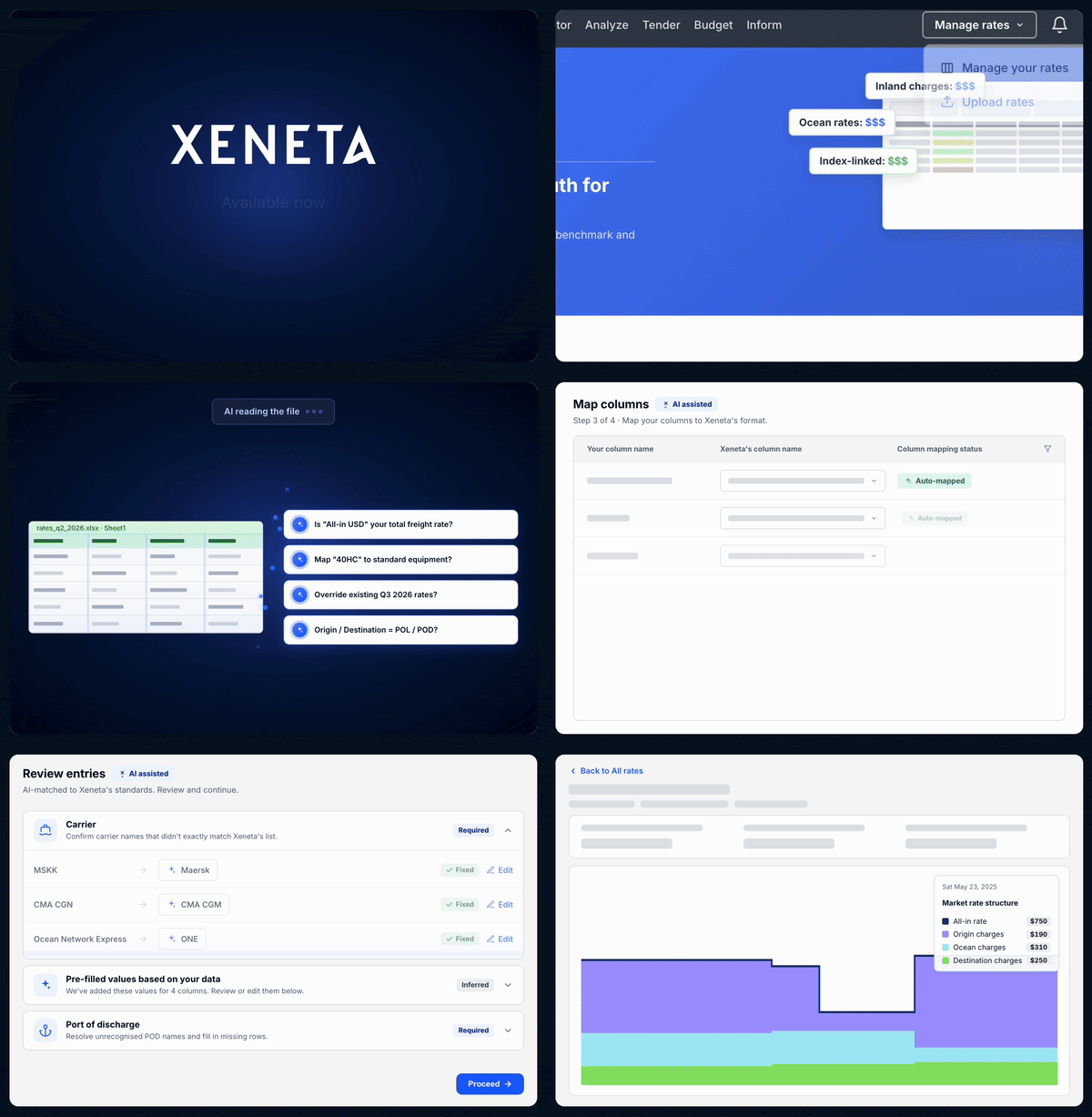
When RHI Magnesita moved to an integrated approach, the practical impact was immediate. Quarterly updates that had previously consumed three full days were completed in a few hours. Supplier inputs followed a single structure. Data was stored in one place, and teams across the business could work from the same source of truth without the version conflicts and reconciliation loops that characterised the previous process.
With reliable data at the centre, the team's attention shifted from maintaining the system to using it. Preparations for negotiations became grounded in current benchmarks. Risks were identified earlier in the cycle. And internal alignment improved because decisions were based on a shared, accurate foundation rather than on interpretation of different datasets held in different files by different teams.
There is also a consequence for carrier relationships that is less often discussed. Carriers and freight forwarders receive rate sheets in dozens of different formats from dozens of different counterparties. Translating those inputs into their own systems before they can price a tender is a significant administrative burden on their side of the relationship as well. When shippers move to a standardised rate structure, that friction reduces for both parties. Tenders move faster and the commercial relationship can focus on the substance of the negotiation rather than the mechanics of reconciling incompatible files.
"Xeneta's Integrated Rate Management will free me and others up to focus on other priorities instead of spending days on manual tasks — reducing that time to just a couple of hours instead of days is a huge deal for us and a big efficiency gain. It will help us to move faster, and keep our data clean and compliant." — Ibrahim Koca, Trade Management Head of Commercial, RHI Magnesita
A new standard for freight procurement
What RHI Magnesita accomplished reflects a transition that is happening across the industry, driven by the same combination of network complexity, market volatility and internal alignment demands that their team confronted. As supply chains grow more interconnected and markets move faster, the organisations that maintain manual, fragmented rate management processes are absorbing a cost that compounds with every disruption event. Networks have expanded, surcharge frequency has increased, and the consequences of operating on inaccurate rate data have grown alongside them.
When Hapag-Lloyd announced its war risk surcharge on 2 March 2026, the shippers who could assess the impact on their contracted rates that day were not working from last quarter's spreadsheet. RHI Magnesita wanted the kind of control that made that possible. The structure they built gave it to them.