


Ocean freight procurement still leans heavily on fixed-rate tenders because they promise stability. The problem is that stability often lasts only until the market moves. When rates rise, suppliers start looking for adjustments or shifting attention to higher-yield cargo. When rates fall, shippers are left paying above-market rates and reopening negotiations. What was meant to create predictability starts creating more work, more friction, and less confidence in the contract itself.
That is why more shippers are taking a closer look at index-linked contracts. Instead of locking in a number that can quickly lose relevance, index-linked agreements create a framework for rates to move with the market in a way both sides have already agreed.
Why fixed-rate contracts keep falling short
Freight rates do not stand still, so contracts should not pretend they do. In a volatile market, a fixed annual rate can start to look outdated almost as soon as it is signed. That does not just create pricing problems but operational problems too. Teams that thought procurement was settled find themselves back in discussions about surcharges, renegotiations, and whether the contract still reflects reality.
In many cases, this is already how the market behaves. Contracts may be labelled fixed, but when conditions change enough, both sides often return to the table. The difference with index-linked contracts is that the adjustment is no longer improvised. It is built into the agreement from the start.
That matters because the cost of the traditional approach goes well beyond the rate itself. Running an RFQ takes time, management attention, and internal coordination. Suppliers invest heavily too, often with no guarantee of winning business. Then, if the market shifts sharply, everyone ends up spending more time renegotiating what was supposed to be settled.
The result is an industry that often pays twice. First for the tender. Then for the renegotiation.
What index-linked contracts do differently
Index-linked contracts offer a cleaner way through. They replace reactive pricing discussions with a transparent mechanism tied to a trusted market benchmark. The rate moves according to pre-agreed rules, whether that means monthly, quarterly, or some other cadence that fits the business. That does not remove volatility, but it does make it easier to manage without turning every market change into a commercial dispute.
It also changes the nature of the buyer-supplier relationship. In a standard tender, most of the energy goes into price. There is rarely much room left to talk about service quality, reliability, sustainability, or how both sides want the relationship to work over time. Once pricing is handled through a rule-based model, those conversations become much easier to have.
It is also worth clearing up a common misconception. Index-linked contracts are not about securing the cheapest rate in the market. They are about landing on a relevant and competitive rate that both sides can continue to work with as conditions change. That is a very different objective, and a much more practical one.
What this looks like in practice
This is easier to understand when you can actually see the rate movements.
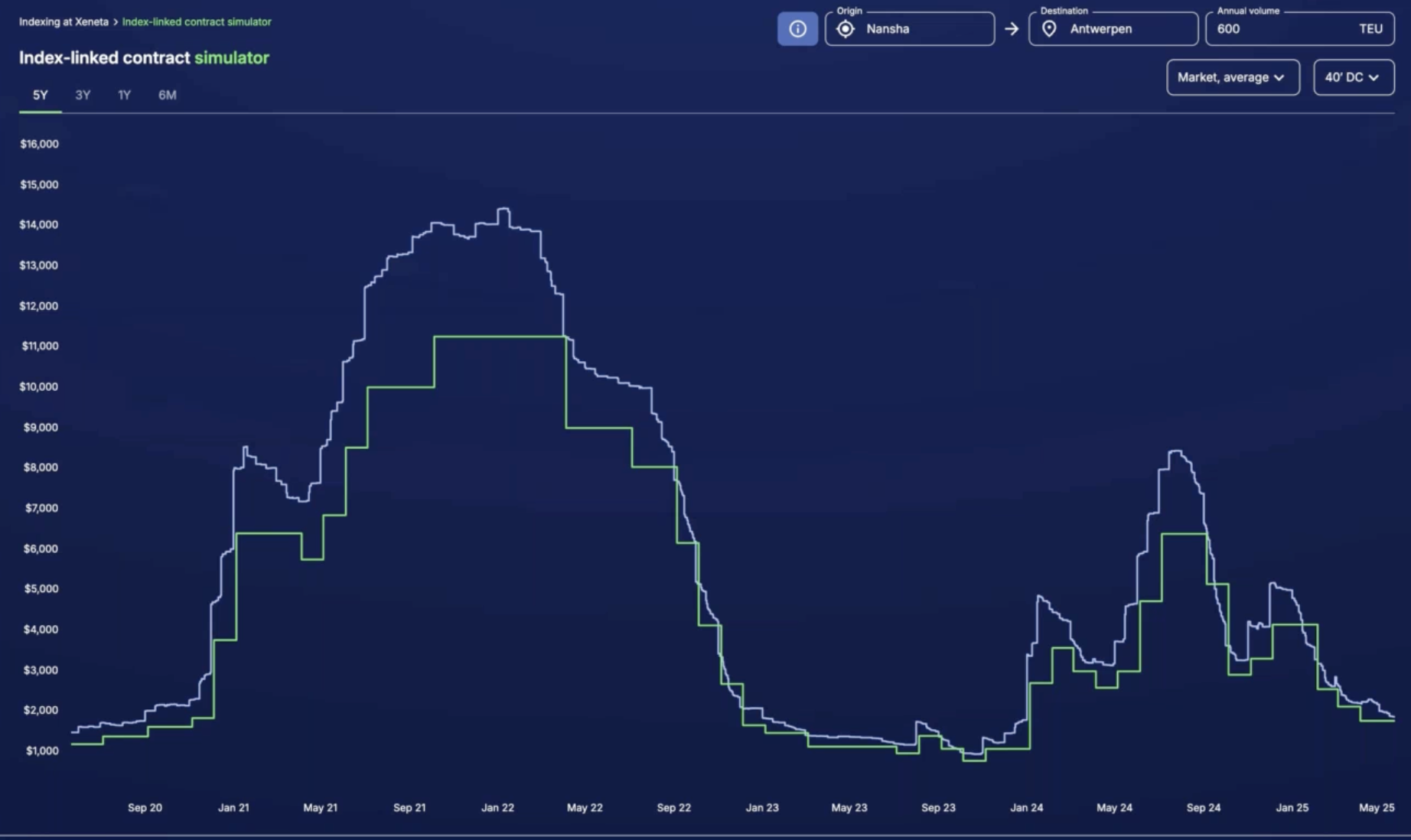
In Xeneta’s Index Simulator, users can build an index-linked contract lane by lane and test how it would have performed against real market data over the previous five years. An example is a China to North Europe corridor with 600 TEUs, starting with a short-term market reference and monthly adjustments.
The first chart shows two things clearly. The short-term market moved sharply, while the index-linked model (green line) followed with more structure and less noise. That immediately turns the conversation from theory into design. Are you following the right benchmark? Is the contract moving too often? Is it responsive enough when the market changes fast?
From there, the model is adjusted to better match how a larger shipper might actually buy freight. Instead of following the short-term market with monthly changes, the contract was switched to reference the long-term market with quarterly adjustments. That produced a calmer, more operationally manageable structure, but it also raised an important question. Was it responsive enough when the market spiked?
That is where the simulator becomes especially useful. By layering short-term market visibility back into the chart and adding a trigger mechanism, the model could respond when the gap between long-term and short-term rates became too wide. In other words, it was possible to design a contract that still followed the long-term market, but reacted faster when the commercial risk of falling behind became too great.
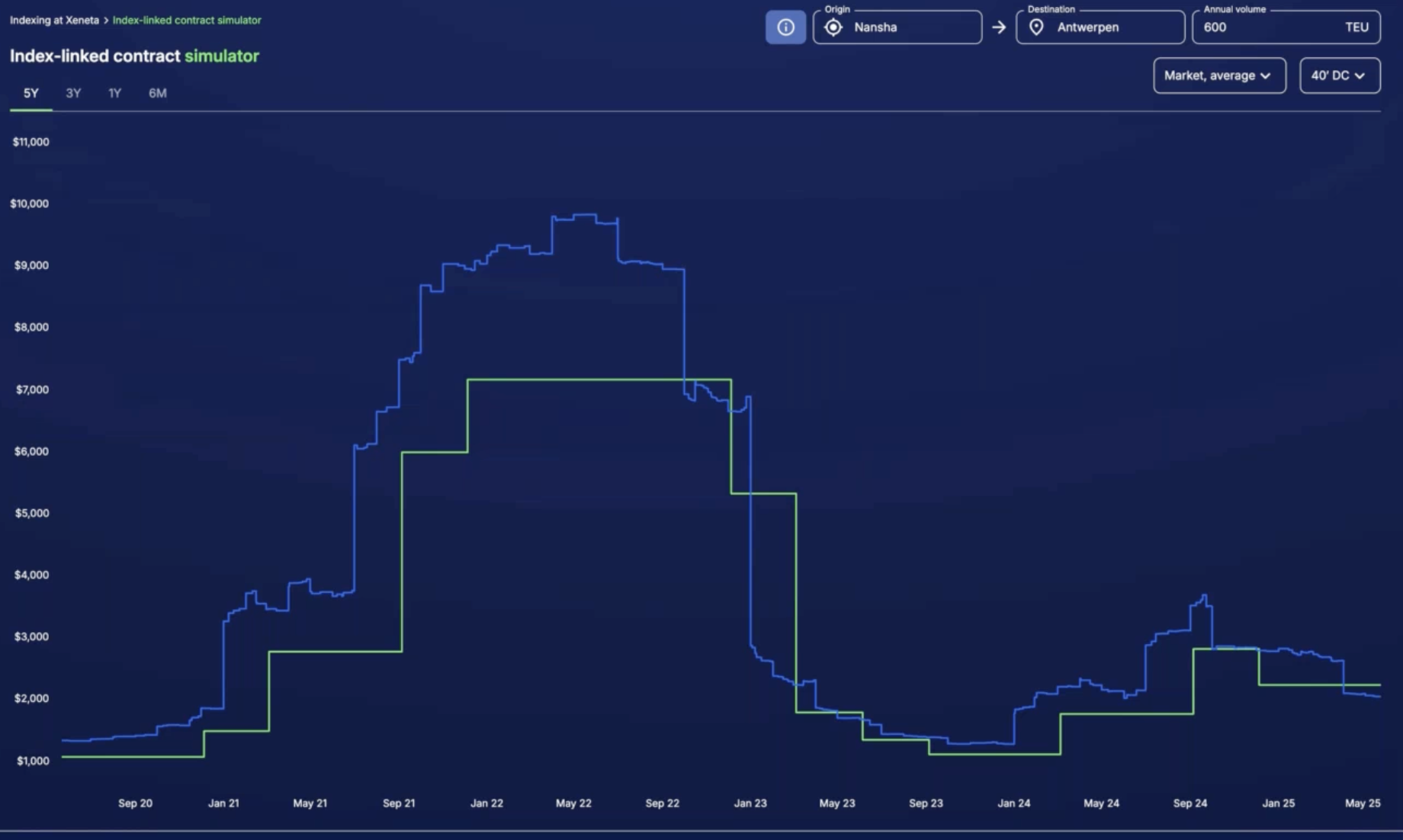
That kind of back testing matters because it shows exactly how the rules would have played out in periods like 2021, when rates accelerated far faster than most annual contracts could keep up with. It also helps both sides see the trade-offs more clearly. A model that is less reactive may be easier to manage operationally, but it could leave too much distance between the contract and the live market. A more responsive model may support service continuity better, but it may need floors, ceilings, or thresholds to avoid overcorrecting.
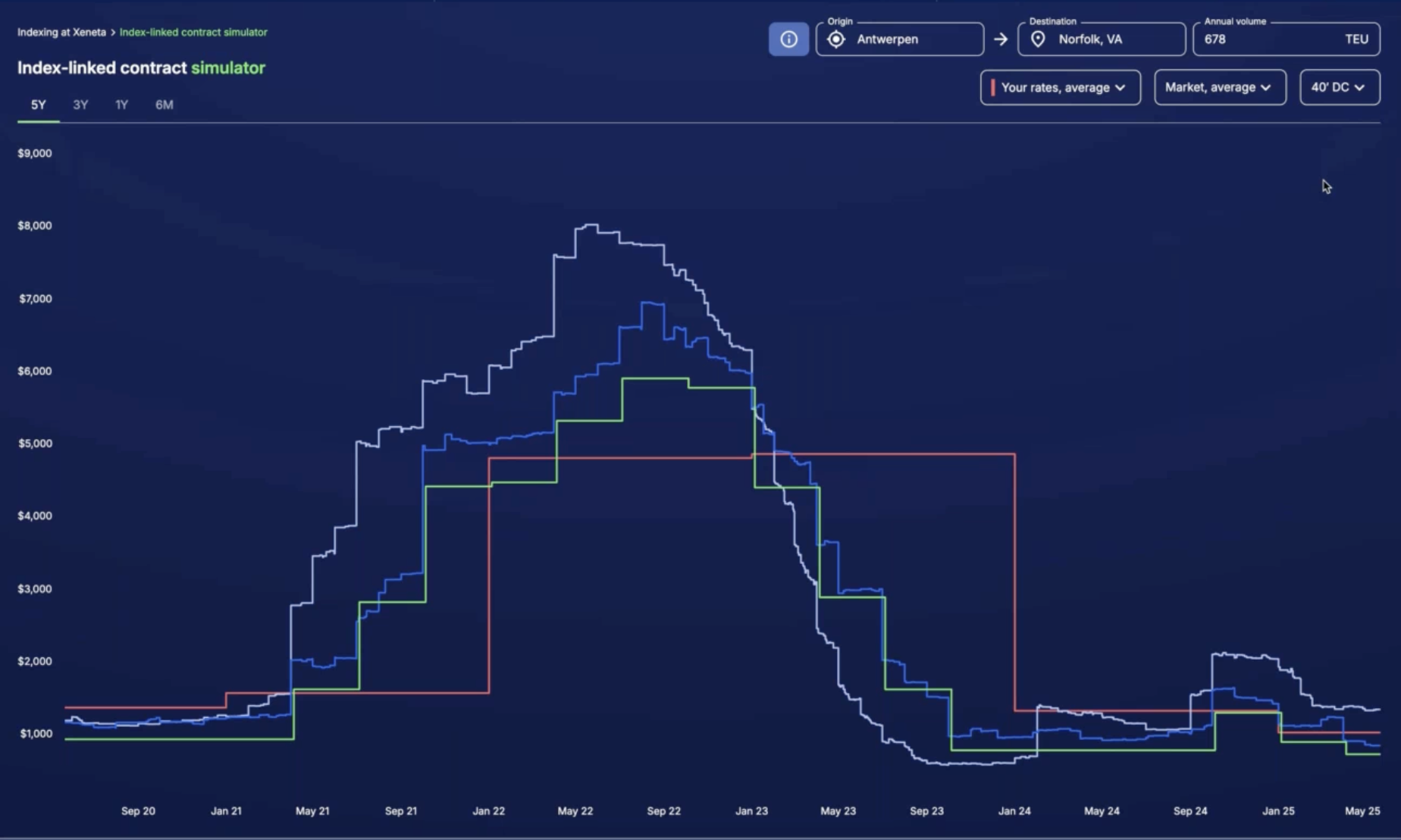
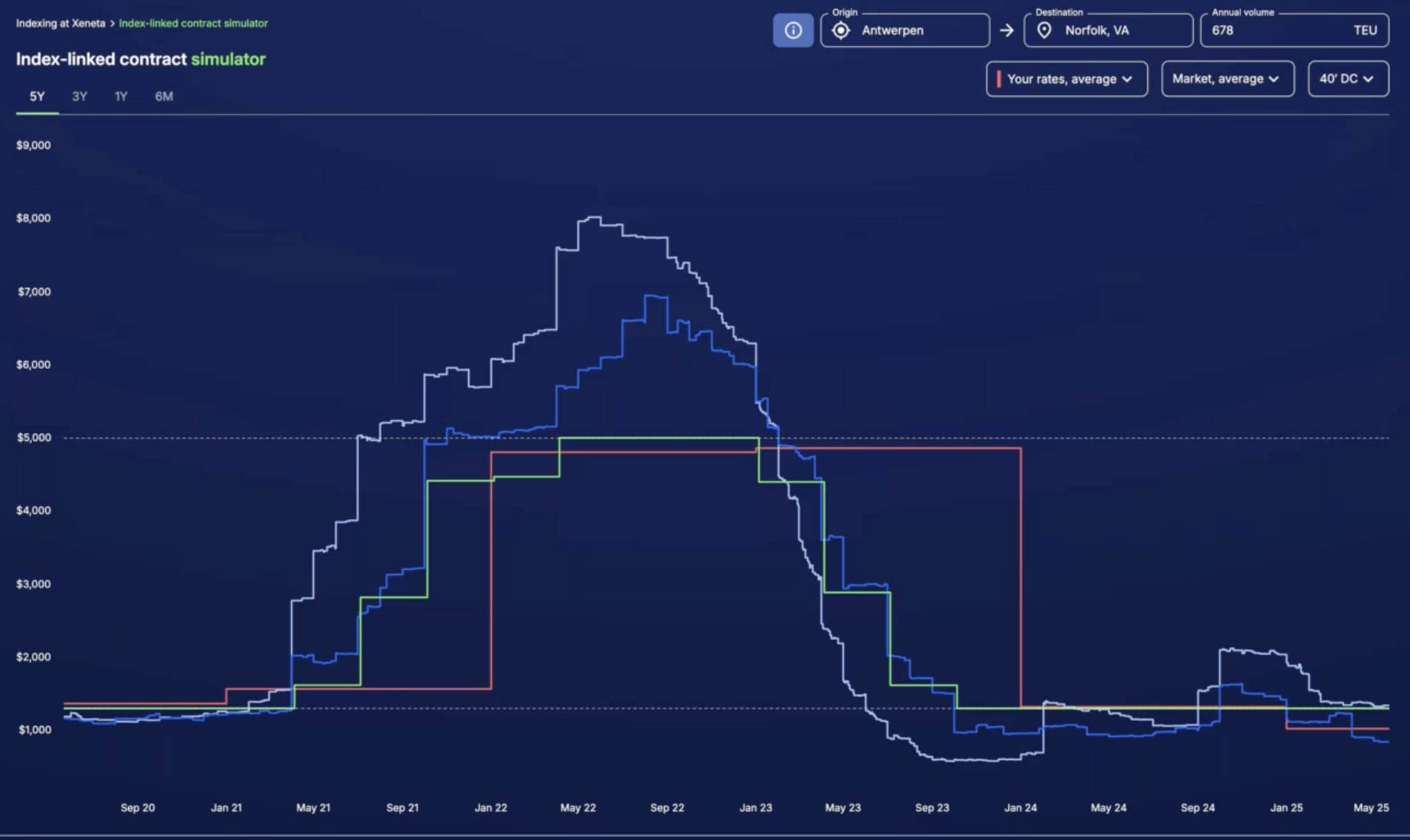
The simulator also allows companies to compare a proposed index-linked model against their own historical rates. Below we have overlaid a shipper’s actual rate history in red against the index-linked output in green. That showed not only where the customer had renegotiated up or down, but also how a rules-based contract could have produced a similar or better outcome with far less friction.
Finally, the below screenshot shows how floors and ceilings can be used to keep the contract within commercially workable bounds. That matters because indexation is not just about reflecting the market. It is also about shaping an agreement both sides can live with. A ceiling may protect the shipper from extreme spikes, while a floor helps preserve supplier economics. The right balance depends on the trade, the cargo, and the relationship.
Why budgeting is often the turning point
For many shippers, the strongest case for indexation starts with budgeting.
One Xeneta customer, a global manufacturer specialising in adhesive solutions, was dealing with a problem that will feel familiar to many procurement teams. On paper, the company’s tenders looked reasonable. Internally, budgets were built around those agreed rates. But by the end of the year, actual transport costs often told a very different story once surcharges, market swings, and renegotiations had worked their way through the system.
As the customer put it: “We were budgeting one thing, but at the end of the year we paid almost twice as much. Indexing brings us much closer to the real budget.”
That gets to the heart of the issue. Predictability in freight does not come from freezing the market. It comes from building contracts that stay closer to market reality, so the gap between budgeted cost and actual cost does not spiral out of control.
For this customer, the issue was serious enough to support a full transition of ocean freight, around 7,000 TEUs annually, from fixed-rate tenders to index-linked contracts. The team started lane by lane, using Xeneta’s benchmarking and Index Simulator to test different models and build internal confidence before expanding further.
Trust played a big role in making that work. “Xeneta brings reliable, confidential, and unbiased data that both shippers and carriers trust,” the customer said. That point matters because index-linked contracts only work when both sides believe the benchmark is fair and the rules are clear.
What supplier buy-in looks like
The same principle can be seen in the experience of Sartorius Stedim Biotech GmbH. Sartorius wanted to improve predictability and access to capacity, and the company already understood the logic of indexation from other areas, including fuel adjustments. Applying that thinking to ocean freight made sense, but only if the underlying benchmark would be recognized by carriers and simple enough to manage in practice.
That is what stood out with Xeneta’s Index. It offered a trusted market reference, broad acceptance among carriers, and a simpler operational setup because Xeneta manages the index updates and administration. Before moving ahead, Sartorius held workshops with key carriers including DB Schenker and Kuehne+Nagel to test the idea and understand how it would be received.
Why simulation matters before you sign
One of the biggest barriers to wider adoption is not the concept itself. It is the uncertainty around it. Procurement teams may see the value quickly, but finance wants confidence in budgeting, legal wants confidence in the mechanism, and internal stakeholders often still feel more comfortable with the appearance of a fixed number, even if that number later becomes difficult to defend.
This is why data and simulation matter so much. A strong index-linked contract has to be tested. Companies need to understand which market makes the most sense to follow, how frequently prices should move, and whether they need floors, ceilings, or trigger mechanisms to protect both sides. Just as importantly, they need to see how those choices would have played out across real market conditions.
That changes the conversation internally. Instead of asking stakeholders to buy into a concept, it gives them something concrete to assess. It also moves negotiation into a healthier place. Rather than returning later to argue about whether the contract still works, both sides can agree upfront on what fair should look like when the market changes.
A practical path to predictability
The bigger shift here is in how predictability is defined. Fixed-rate contracts assume predictability comes from locking a number in place. Index-linked contracts take a more realistic view. They assume the market will move and focus instead on making sure the contract can move with it in a transparent, disciplined way.
That is why they are gaining traction. Not because they make freight markets stable, but because they give shippers and suppliers a better way to deal with instability when it shows up. In a market where fixed rates often turn out not to stay fixed for long, that is a far more practical foundation for a lasting agreement.
For BCOs looking to explore index-linked contracts, learn more here.