
.png?width=1200&name=image%20(45).png)
There are signs that 2026 could be the year container ships make a largescale return to the Red Sea – but what would that look like and what would it mean for shippers?
Below are five key considerations for shippers.
1. Different strategies to Red Sea return across carriers
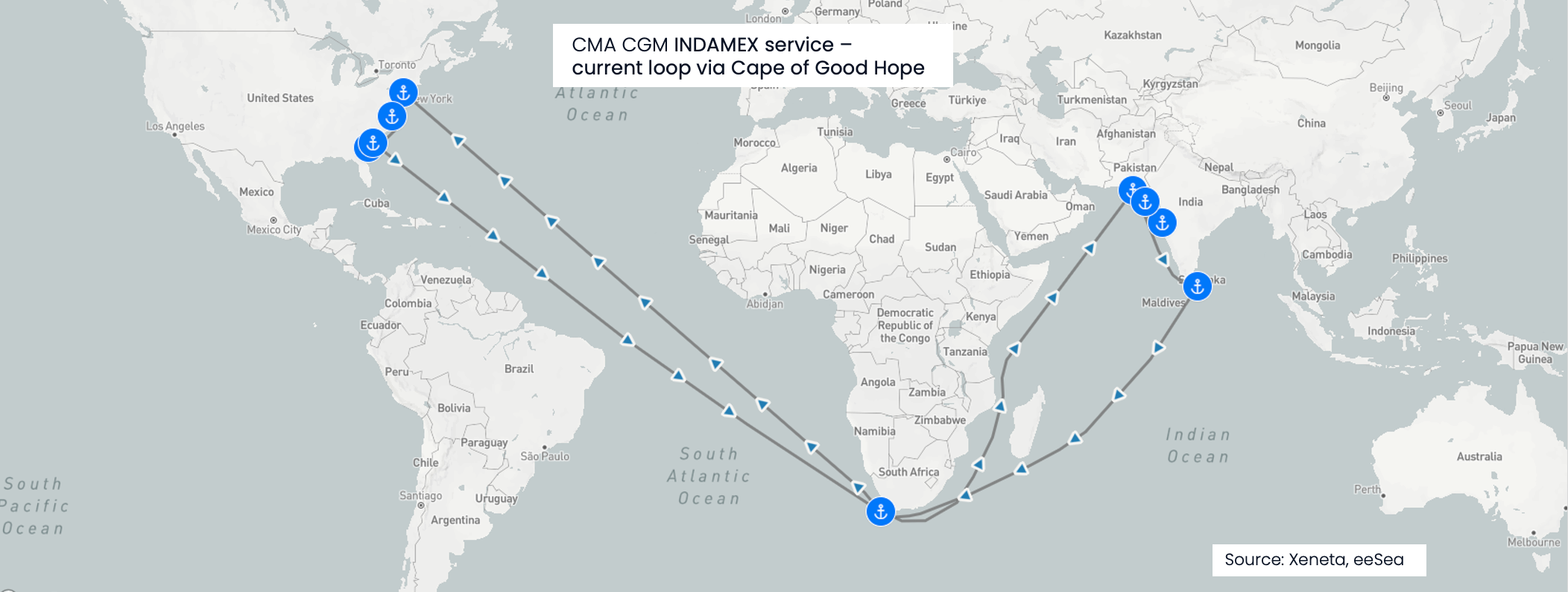
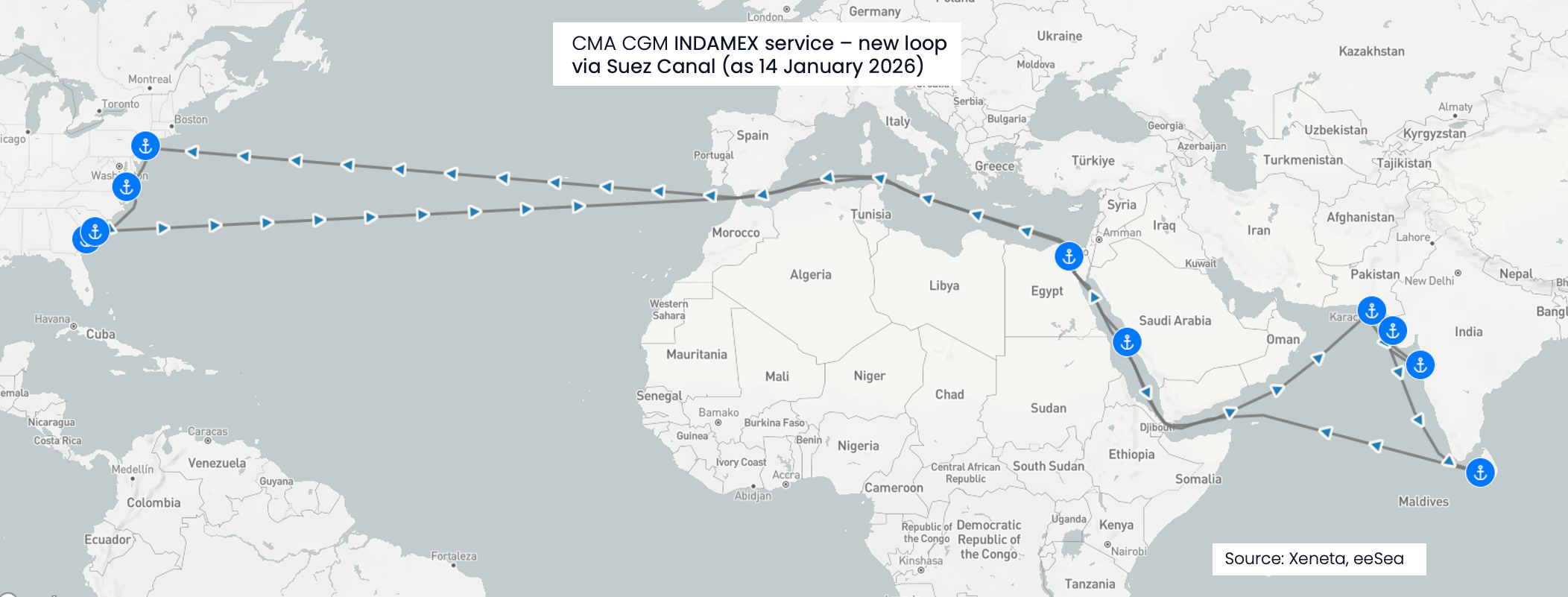
CMA CGM has announced the return to the Suez Canal on three of its services. The first service with full loop, transiting Red Sea on both fronthaul and backhaul legs, is the INDAMEX connecting India/Pakistan with US East Coast.
eeSea data, powered by Xeneta, shows this will cut round trip transit times on this service by two weeks to 77 days and free up two ships.
Two other CMA CGM services have had their backhaul legs rerouted via Suez Canal – MEX (Ocean Alliance MED2) and FAL1 (OA NEU4) – reducing roundtrip transit time by one week and freeing up one ship respectively.
Other carriers are also testing the water.
Maersk made its first transit through Suez Canal in December with the Maersk Sebarok sailing through the region on the MECL1 service connecting Middle East and US East Coast.
It should be noted that, unlike CMA CGM, this was not announced until after the ship had transiting the region. It suggests Maersk is still a fair way from a largescale return, but unannounced transits were used by CMA CGM as it built towards a first announced transit, so perhaps Maersk is taking a similar approach.
Unannounced transits are understandable as carriers test the water, but they can be tricky for both shippers and ports if the ships and containers suddenly arrive a week earlier than planned.
2. How far away is a full return to the Red Sea?
The announcement from CMA CGM has built up hope of a largescale return of container ships in 2026. However, it is important to retain a sense of reality in terms of what it will take to bring back “normality” to the Red Sea region.
There is still a long way to go before transits return to pre-Red Sea Crisis levels.
Container ships have continued to sail through the Suez Canal throughout the crisis - 120 transits in November 2025, down from 583 in October 2023, shortly before the escalation of attacks on merchant ships by Houthi militia. However, the container ships that continued to transit the canal have been operated by smaller carriers deployed on regional trades with a lower risk profile to attack by Houthi Militia.
The recent transits by CMA CGM and Maersk do not move the needle very much in overall terms.
It is not just the number of transits of the Suez Canal that remains well down on pre-Red Sea Crisis levels. The below table shows transit times on fronthauls to Europe are much higher, schedule reliability is much lower and both spot and long term freight rates still have a way to fall before they return to the levels of October 2023
| FAR EAST TO MEDITERRANEAN | |||||
|
Announced transit time |
Actual transit time |
Schedule Reliability |
Spot freight rates |
Long-term freight rates |
|
|
1 Oct 2023 |
33 days |
34 days |
45.31% |
USD 1714 per FEU |
USD 1970 per FEU |
|
23 Dec 2025 |
46 days |
49 days |
28.80% |
USD 4139 per FEU |
USD 3049 per FEU |
|
Change |
+13 days |
+15 days |
-16.5pp |
+141.5% |
+54.52% |
| FAR EAST TO NORTH EUROPE | |||||
|
Announced transit time |
Actual transit time |
Schedule Reliability |
Spot freight rates |
Long-term freight rates |
|
|
1 Oct 2023 |
38 days |
40 days |
48.81% |
USD 1066 per FEU |
USD 1278 per FEU |
|
23 Dec 2025 |
46 days |
52 days |
27.5% |
USD 2586 per FEU |
USD 2182 per FEU |
|
Change |
+8 days |
+12 days |
-21.3pp |
+142.61% |
+70.7% |
3. What are the potential knock-on effects of carriers returning to Red Sea?
As highlighted above, shorter transit times through the Suez Canal rather than sailing around the Cape of Good Hope need to be managed by shippers who could see goods arrive at port earlier than planned.
This also raises the risk of severe congestion as networks re-adjust. At the moment, there are only a handful of service changes, but if this happens at a significant scale in a short period of time, a situation could arise where large numbers of ships all arrive at port at the same time.
For example, two ships could leave the Far East a week apart, but arrive at the US East Coast at the same time if one heads via the Suez Canal and the other around Africa.
This would be a reversal of the congestion seen in 2024 when services were adjusted to Cape of Good Hope routes in the immediate aftermath of the crisis.
The risk of congestion is reduced if carriers adopt a gradual return, but once one or two major carriers commit to a full return, the pressure on others to follow will grow exponentially.
Another important factor is the time of year carriers (and their insurers) deem it safe and a ramping up of Red Sea transits occurs.
The prime window to readjust services to Red Sea routes and minimize disruption would be immediately following Lunar New Year, which this year is quite late in mid-February.
The post-holiday slump in demand would allow the worst of the disruption to come and fade before peak season later in the year. Conversely, if there is major adjusting in services during the cargo rush ahead of Lunar New Year, the risk of disruption increases significantly.
4. How can shippers tender during a period of uncertainty over Red Sea return?
A largescale return to the Red Sea will free up ships. So far, the service adjustments highlighted in this update have released on average one ship for every one way transit.
This will exacerbate the overcapacity of container shipping supply already in the market and put further downward pressure on rates. It may also finally see the idle fleet and ship demolitions tick up.
This is tricky timing for those shippers tendering for new 2026 contracts. Against this potential for falling freight rates, shippers should consider index-linked contracts or fixed re-negotiation triggers based on market movements (either by date or percentage shift in rates).
Surcharges will also be hugely important given there is likely to be a growing use of the Suez Canal by container ships during the lifespan of a shipper’s next contract. The all-in rate a shipper agrees with their service provider gets the most attention, but the way that rate is made up is critical to shippers retaining flexibility and the ability to react decisively to developments during the contract period.
If there is a largescale return to Red Sea, shippers must have clearly defined terms in the contract to govern how Red Sea surcharges will be reduced/removed. This means clear triggers for when and by how much the Red Sea surcharge should be adjusted.
If shippers fail to do this they risk paying Red Sea surcharges long after the ships transporting their containers have returned to the region.
5. It’s about more than freight rates
Shippers need to keep a close eye on transit times as well as rate developments in the coming weeks and months. This will provide early indications of schedule changes so a shipper can take action to lower the risk of supply chain disruption.
The Xeneta platform includes eeSea data on transit times along with alerts when a carrier undertakes a ‘dark’ test of Red Sea transits.
It is going to become increasingly difficult for shippers to keep track of where goods are and when they are scheduled to arrive if transit times are differing by as much as week on the same service operated by the same carrier.
Carriers will provide communication to their customers, but having access to eeSea and Xeneta data means those customers are ready to act decisively when official service changes are made and manage cost and inventory levels much more effectively.
.png?width=387&name=freight-ship-reliability%20(1).png)
.jpg?width=387&name=ocean-freight-shipping-reliability-scorecard--feb-26%20(1).jpg)