

Carrier decisions have always shaped supply chain performance, but the past decade has pushed the limits of traditional evaluation methods. Volatile schedules, shifting alliances and growing internal scrutiny have put procurement teams under pressure to justify why certain carriers win business and others do not.
Many teams recognise the gap. They want a fair, structured way to compare carriers, yet most still rely on fragmented data, experience-led judgment and scorecards stitched together manually. By the time a scorecard is finished, market conditions or carrier behaviour may already have changed.
This is exactly why carrier scorecards are moving from “nice to have” documents to a core part of modern procurement strategy. Not as static reports produced once per tender, but as an always-on view of how carriers perform across cost, service and environmental impact.
This guide breaks down what a carrier scorecard is, why it matters and what shippers should expect from a modern, data-driven approach.
Why procurement teams are rethinking carrier evaluation
When speaking with shippers across industries, three themes surface again and again.
Decisions are still heavily influenced by familiarity and habit
Many long-term relationships between shippers and carriers were built on trust, not data. That worked when networks were stable and capacity predictable. Today performance varies more frequently and expectations from stakeholders are higher.
The performance data available is inconsistent or incomplete
Shippers regularly report challenges such as:
- carriers reporting optimistic transit times
- inconsistent on-time delivery definitions
- gaps between operational performance and what is submitted in tenders
- difficulty comparing carriers without a unified format
Without a common baseline, procurement teams struggle to defend their choices.
Manual scorecards are slow and subjective
Most teams still build them by pulling data from multiple systems, consolidating spreadsheets, adjusting formulas and aligning inputs manually. This introduces:
- recency bias
- errors
- a narrow set of metrics
- results that are outdated quickly
The process demands hours of work and provides little confidence.
A modern carrier scorecard exists to replace these blind spots with a consistent, evidence-based foundation.
What is a carrier scorecard?
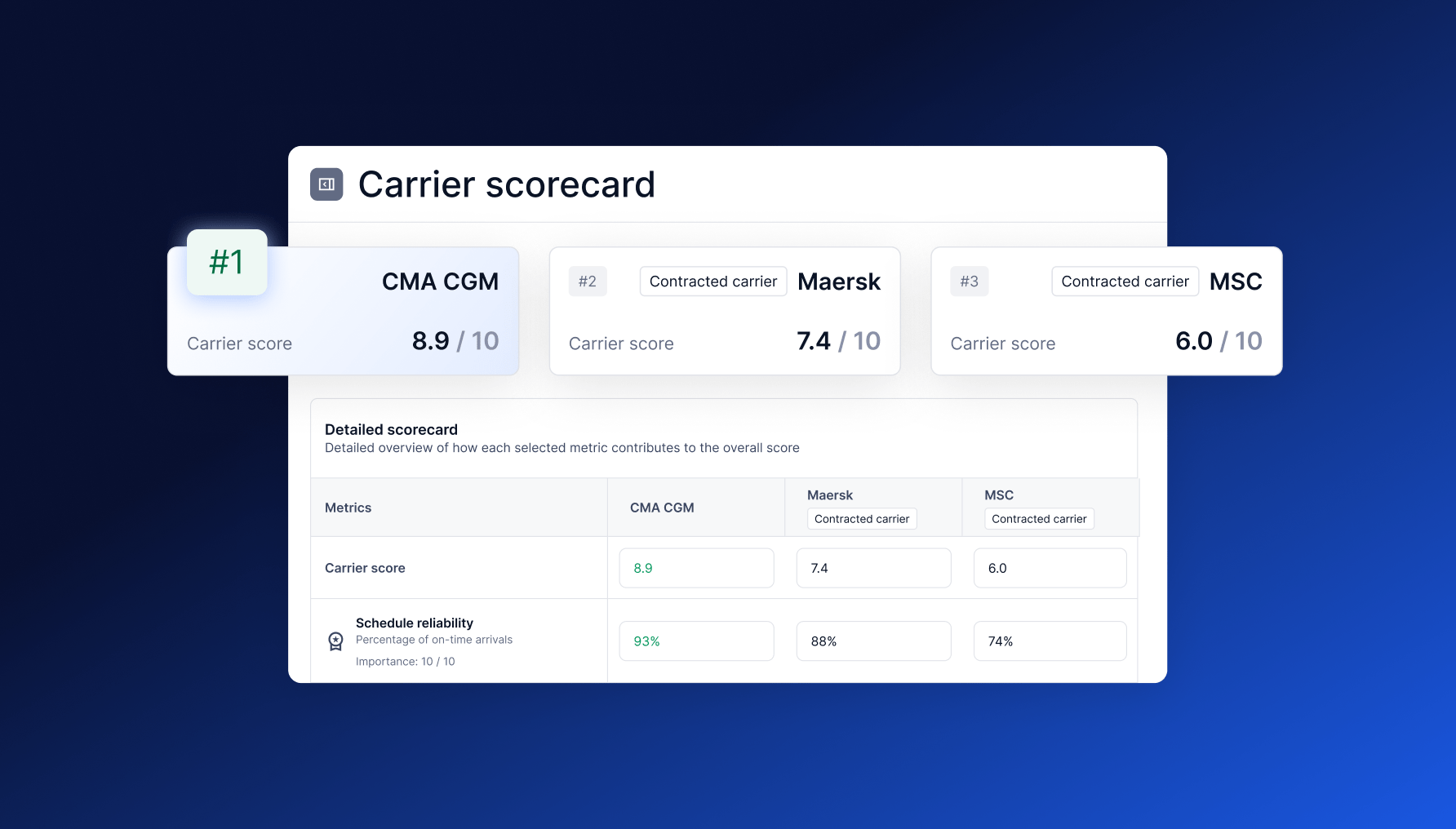
A carrier scorecard is a structured tool used to evaluate carriers across the metrics that matter most to your business.
Traditional scorecards focused on rate. Modern scorecards incorporate a broader set of performance indicators such as:
- Schedule reliability
- Transit time consistency
- Capacity availability
- Emissions performance
- Market competitiveness
- Service stability on specific corridors
Instead of comparing fragmented information, a scorecard creates a balanced, multi-metric view of how carriers perform over time.
Why carrier scorecards are becoming essential in 2025 and beyond
Several shifts in ocean shipping have made structured evaluation not only useful but necessary.
Supply chains are more sensitive to reliability
A missed sailing or inconsistent ETA can trigger downstream disruption. Reliability is now as important as price.
Procurement must defend decisions internally
Finance, logistics and sustainability teams expect to see the rationale behind supplier choices. A structured scorecard removes subjectivity from the conversation.
Carriers are repositioning their strategies
Alliances, networks and service rotations continue to evolve. Past performance does not always indicate future reliability.
A carrier scorecard creates the clarity needed to adapt quickly, audit decisions and maintain alignment across functions.
What a modern carrier scorecard should include
While scorecards vary between organizations, the most effective ones share five characteristics.
Multi-dimensional evaluation
No single metric captures the full carrier experience. A robust scorecard combines:
- cost competitiveness
- operational performance
- service quality
- environmental impact
This prevents rate-only decisions and highlights trade-offs.
Configurable weighting
Not every shipper values metrics the same way. Some prioritize emissions. Others focus on reliability or capacity stability. A modern scorecard allows teams to adjust weightings based on strategic priorities.
Transparent data sources
Performance comparisons should be grounded in objective data, not carrier-reported information that may be influenced by commercial positioning.
Consistency across regions
With global teams using the same structure, scorecards become a common language for internal alignment.
Repeatability
A scorecard should not take days to build. It should be updated regularly as part of ongoing supplier management.
How leading shippers are using carrier scorecards
Carrier scorecards are now shaping procurement strategies in several ways.
Selecting carriers during tenders
A scorecard provides a way to compare bids not only on price, but also on operational performance and environmental impact.
Managing existing suppliers
Many teams now use scorecards as part of quarterly business reviews to identify performance gaps and hold carriers accountable.
Identifying new partners
Scorecards reveal high-performing carriers that may not have been considered before.
Improving internal communication
Procurement, logistics and finance can align decisions quickly with a shared reference point.
Strengthening sustainability selection criteria
Emissions benchmarks help teams select greener options without sacrificing reliability or cost competitiveness.
What happens when scorecards become part of the workflow
Shippers who adopt a structured scorecard process report several benefits.
- Decisions become more defensible and transparent
- Tender evaluations become faster
- Supplier conversations become more fact-based
- Internal alignment improves
- Performance trends become clearer
- Procurement shifts from reactive to strategic
A carrier scorecard is not just another document. It becomes an engine for consistency, fairness and long-term planning.
The bottom line
Carrier scorecards are becoming a foundation for modern ocean procurement. As networks expand and markets move faster, procurement teams need more than opinions or historic relationships. They need a structured, data-backed view of performance that supports smarter decisions and stronger supplier relationships.
Scorecards give organizations the clarity they need to move with confidence, justify their choices and operate with a higher level of accountability across the entire supply chain.
If your team is evaluating how to improve carrier decision-making, a structured scorecard is one of the most practical places to start.
Replace bias and habit with clarity. Let data, not opinion, guide who earns your business
Learn how procurement teams are using Xeneta’s Carrier Comparison Scorecard to standardize evaluations, compare performance and strengthen decision-making across global networks.