


Lunar New Year is fast approaching and would ordinarily be a period of increased demand and upward pressure on freight rates – but this year, interesting trends are emerging on major Far East trades to Europe and US that make life more difficult for logistics and procurement professionals managing supply chain cost and resilience.
With data and intelligence, it is possible to stay ahead of the game.
Traditional carrier strategy for Lunar New Year
Lunar New Year falls on 17 February this year – the latest it has been since 2015 – and gives shippers seven weeks to get their goods out of the Far East before the holiday shutdown.
The traditional approach from carriers is to offer ample capacity to meet the cargo rush in the weeks leading up to Lunar New Year, then blank a host of sailings in the weeks following it.
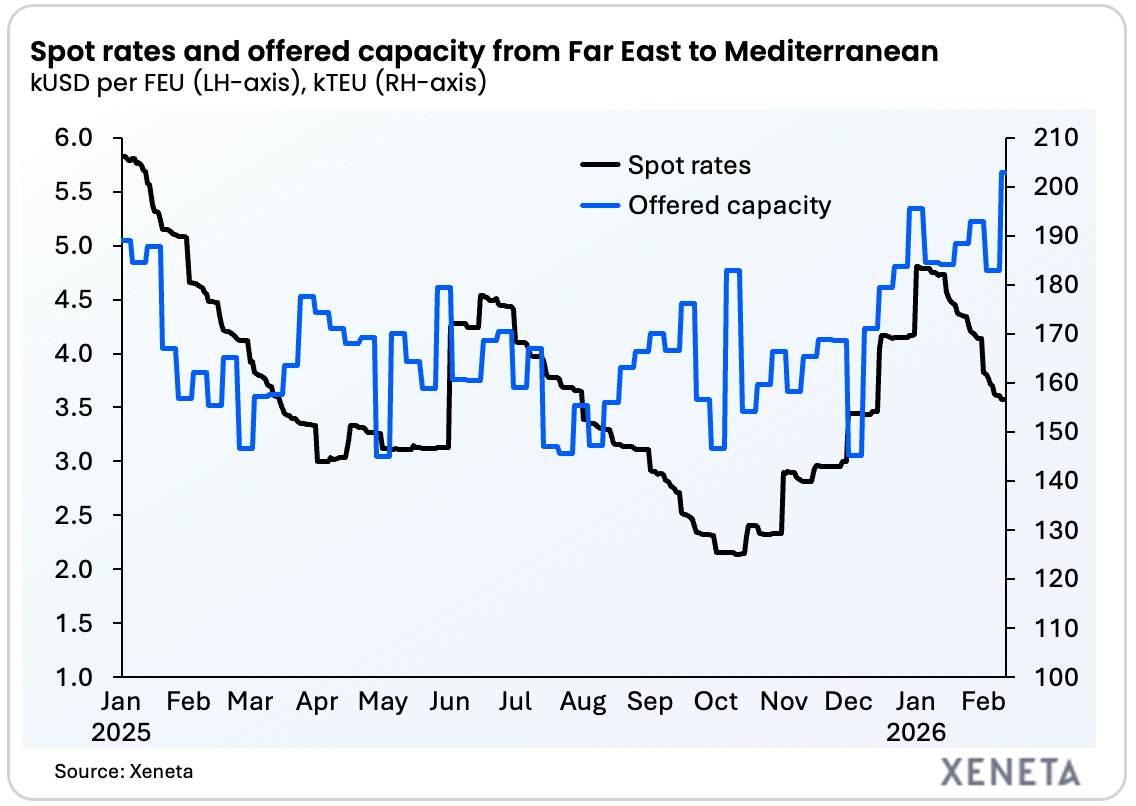
Between the Far East and Europe, Xeneta data clearly shows an increase in offered capacity during January. Average offered capacity into the Mediterranean was more than 200 000 TEU at the start of February – the highest since June 2024. Into North Europe, capacity increased to 326 400 TEU.
Compared to the peak of offered capacity before Lunar New Year in 2025, that is a 7% increase into the Mediterranean and 5% into North Europe.
Did carriers overestimate the pre-Lunar New Year rush?
It would seem so.
Average spot rates from Far East to North Europe are down 17% since the start of the year at USD 2 350 per FEU (40ft equivalent container). Into the Mediterranean, average spot rates have fallen 26% to USD 3 580 per FEU.
It must be worrying for carriers to be unable to keep rates up during what is typically a strong month and suggests demand is not there to meet the capacity offered.
The Far East fronthauls into the US should be of even more concern for carriers. Despite not raising capacity to the extent seen on trades into Europe, carriers have still seen average spot rates fall an even greater 34% into the US West Coast and 29% into the US East Coast, standing at USD 1 520 per FEU and USD 2 340 per FEU respectively.
This suggests demand on the Transpacific trade is substantially down, even with pre Lunar New Year rush.
Analyzing carrier behavior
Procurement and logistics professionals will look at subdued demand and falling freight rates in the run up to Lunar New Year and question whether they are paying the ‘right’ freight rate to move their containers. They should also question how this plays into a longer term procurement strategy.
The timing of softening spot rates in the run up to Lunar New Year underlines the importance of procurement professionals replacing gut feeling with market truth. This is especially the case for those US shippers looking ahead to tender negotiations in early March.
Even without adding significant capacity ahead of Lunar New Year, carriers have not been able to balance supply and demand enough to keep spot rates stable, let alone push them up, as might have been the case in a “normal” year. Of course, with a tariff hangover from 2025 and the prospect of a largescale return to Red Sea, 2026 cannot be categorized as a normal year.
A year-on-year comparison also shows average spot rates down 63% from the Far East into the US West Coast – a cost saving of USD 2 590 per FEU. Into the US East Coast, shippers are looking at a saving of 63% against the market average 12 months ago, down USD 2 980 per FEU.
What will carriers do next?
It is clear from the Xeneta data outlined above that shippers should take the upper hand in new contract negotiations, but carriers will not remain passive as freight rates tumble. Carriers will respond through aggressive capacity management, so shippers should be ready for the operational and supply chain resilience risks this may bring.
It is possible to use Xeneta data to anticipate these operational shifts before they impact supply chains, allowing for a proactive approach rather than spending time firefighting last-minute disruption.
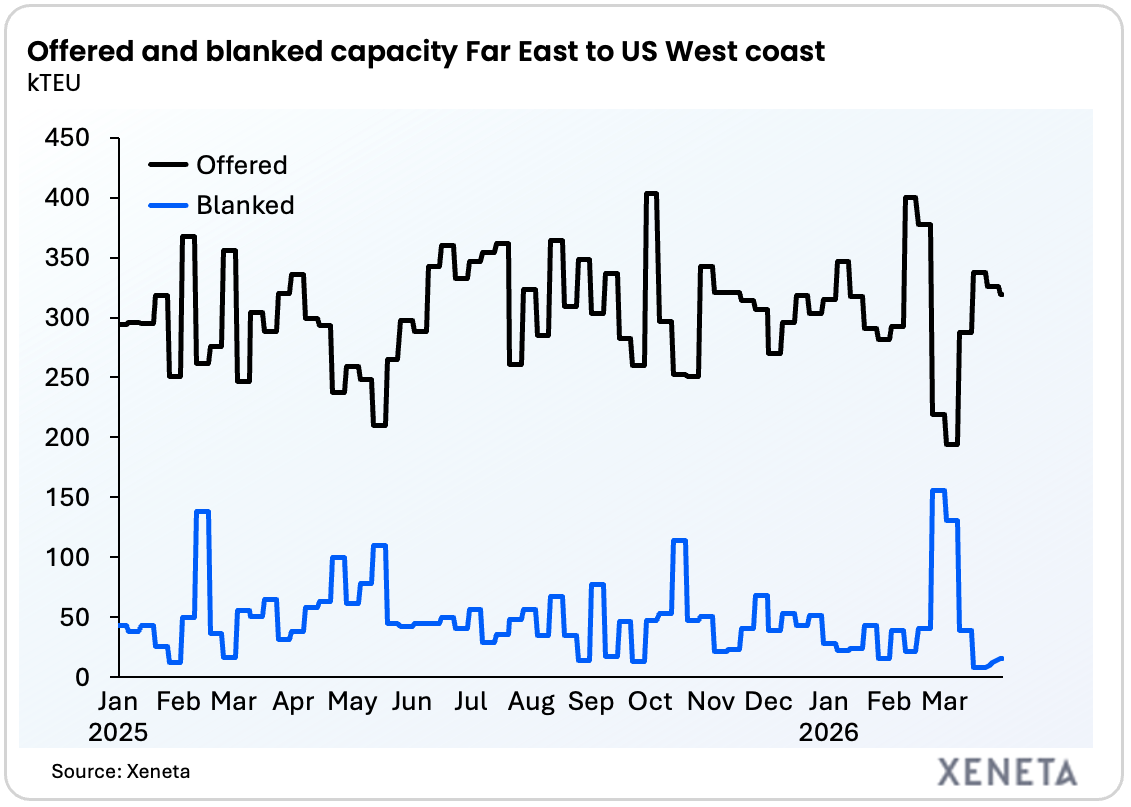
For example, carriers have announced plenty of blank sailings in the weeks following Lunar New Year in the hope it will prevent spot rates falling further against a backdrop of subdued demand out of the Far East.
From Far East to the US West Coast, carriers have already announced the blanking of 155 400 TEU in the week immediately after Lunar New Year and a further 130 300 TEU in the first week of March.
The blanks announced so far will see capacity between the Far East and US West Coast fall below 200 000 TEU in the week commencing 2 March – the lowest capacity on this trade in almost two years. It is even lower than the capacity offered in the weeks following Trump’s “Liberation Day” announcement of sweeping tariffs in April last year.
From the Far East to North Europe, blank sailings look set to peak in the last week of February with 135 800 TEU already removed. The peak into the Mediterranean will be in the second week of March at a lower 56 100 TEU blanked.
Risk and opportunity for shippers
Shippers and carriers will both expect long and short term freight rates to soften further in 2026. But if shippers rely on gut feeling to set target freight rates based on previous Lunar New Year periods, they risk leaving money on the table.
Paying ‘too much’ is not the only risk - softening freight rates could also have an operational sting in the tail for shippers if it means carriers take a more aggressive approach to managing capacity, particularly through blanked sailings.
Again, if shippers do not use data and intelligence, they limit their ability to pre-empt and adapt their strategy according to the operational shifts.
Time spent firefighting disruption and delays could be far better spent using data for pro-active supply chain resilience.
Xeneta allows you to see freight risks before they impact your supply chain.
When emerging trends hit and carriers respond through aggressive capacity management, Xeneta gives you the clarity, early warning signals, and AI-enhanced insight to stay ahead of market shifts, mitigate risk, and keep your supply chain moving confidently.
Remember, volatility isn’t optional. Being blindsided is.
Find out more here.