



It's January. Ocean contracts are signed. Freight is budgeted at $120 million. The margin outlook is agreed and presented to the board. Forecasts reflect the best assumptions available on rates, volumes, and reliability.
At that point, freight appears contained within the financial plan.
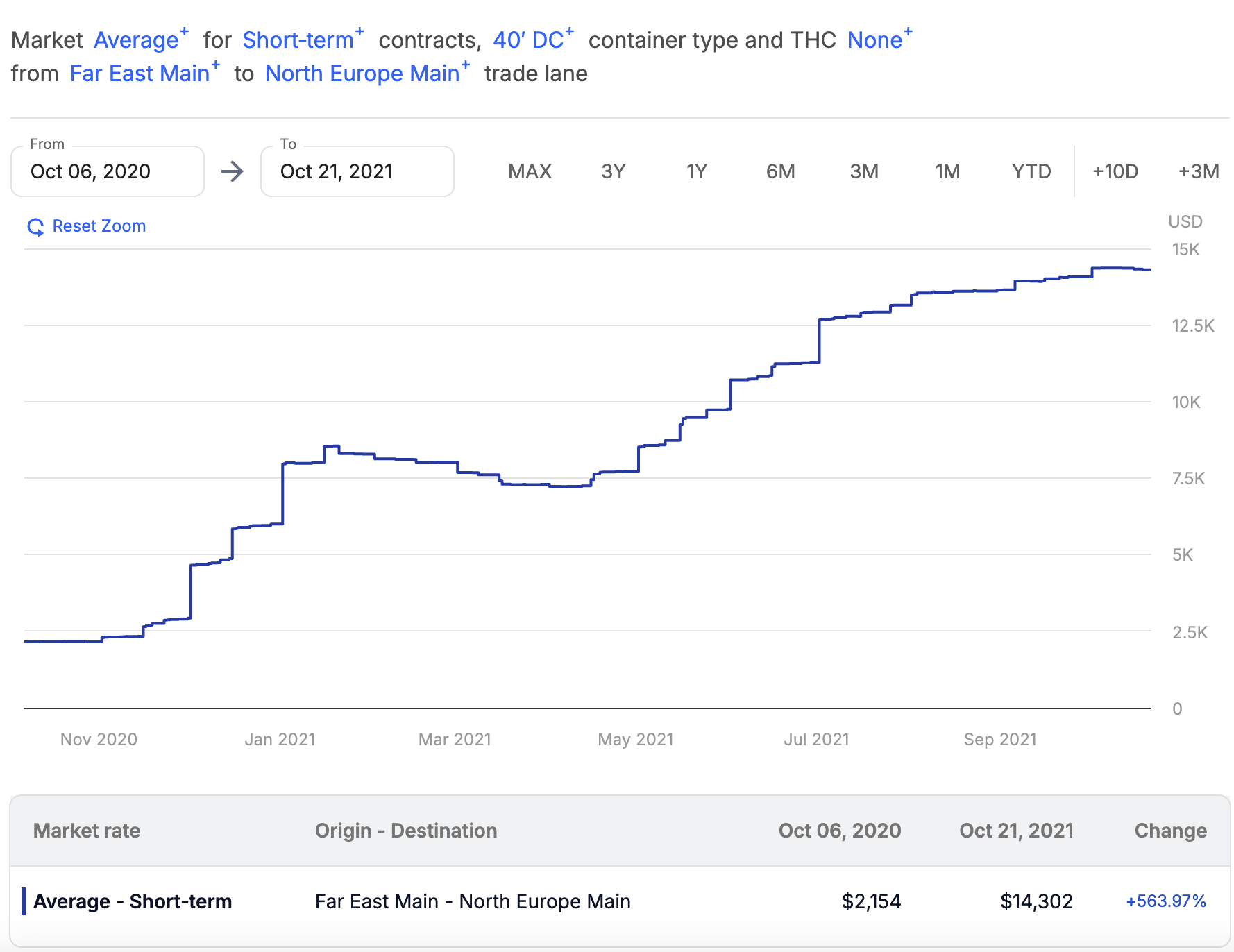
Recent years show how quickly that can change. Xeneta data indicates that global ocean container rates increased more than 500 percent during the pandemic before falling back as capacity returned. Since then, Red Sea disruption, port congestion, labor negotiations, and alliance reshuffling have continued to move rates materially within the span of a single fiscal year.
For large importers and manufacturers, logistics-related costs typically represent between 5 and 15 percent of revenue, according to the CSCMP State of Logistics Report. Transportation is often the largest component. When markets move sharply, the impact flows directly into gross margin guidance that has already been communicated externally.
When freight moves beyond the budget buffer
Most Finance teams build some flexibility into their annual plans. A degree of contingency is expected to absorb normal volatility.
Small rate movements are manageable. The pressure begins when rates increase sharply and quickly.
If freight costs rise materially in a short period, the built-in flex can disappear. What follows is often a difficult internal process. Finance needs to understand how the gap will be closed. Marketing budgets are revisited. Hiring plans are slowed or paused. Regional spending is reviewed. Procurement is asked to find further efficiencies beyond freight.
EBITDA may still be protected. But protecting it requires additional effort and difficult trade-offs across the organization.
The financial result might look stable. The path to get there rarely is.
This is where visibility becomes critical. If exposure is identified early, mitigation can be phased and deliberate. If it emerges late, action becomes reactive.
A mid-year rate shock
Consider a practical example.
A listed consumer goods company begins the year with a $120 million ocean freight budget embedded in its gross margin guidance.
In the second quarter, geopolitical disruption reduces effective capacity across key trades. Spot rates climb 30 percent within weeks. Contracted allocations tighten and some volumes are secured at higher short-term rates.
For the remaining two quarters, the company’s blended freight cost runs approximately 20 percent above its original assumption.
That shift equates to roughly $12 million in incremental cost across the second half.
At this stage, Finance evaluates the options. Allowing EBITDA to fall by the full amount may not be acceptable. Instead, savings are identified in other cost categories, discretionary initiatives are postponed, and additional procurement efforts are launched. Pricing actions may be explored, although competitive dynamics often limit flexibility.
Assume mitigation reduces the net impact and $8 million ultimately flows through to EBITDA.
If the business generates $400 million in EBITDA and trades at 11×, that reduction corresponds to approximately $88 million in enterprise value.
The valuation impact can extend beyond that arithmetic. Markets often react strongly to even modest guidance misses. A slight shortfall in EBITDA can trigger a disproportionate share price movement if investors interpret it as a loss of control.
Equity markets price confidence in competence as much as near-term earnings. When cost shocks appear unanticipated, trust can erode quickly. In more severe cases, share prices adjust sharply as investors reassess risk.
The issue is rarely just the freight increase itself but whether management demonstrated visibility and control.
When freight becomes visible on earnings calls
This dynamic has played out publicly.
During 2022 and 2023 earnings cycles, global brands including Nike and Adidas cited elevated freight and logistics costs as contributors to gross margin pressure. As ocean rates normalized, both companies later referenced lower transportation expenses as factors supporting margin recovery.
In each case, freight was material enough to feature in investor discussions.
Investors understand that transportation markets are cyclical. What they examine more closely is whether those cycles were anticipated, modeled, and communicated.
The distinction between structural cost discipline and cyclical tailwind influences confidence.
The upside is often missed
Freight volatility also creates opportunity.
When markets soften, companies with real-time visibility can see whether their contracted rates sit above prevailing levels. That insight allows procurement teams to renegotiate, rebalance allocations, or accelerate tenders.
Without that visibility, savings may pass unnoticed.
In those circumstances, resources that could have been reallocated to growth initiatives, marketing investment, or strategic hiring remain tied up in avoidable cost. The benefit of freight intelligence therefore extends beyond downside protection. It enables deliberate capital allocation when conditions move in the company’s favor.
The working capital dimension
Freight volatility also shapes inventory decisions.
When reliability weakens or capacity tightens, businesses often increase safety stock to protect service levels. Inventory days of supply rise and additional cash becomes tied up in working capital. For companies operating at scale, even small percentage increases represent significant capital commitments.
Mode shifts add further complexity. Air freight, frequently priced several times higher per kilo than ocean, may be used to preserve customer commitments when ocean capacity is constrained. That decision protects revenue but increases cost per unit and further pressures margins.
These effects are interconnected. Margin, inventory, and cash flow move together.
Even when EBITDA is stabilized through mitigation elsewhere, capital efficiency can deteriorate.
Confidence, guidance, and shareholder value
At common trading multiples, even modest EBITDA variance can translate into substantial movements in enterprise value. A $10 million swing at a 10× multiple equates to $100 million in valuation impact.
Yet markets do not respond purely to calculation.
Budgets need flex, and some volatility is expected. What unsettles investors is repeated surprise. A pattern of late adjustments, unmodeled exposure, or reactive mitigation can create doubt about planning discipline. That doubt can lead to a sharper share price reaction than the financial variance alone would justify.
Better visibility into freight markets reduces the likelihood that shocks become surprises. Over time, consistency in forecasting and risk management strengthens credibility with investors.
Planning with volatility in mind
Freight markets will continue to fluctuate. Long-term contracts will not always move in line with spot rates. Disruption will surface in new forms.
Incorporating market intelligence directly into financial planning reduces exposure to both downside shocks and missed upside.
Continuous benchmarking lowers the risk of locking in rates that diverge materially from prevailing conditions. Forward-looking rate outlooks support more realistic budget assumptions. Scenario modeling clarifies the range of potential outcomes before they appear in reported results.
When Procurement and Finance align early around shared data and quantified exposure, discussions focus on managing risk rather than explaining variance.
Freight sits within the supply chain, but its influence extends into earnings quality, working capital discipline, and investor perception.
Learn how to forecast, not just react
Freight volatility does not need to result in internal friction or external uncertainty.
Xeneta supports finance and procurement teams with live benchmarking, forward-looking freight rate forecasts, and data-driven budget planning tools designed for volatile markets.
If predictability, scenario planning, and working capital discipline are priorities in your next planning cycle, watch Xeneta's on-demand webinar Explain It to Finance: Freight Decisions That Hold Up Under Scrutiny.
Greater visibility does not prevent markets from moving. It ensures that when they do, the business is prepared.
.png?width=1245&height=420&name=Webinar_Wisepops.%20Explain%20It%20To%20Finance%20(1).png)
.jpg?width=387&name=Prospect_LIpost_WebinarAugust2025%20(6).jpg)