

Volatility has reshaped ocean freight in ways few procurement teams were fully prepared for. Rates swing sharply, tender cycles collapse under shifting market conditions and fixed-price agreements rarely hold for their full term. As a result, many shippers are questioning whether the traditional RFQ model can still protect budgets or service.
This has led to growing interest in index-linked freight contracts. These agreements adjust automatically with the market, allowing both shippers and carriers to stay aligned even when conditions change quickly. But despite their potential, index-linked freight contracts are still widely misunderstood. Many teams do not know how they work, when to use them or how to design them in a way that avoids unintended risk.
This guide breaks down the fundamentals. What index-linked freight contracts are, why they matter, how they work in practice and what shippers should consider before adopting them.
Why traditional freight contracts are collapsing under market pressure
Most global supply chains still rely on fixed-price contracts agreed during lengthy RFQ cycles. In a stable market this model worked. In today’s environment it is becoming difficult to defend. Several pressures are pushing teams to explore alternatives.
Fixed rates become misaligned faster than teams can renegotiate
A 4 to 6 month tender cycle for a 12 month contract is no longer compatible with a market that can swing in weeks. When rates rise, carriers push for surcharges or allocations shift. When rates fall, shippers find themselves locked into uncompetitive pricing until the next negotiation window.
Both sides lose trust in the contract’s ability to hold
Shippers experience rolled cargo or unexpected charges. Carriers see volume commitments shift elsewhere when the spot market drops. Neither side intentionally breaks agreements, but volatility turns good faith contracts into fragile ones.
Procurement loses strategic time to endless renegotiation
When market conditions shift, contract adjustments become urgent and reactive. This consumes time that should be spent on preventive planning, supplier strategy and long-term resilience.
Index-linked freight contracts emerged as a way to solve these structural problems rather than continue battling their symptoms.
What is an index-linked freight contract?
An index-linked freight contract ties the base rate of a lane to a neutral, published freight index. Instead of fixing a price for the entire period, both parties agree that the price will follow an index representing real market conditions.
Shippers benefit by paying fair market rates throughout the contract period.
Carriers benefit by securing longer-term relationships without the risk of being trapped in unfavourable pricing.
These contracts do not remove volatility, but they remove the dispute that volatility creates.
How index-linked freight contracts actually work
At a high level, the structure is simple.
Select the right index
This means choosing a market index that accurately reflects the lane and container type relevant to the contract. A misaligned index can lead to unfair pricing swings or poor tracking.
Define the update frequency
Most index-linked freight contracts adjust monthly, but weekly or quarterly updates are possible depending on volume and operational requirements.
Set upper and lower boundaries if necessary
Floors, ceilings or hybrid structures can be added to manage extreme market scenarios.
Agree on surcharges and handling rules
A good index-linked contract minimises ambiguity and clearly spells out what is indexed and what remains fixed.
Monitor the contract over time
Both sides track performance, verify adjustments and review any operational impact.
Done well, this creates a transparent and predictable structure where both sides understand how rates will evolve.
Why shippers are only now adopting index-linked contracts
Despite the logic, most shippers have never adopted index-linked freight contracts. The reason is not reluctance. It is capability.
Knowledge gaps
Procurement teams often lack the practical guidance required to design index-linked contracts. Many fear choosing the wrong index, applying the wrong surcharge structure or leaving themselves more exposed than before.
No standardisation
There has been no common industry framework. Every shipper and every forwarder structures indexation differently, which slows adoption and complicates negotiation.
Lack of modelling tools
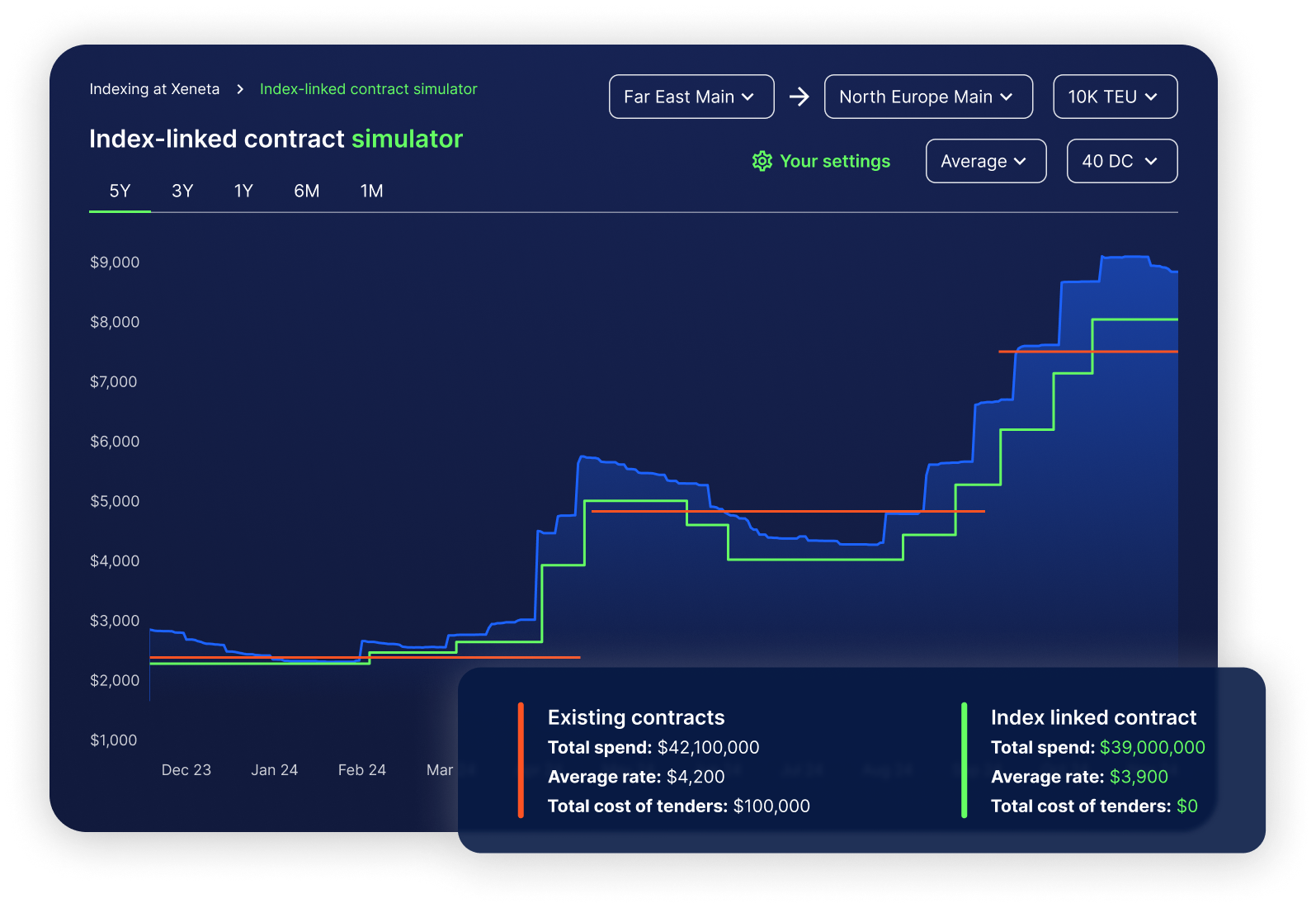
Without a way to simulate the contract structure, shippers cannot see how different rules would have performed over time. This prevents confident internal alignment, especially with finance.
Limited trust
Both shippers and carriers have been wary of entering an indexed agreement without full confidence in the data source powering it.
These barriers are exactly why frameworks, simulators and education have become essential.
Why index-linked freight contracts are gaining momentum
Market conditions have shifted again. Global shippers are moving to multi-layered procurement strategies that balance fixed, indexed and spot exposure. And several forces are accelerating adoption.
Finance wants budget predictability
Indexation replaces subjective renegotiation with a transparent and explainable cost model. It also provides a clearer forecast than traditional tender cycles.
Procurement wants speed
Teams are under pressure to eliminate unnecessary work, shorten tender cycles and reduce administrative load. Index-linked structures remove entire negotiation rounds.
Carriers want stability
Forward visibility, volume consistency and a shared reference point make indexed agreements more attractive than chasing short-term market swings.
The market rewards flexibility
Companies that adapt their procurement model to market conditions outperform those trapped in rigid annual contracts.
Index-linked freight contracts are not a trend. They are a strategic response to a structural shift in global trade.
Considerations before adopting index-linked freight contracts
Shippers evaluating indexation should ask themselves a few critical questions.
Do we understand our exposure?
Not all lanes require indexation. High-volume lanes with significant volatility benefit most.
Do we have the right indices?
A contract is only as good as the index that powers it. The wrong index can erode trust quickly.
Can we simulate the impact before committing?
Simulation is essential for internal alignment. Without backtesting, the organisation cannot understand how the contract behaves.
Are we prepared to blend fixed, indexed and spot exposure?
The strongest strategies mix models rather than replacing one entirely.
Do we have a monitoring structure in place?
Automated tracking and alerts prevent deviations and ensure both sides stay aligned. Organisations that answer these questions upfront see the highest success rates.
What leading shippers are doing now
Teams adopting index-linked freight contracts are not abandoning their existing processes. They are modernising them.
They start with education. They test different rules in a risk-free environment. They build the case internally with real data rather than theory. They negotiate from a position of clarity not urgency. They monitor the contract with shared visibility and mutual trust. And most importantly, they reduce the time spent reacting and increase the time spent planning.
Index-linked freight contracts shift procurement from a cycle of firefighting to a model of long-term stability.
Build smarter contracts. Not bigger spreadsheets.
If your team is evaluating index-linked freight contracts or considering hybrid procurement models, the best starting point is understanding how different index rules perform for your own lanes.
Learn more about Xeneta’s Index-Linked Contract Simulator where you can simulate, model and compare different index structures before committing to any real agreement.